
Pulp Fiction, 1956 · page 85 of 164
Authentic Science Fiction Monthly No. 71 — page 85: what you’re looking at
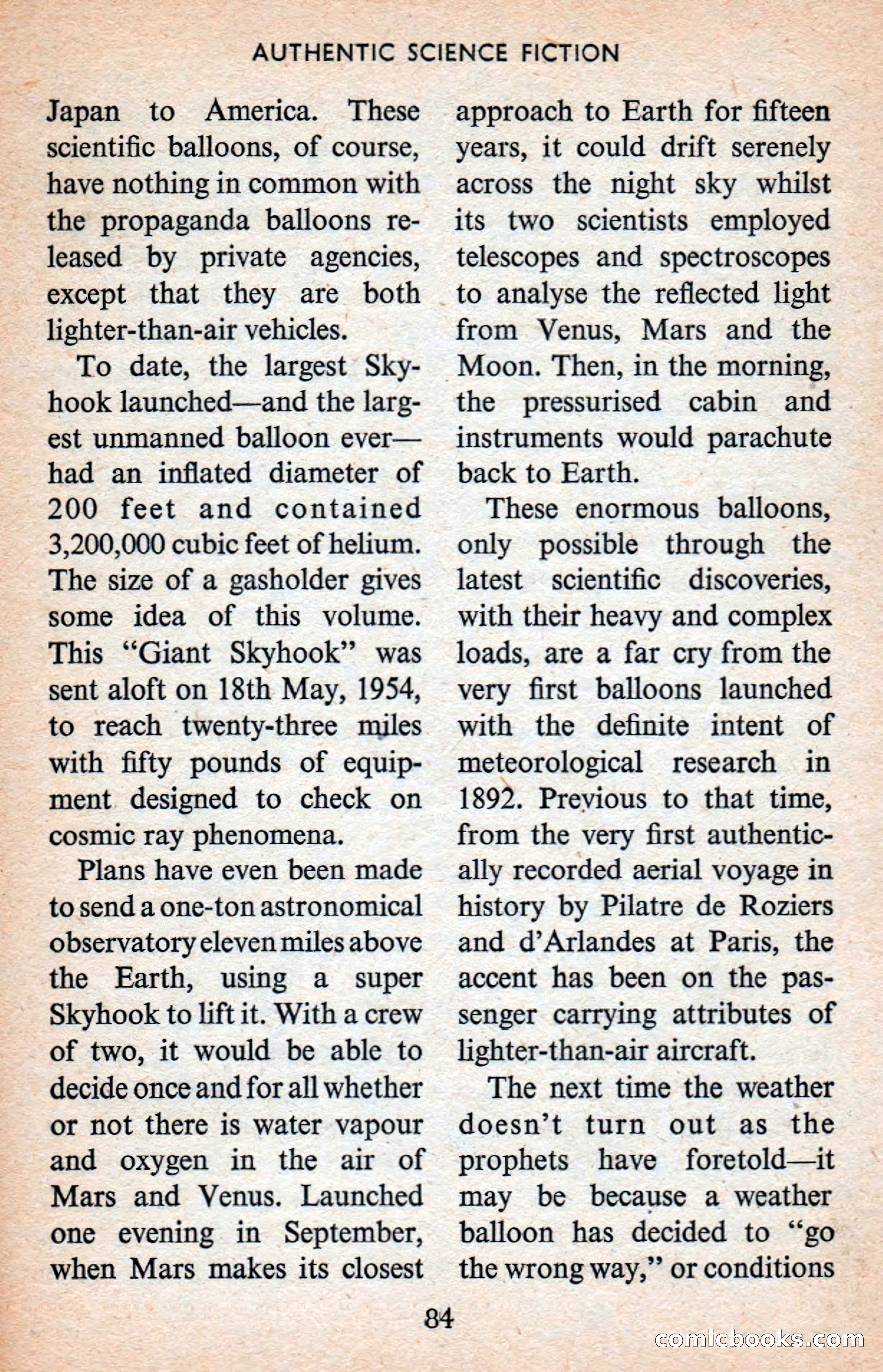
A restored page from Pulp Fiction, 1956. Page through the whole issue in the reader above.
📄 Transcribed text from this page (OCR, searchable)
Machine-transcribed from the original scan — historical spelling and the odd misread are preserved.
AUTHENTIC SCIENCE FICTION Japan to America. These scientific balloons, of course, have nothing in common with the propaganda balloons re- leased by private agencies, except that they are both lighter-than-air vehicles. To date, the largest Sky- hook launched—and the larg- est unmanned balloon ever— had an inflated diameter of 200 feet and contained 3,200,000 cubic feet of helium. The size of a gasholder gives some idea of this volume. This “Giant Skyhook” was sent aloft on 18th May, 1954, to reach twenty-three miles with fifty pounds of equip- ment designed to check on cosmic ray phenomena. Plans have even been made to send a one-ton astronomical observatory eleven miles above the Earth, using a super Skyhook to lift it. With a crew of two, it would be able to decide once and for all whether or not there is water vapour and oxygen in the air of Mars and Venus. Launched one evening in September, when Mars makes its closest 84 approach to Earth for fifteen years, it could drift serenely across the night sky whilst its two scientists employed telescopes and spectroscopes to analyse the reflected light from Venus, Mars and the Moon. Then, in the morning, the pressurised cabin and instruments would parachute back to Earth. These enormous balloons, only possible through the latest scientific discoveries, with their heavy and complex loads, are a far cry from the very first balloons launched with the definite intent of meteorological research in 1892. Previous to that time, from the very first authentic- ally recorded aerial voyage in history by Pilatre de Roziers and d’Arlandes at Paris, the accent has been on the pas- senger carrying attributes of lighter-than-air aircraft. The next time the weather doesn’t turn out as the prophets have foretold—it may be because a weather balloon has decided to “go the wrong way,” or conditions conniclsooks.com