
Pulp Fiction, 1956 · page 82 of 164
Authentic Science Fiction Monthly No. 71 — page 82: what you’re looking at
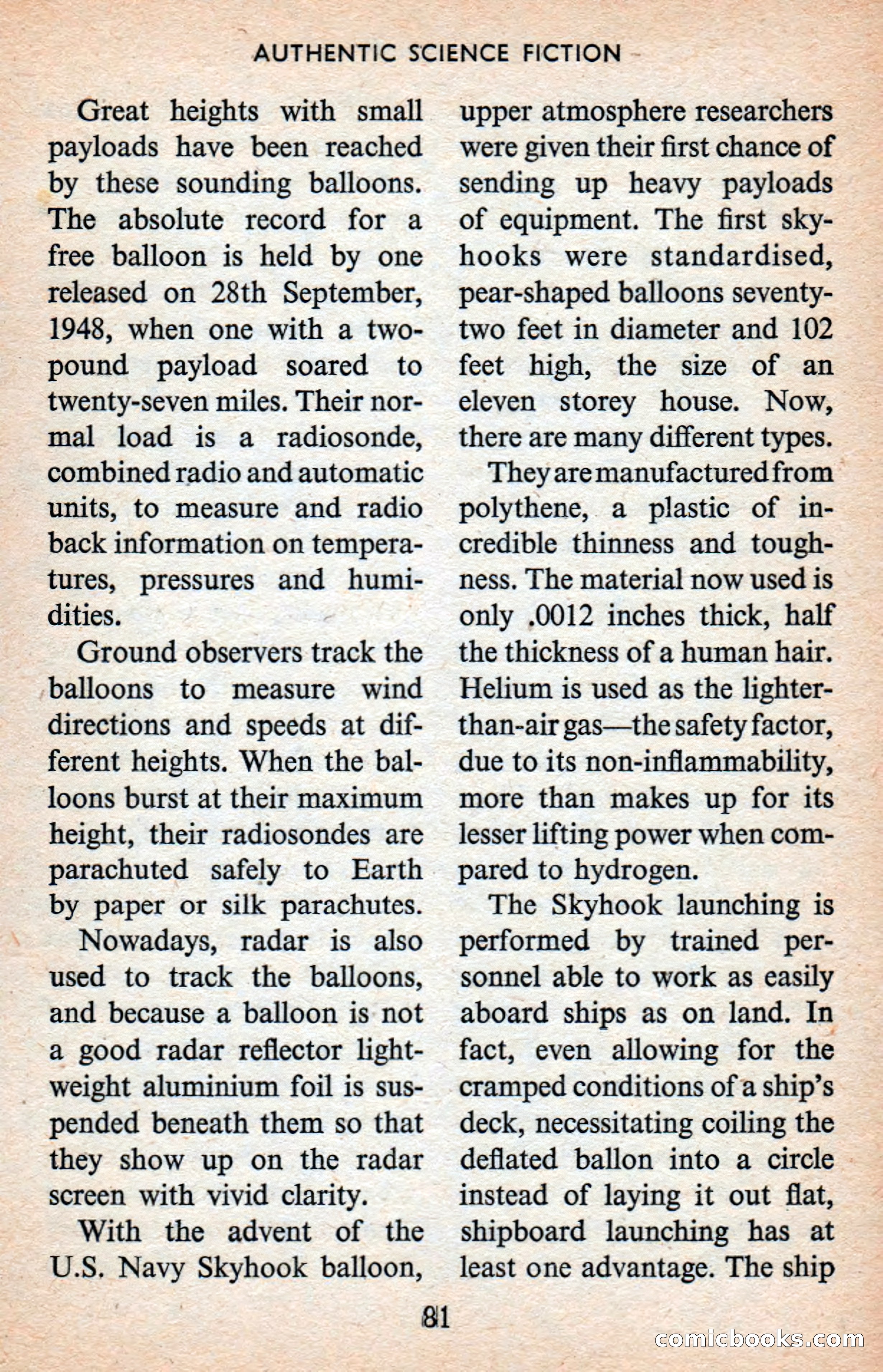
A restored page from Pulp Fiction, 1956. Page through the whole issue in the reader above.
📄 Transcribed text from this page (OCR, searchable)
Machine-transcribed from the original scan — historical spelling and the odd misread are preserved.
“AUTHENTIC SCIENCE FICTION - Great heights with small payloads have been reached by these sounding balloons. The absolute record for a free balloon is held by one released on 28th September, 1948, when one with a two- _ pound payload soared to twenty-seven miles. Their nor- mal load is a radiosonde, combined radio and automatic units, to measure and radio back information on tempera- tures, pressures and humi- dities. Ground observers track the balloons to measure wind directions and speeds at dif- ferent heights. When the bal- loons burst at their maximum height, their radiosondes are parachuted safely to Earth by paper or silk parachutes. Nowadays, radar is also used to track the balloons, and because a balloon is not a good radar reflector light- _ weight aluminium foil is sus- pended beneath them so that they show up on the radar screen with vivid clarity. With the advent of the U.S. Navy Skyhook balloon, 81 upper atmosphere researchers were given their first chance of sending up heavy payloads of equipment. The first sky- hooks were standardised, pear-shaped balloons seventy- two feet in diameter and 102 feet high, the size of an eleven storey house. Now, there are many different types. They aremanufacturedfrom polythene, a plastic of in- credible thinness and tough- ness. The material now used is only .0012 inches thick, half the thickness of a human hair. Helium is used as the lighter- than-air gas—the safety factor, due to its non-inflammability, more than makes up for its lesser lifting power when com- pared to hydrogen. The Skyhook launching is performed by trained per- sonnel able to work as easily — aboard ships as on land. In fact, even allowing for the cramped conditions of a ship’s deck, necessitating coiling the deflated ballon into a circle © instead of laying it out flat, shipboard launching has at least one advantage. The ship conniclsooks.conn