
Pulp Fiction, 1956 · page 39 of 162
Authentic Science Fiction Monthly, No. 67 — page 39: what you’re looking at
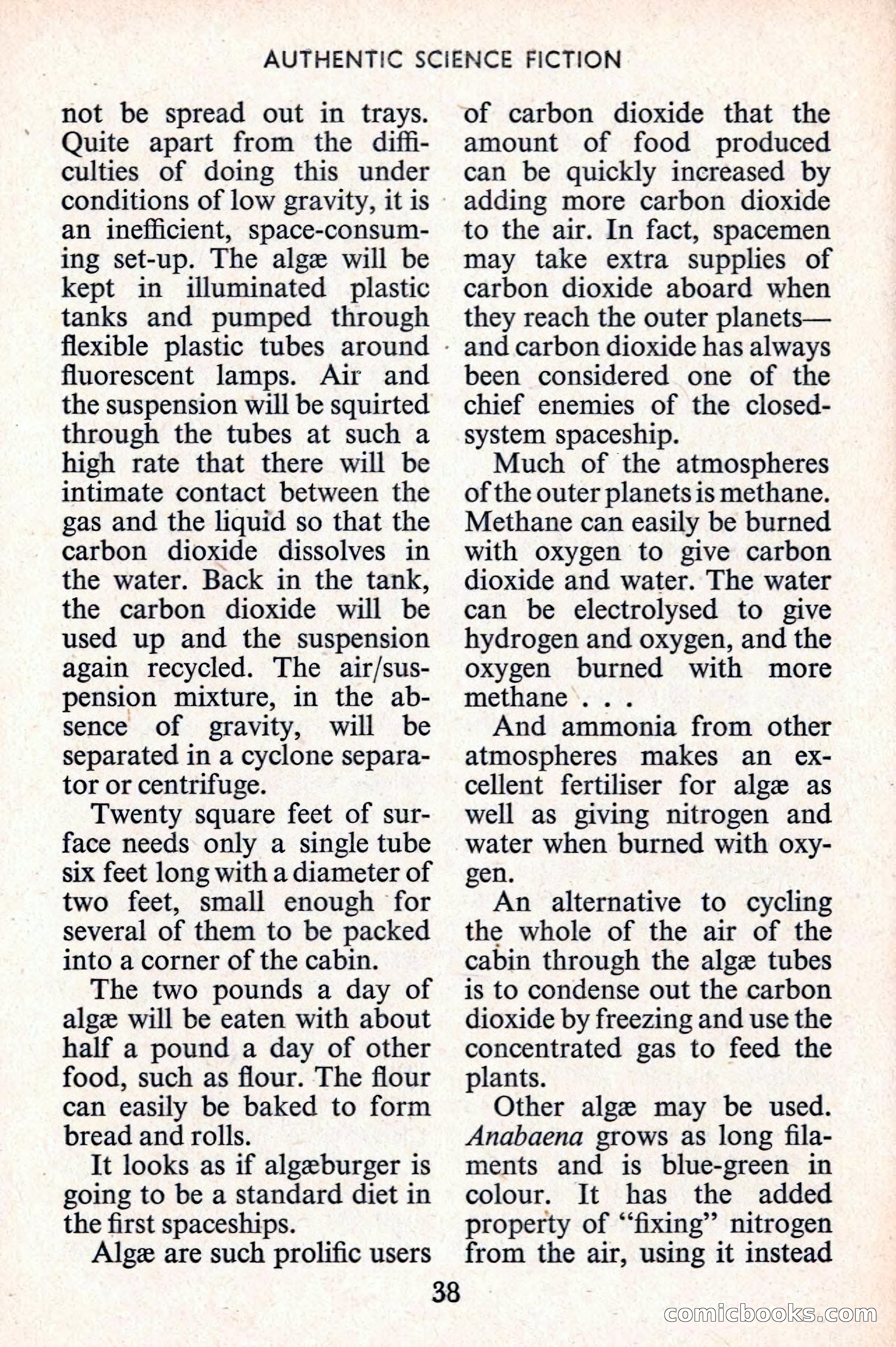
A restored page from Pulp Fiction, 1956. Page through the whole issue in the reader above.
📄 Transcribed text from this page (OCR, searchable)
Machine-transcribed from the original scan — historical spelling and the odd misread are preserved.
AUTHENTIC SCIENCE FICTION not be spread out in trays. Quite apart from the diffi- culties of doing this under conditions of low gravity, it is an inefficient, space-consum- ing set-up. The alge will be kept in illuminated plastic tanks and pumped through flexible plastic tubes around - fluorescent lamps. Air and the suspension will be squirted through the tubes at such a high rate that there will be intimate contact between the gas and the liquid so that the carbon dioxide dissolves in the water. Back in the tank, the carbon dioxide will be used up and the suspension again recycled. The air/sus- pension mixture, in the ab- sence of gravity, will be separated in a cyclone separa- tor or centrifuge. Twenty square feet of sur- face needs only a single tube six feet long with a diameter of two feet, small enough for several of them to be packed into a corner of the cabin. The two pounds a day of algz will be eaten with about half a pound a day of other food, such as flour. The flour can easily be baked to form bread and rolls. It looks as if algeeburger is going to be a standard diet in the first spaceships. Algz are such prolific users 38 of carbon dioxide that the amount of food produced can be quickly increased by adding more carbon dioxide to the air. In fact, spacemen may take extra supplies of carbon dioxide aboard when they reach the outer planets— and carbon dioxide has always been considered one of the chief enemies of the closed- system spaceship. Much of the atmospheres of the outer planets is methane. Methane can easily be burned with oxygen to give carbon dioxide and water. The water can be electrolysed to give hydrogen and oxygen, and the oxygen burned with more methane’... And ammonia from other atmospheres makes an ex- cellent fertiliser for alge as well as giving nitrogen and water when burned with oxy- gen. An alternative to cycling the whole of the air of the cabin through the alge tubes is to condense out the carbon dioxide by freezing and use the concentrated gas to feed the plants. Other alge may be used. Anabaena grows as long fila- ments and is blue-green in colour. It has the added property of “fixing” nitrogen from the air, using it instead comiclooks.cormn