
Pulp Fiction, 1956 · page 38 of 162
Authentic Science Fiction Monthly, No. 67 — page 38: what you’re looking at
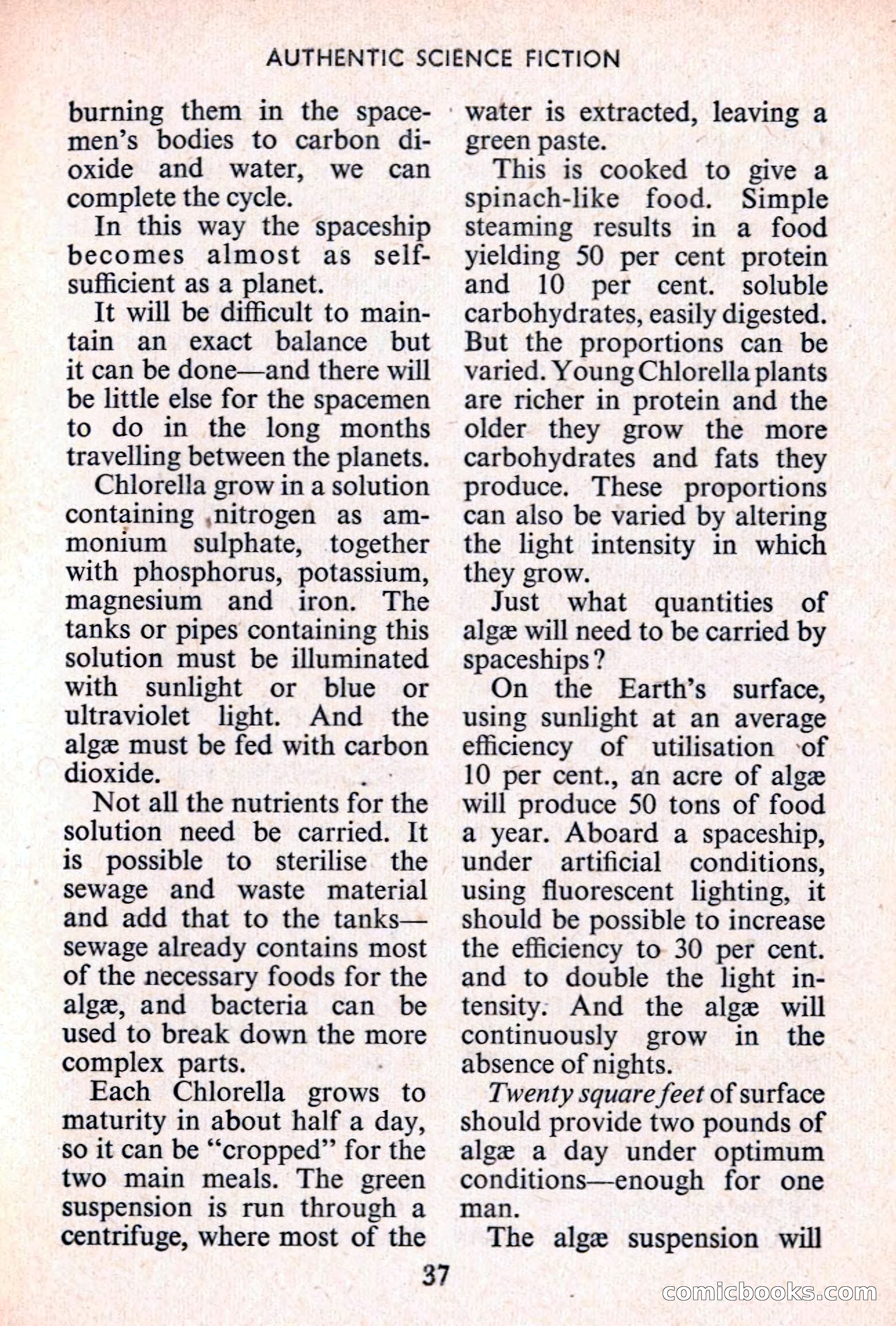
A restored page from Pulp Fiction, 1956. Page through the whole issue in the reader above.
📄 Transcribed text from this page (OCR, searchable)
Machine-transcribed from the original scan — historical spelling and the odd misread are preserved.
AUTHENTIC SCIENCE FICTION burning them in the space- men’s bodies to carbon di- oxide and water, we can complete the cycle. In this way the spaceship becomes almost as self- sufficient as a planet. It will be difficult to main- tain an exact balance but it can be done—and there will be little else for the spacemen to do in the long months travelling between the planets. Chlorella grow in a solution containing ,nitrogen as am- monium sulphate, together with phosphorus, potassium, magnesium and iron. The tanks or pipes containing this solution must be illuminated with sunlight or blue or ultraviolet light. And the alge must be fed with carbon dioxide. Not all the nutrients for the solution need be carried. It is possible to sterilise the sewage and waste material and add that to the tanks— sewage already contains most of the necessary foods for the alge, and bacteria can be used to break down the more complex parts. Each Chlorella grows to maturity in about half a day, so it can be “‘cropped”’ for the two main meals. The green suspension is run through a centrifuge, where most of the 37 ' water is extracted, leaving a green paste. This is cooked to give a spinach-like food. Simple steaming results in a food yielding 50 per cent protein and 10 per cent. soluble carbohydrates, easily digested. But the proportions can be varied. Young Chlorella plants are richer in protein and the older they grow the more carbohydrates and fats they produce. These proportions can also be varied by altering the light intensity in which they grow. Just what quantities of alge will need to be carried by spaceships ? On the Earth’s surface, using sunlight at an average eficiency of utilisation -of 10 per cent., an acre of alge will produce 50 tons of food a year. Aboard a spaceship, under artificial conditions, using fluorescent lighting, it should be possible to increase the efficiency to 30 per cent. and to double the light in- tensity: And the alge will continuously grow in the absence of nights. Twenty square feet of surface should provide two pounds of alge a day under optimum conditions—enough for one man. The alge suspension will comicloooks.com