
Pulp Fiction, 1956 · page 159 of 162
Authentic Science Fiction Monthly, No. 67 — page 159: what you’re looking at
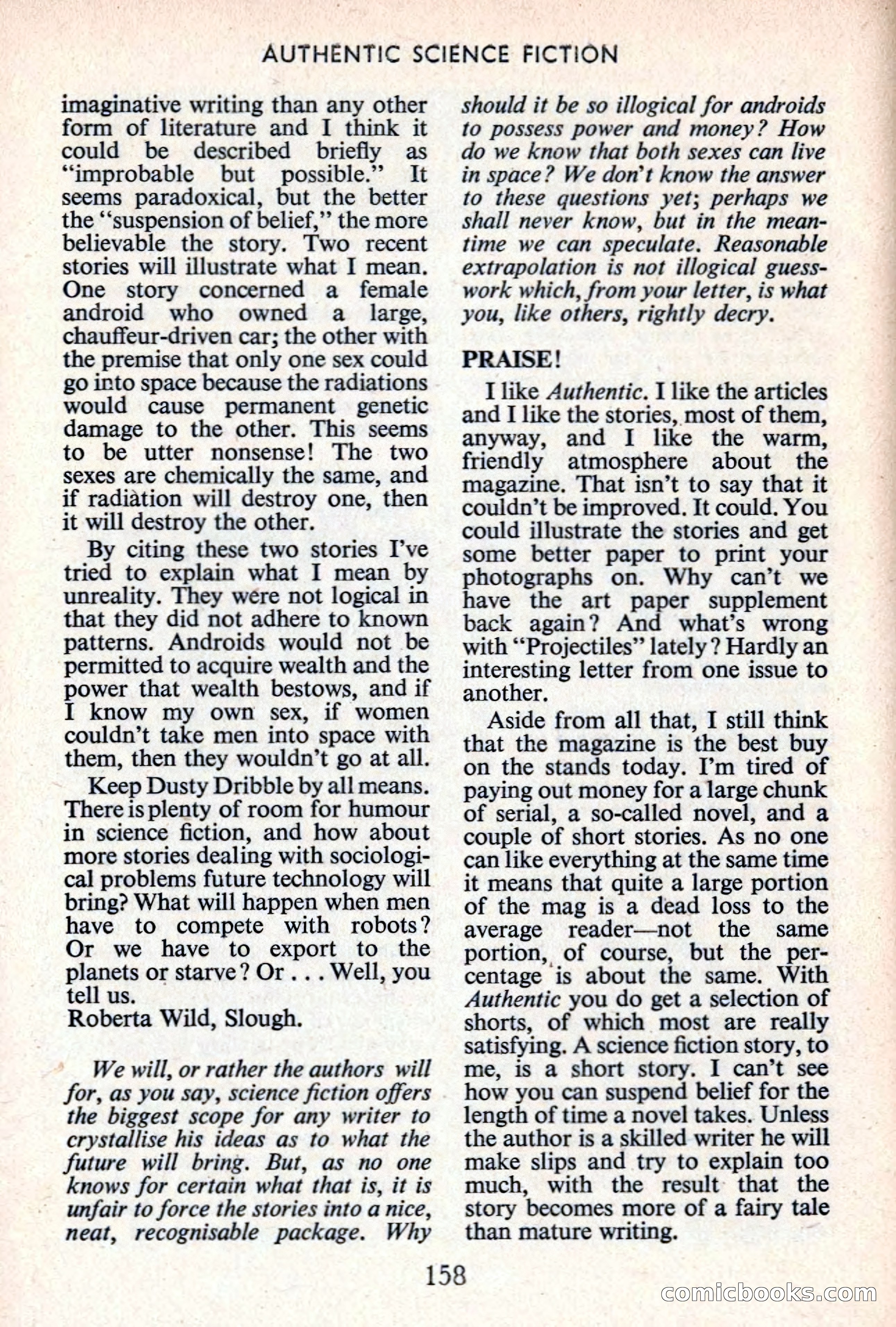
A restored page from Pulp Fiction, 1956. Page through the whole issue in the reader above.
📄 Transcribed text from this page (OCR, searchable)
Machine-transcribed from the original scan — historical spelling and the odd misread are preserved.
AUTHENTIC SCIENCE FICTION imaginative writing than any other form of literature and I think it could be described briefly as “improbable but possible.” It seems paradoxical, but the better the ‘‘suspension of belief,” the more believable the story. Two recent stories will illustrate what I mean. One story concerned a female android who owned a large, chauffeur-driven car; the other with the premise that only one sex could go into space because the radiations would cause permanent genetic damage to the other. This seems to be utter nonsense! The two sexes are chemically the same, and if radiation will destroy one, then it will destroy the other. By citing these two stories I’ve tried to explain what I mean by unreality. They wére not logical in that they did not adhere to known patterns. Androids would not be permitted to acquire wealth and the power that wealth bestows, and if I know my own sex, if women couldn’t take men into space with them, then they wouldn’t go at all. Keep Dusty Dribble by all means. There is plenty of room for humour in science fiction, and how about more stories dealing with sociologi- cal problems future technology will bring? What will happen when men have to compete with robots? Or we have to er to the ae or starve? Or... Well, you te Roberta Wild, Slough. We will, or rather the authors will for, as you say, science fiction offers the biggest scope for any writer to crystallise his ideas as to what the future will bring. But, as no one knows for certain what that is, it is unfair to force the stories into a nice, neat, recognisable package. Why should it be so illogical for androids to possess power and money? How do we know that both sexes can live in space? We don’t know the answer to these questions yet; perhaps we shall never know, but in the mean- time we can speculate. Reasonable extrapolation is not illogical guess- work which, from your letter, is what you, like others, rightly decry. PRAISE! I like Authentic. I like the articles and I like the stories, most of them, anyway, and I like the warm, friendly atmosphere about the magazine. That isn’t to say that it couldn’t be improved. It could. You could illustrate the stories and get some better paper to print your photographs on. Why can’t we have the art paper supplement back again? And what’s wrong with “Projectiles” lately ? Hardly an interesting letter from one issue to another. Aside from all that, I still think that the magazine is the best buy on the stands today. I’m tired of paying out money for a large chunk of serial, a so-called novel, and a couple of short stories. As no one can like everything at the same time it means that quite a large portion of the mag is a dead loss to the average reader—not the same portion, of course, but the per- centage is about the same. With Authentic you do get a selection of shorts, of which most are really satisfying. A science fiction story, to me, is a short story. I can’t see how you can suspend belief for the length of time a novel takes. Unless the author is a skilled writer he will make slips and try to explain too much, with the result that the story becomes more of a fairy tale than mature writing. 158 comicloooks.conm