
Pulp Fiction, 1956 · page 158 of 162
Authentic Science Fiction Monthly, No. 67 — page 158: what you’re looking at
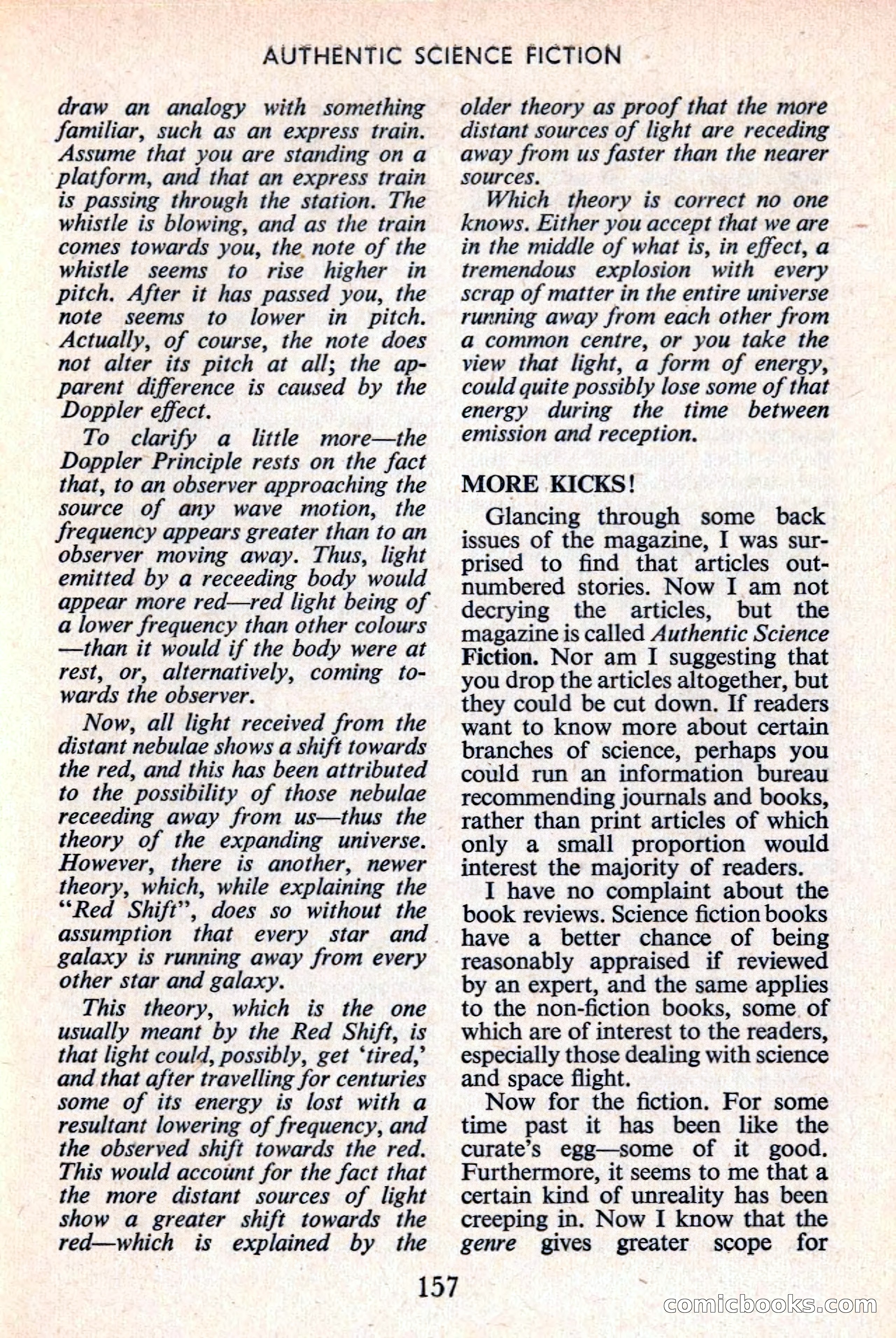
A restored page from Pulp Fiction, 1956. Page through the whole issue in the reader above.
📄 Transcribed text from this page (OCR, searchable)
Machine-transcribed from the original scan — historical spelling and the odd misread are preserved.
AUTHENTIC SCIENCE FICTION draw an analogy with something familiar, such as an express train. Assume that you are standing on a platform, and that an express train is passing through the station. The whistle is blowing, and as the train comes towards you, the note of the whistle seems to rise higher in pitch, After it has passed you, the note seems to lower in pitch. Actually, of course, the note does not alter its pitch at all; the ap- parent difference is caused by the Doppler effect. To clarify a little more—the Doppler Principle rests on the fact that, to an observer approaching the source of any wave motion, the frequency appears greater than to an observer moving away. Thus, light emitted by a receeding body would appear more red—tred light being of a lower frequency than other colours —than it would if the body were at rest, or, alternatively, coming to- wards the observer. Now, all light received from the distant nebulae shows a shift towards the red, and this has been attributed to the possibility of those nebulae receeding away from us—thus the theory of the expanding universe. However, there is another, newer theory, which, while explaining the *“Red Shift’, does so without the assumption that every star and galaxy is running away from every other star and galaxy. This theory, which is the one usually meant by the Red Shift, is that light could, possibly, get ‘tired,’ and that after travelling for centuries some of its energy is lost with a resultant lowering of frequency, and the observed shift towards the red. This would account for the fact that the more distant sources of light show a greater shift towards the red—which is explained by the 157 older theory as proof that the more distant sources of light are receding away from us faster than the nearer sources. Which theory is correct no one knows. Either you accept that we are in the middle of what is, in effect, a tremendous explosion with every scrap of matter in the entire universe running away from each other from a common centre, or you take the view that light, a form of energy, could quite possibly lose some of that energy during the time between emission and reception. MORE KICKS! Glancing through some back issues of the magazine, I was sur- prised to find that articles out- numbered stories. Now I am not decrying the articles, but the magazine is called Authentic Science Fiction. Nor am I suggesting that you drop the articles altogether, but they could be cut down. If readers want to know more about certain branches of science, perhaps you could run an information bureau recommending journals and books, rather than print articles of which only a small proportion would interest the majority of readers. I have no complaint about the book reviews. Science fiction books have a better chance of being reasonably appraised if reviewed by an expert, and the same applies to the non-fiction books, some of which are of interest to the readers, especially those dealing with science and space flight. Now for the fiction. For some time past it has been like the curate’s egg—some of it good. Furthermore, it seems to me that a certain kind of unreality has been creeping in. Now I know that the genre gives greater scope for comiclooks.cormn