
Pulp Fiction, 1956 · page 80 of 162
Authentic Science Fiction Monthly, No. 66 — page 80: what you’re looking at
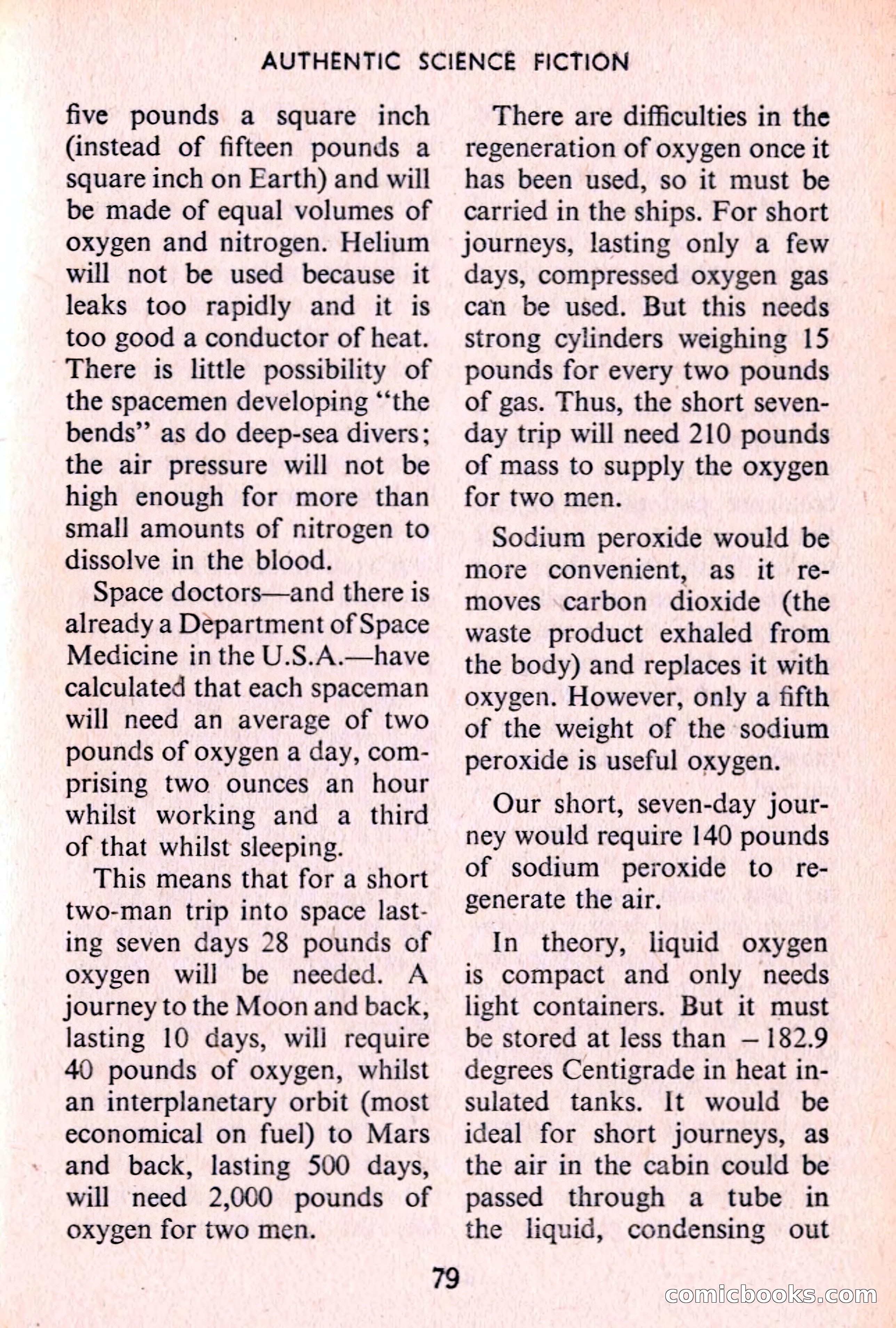
A restored page from Pulp Fiction, 1956. Page through the whole issue in the reader above.
📄 Transcribed text from this page (OCR, searchable)
Machine-transcribed from the original scan — historical spelling and the odd misread are preserved.
AUTHENTIC SCIENCE FICTION five pounds a square inch (instead of fifteen pounds a square inch on Earth) and will be made of equal volumes of oxygen and nitrogen. Helium will not be used because it leaks too rapidly and it is too good a conductor of heat. There is little possibility of the spacemen developing “‘the bends”’ as do deep-sea divers; the air pressure will not be high enough for more than small amounts of nitrogen to dissolve in the blood. Space doctors—and there is already a Department of Space Medicine in the U.S.A.—have calculated that each spaceman will need an average of two pounds of oxygen a day, com- prising two ounces an hour whilst working and a third of that whilst sleeping. This means that for a short two-man trip into space last- ing seven days 28 pounds of oxygen will be needed. A journey to the Moon and back, lasting 10 days, will require 40 pounds of oxygen, whilst an interplanetary orbit (most economical on fuel) to Mars and back, lasting 500 days, will need 2,000 pounds of oxygen for two men. There are difficulties in the regeneration of oxygen once it has been used, so it must be carried in the ships. For short journeys, lasting only a few days, compressed oxygen gas can be used. But this needs strong cylinders weighing 15 pounds for every two pounds of gas. Thus, the short seven- day trip will need 210 pounds of mass to supply the oxygen for two men. Sodium peroxide would be more convenient, as it re- moves carbon dioxide (the waste product exhaled from the body) and replaces it with oxygen. However, only a fifth of the weight of the sodium peroxide is useful oxygen. Our short, seven-day jour- ney would require 140 pounds of sodium peroxide to re- generate the air. In theory, liquid oxygen is compact and only needs light containers. But it must be stored at less than — 182.9 degrees Centigrade in heat in- sulated tanks. It would be ideal for short journeys, as the air in the cabin could be passed through a tube in the liquid, condensing out comiclooks.corn