
Pulp Fiction, 1956 · page 41 of 162
Authentic Science Fiction Monthly, No. 66 — page 41: what you’re looking at
A restored page from Pulp Fiction, 1956. Page through the whole issue in the reader above.
📄 Transcribed text from this page (OCR, searchable)
Machine-transcribed from the original scan — historical spelling and the odd misread are preserved.
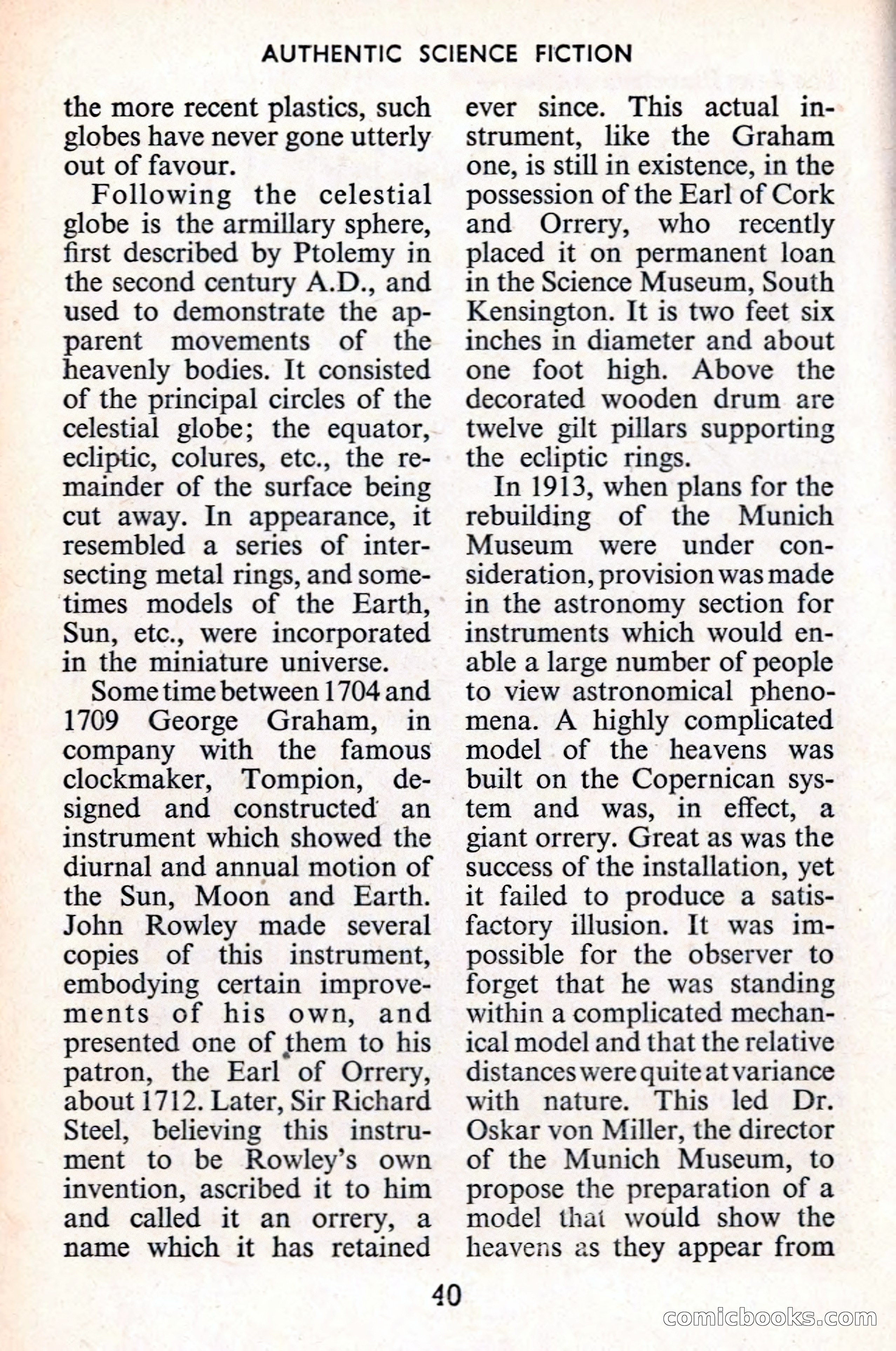
AUTHENTIC SCIENCE FICTION the more recent plastics, such globes have never gone utterly out of favour. Following the celestial globe is the armillary sphere, first described by Ptolemy in the second century A.D., and used to demonstrate the ap- parent movements of the heavenly bodies. It consisted of the principal circles of the celestial globe; the equator, ecliptic, colures, etc., the re- mainder of the surface being cut away. In appearance, it resembled a series of inter- secting metal rings, and some- times models of the Earth, Sun, etc., were incorporated in the miniature universe. Some time between 1704 and 1709 George Graham, in company with the famous clockmaker, Tompion, de- signed and constructed an instrument which showed the diurnal and annual motion of the Sun, Moon and Earth. John Rowley made several copies of this instrument, embodying certain improve- ments of his own, and presented one of them to his patron, the Earl of Orrery, about 1712. Later, Sir Richard Steel, believing this instru- ment to be Rowley’s own invention, ascribed it to him and called it an orrery, a name which it has retained 40 ever since. This actual in- strument, like the Graham one, is still in existence, in the possession of the Earl of Cork and Orrery, who recently placed it on permanent loan in the Science Museum, South Kensington. It is two feet six inches in diameter and about one foot high. Above the decorated wooden drum are twelve gilt pillars supporting the ecliptic rings. In 1913, when plans for the rebuilding of the Munich Museum were under con- sideration, provision was made in the astronomy section for instruments which would en- able a large number of people to view astronomical pheno- mena. A highly complicated model of the heavens was built on the Copernican sys- tem and was, in effect, a giant orrery. Great as was the success of the installation, yet it failed to produce a satis- factory illusion. It was im- possible for the observer to forget that he was standing within a complicated mechan- ical model and that the relative distances were quite at variance with nature. This led Dr. Oskar von Miller, the director of the Munich Museum, to propose the preparation of a model that would show the heavens as they appear from comiclbooks.com