
Pulp Fiction, 1956 · page 40 of 162
Authentic Science Fiction Monthly, No. 66 — page 40: what you’re looking at
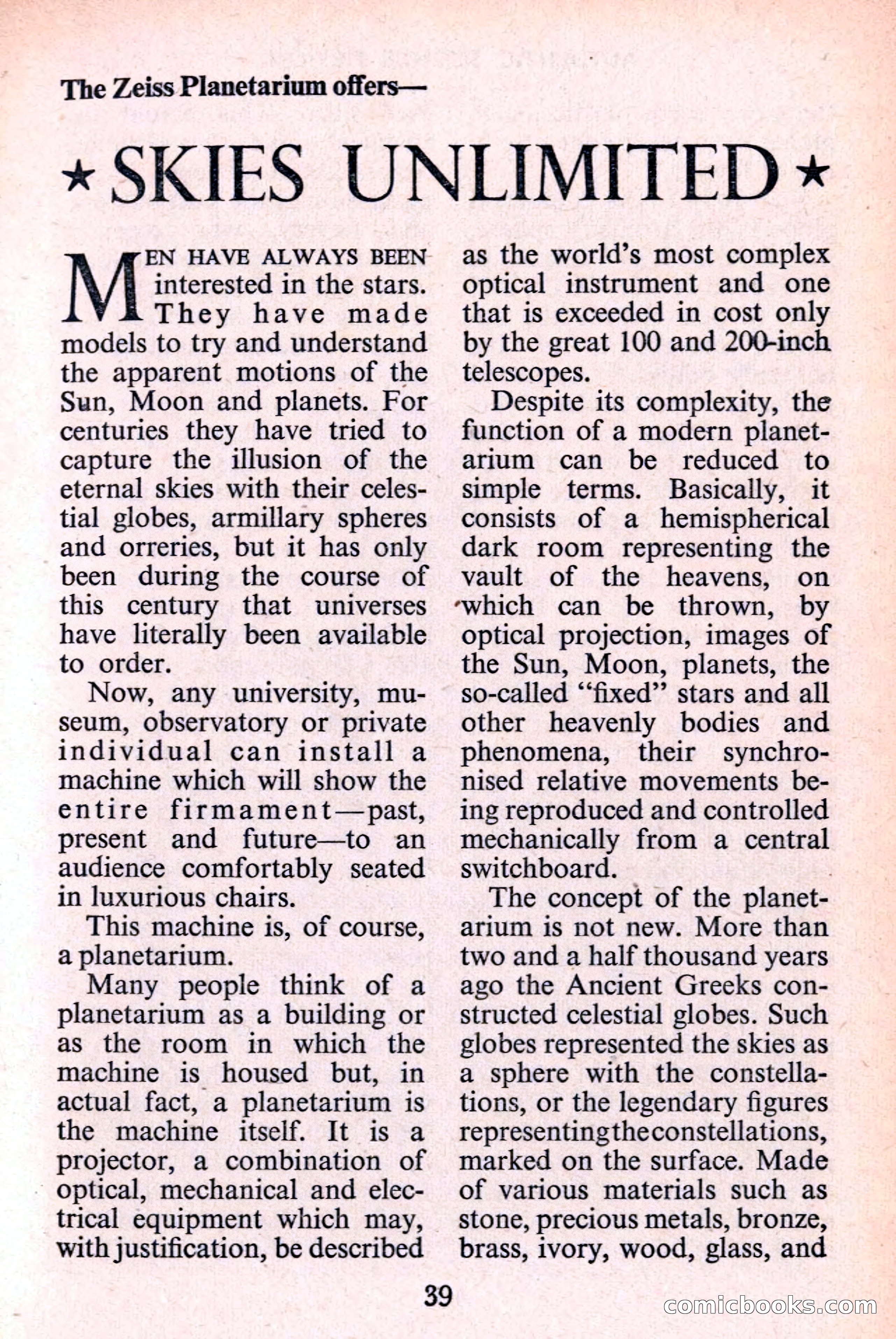
A restored page from Pulp Fiction, 1956. Page through the whole issue in the reader above.
📄 Transcribed text from this page (OCR, searchable)
Machine-transcribed from the original scan — historical spelling and the odd misread are preserved.
The Zeiss Planetarium offers— * SKIES UNLIMITED * EN HAVE ALWAYS BEEN M interested in the stars. They have made models to try and understand the apparent motions of the Sun, Moon and planets. For centuries they have tried to capture the illusion of the eternal skies with their celes- tial globes, armillary spheres and orreries, but it has only been during the course of this century that universes have literally been available to order. Now, any university, mu- seum, observatory or private individual can install a machine which will show the entire firmament—past, present and future—to an audience comfortably seated in luxurious chairs. This machine is, of course, a planetarium. Many people think of a planetarium as a building or as the room in which the machine is housed but, in actual fact, a planetarium is the machine itself. It is a projector, a combination of optical, mechanical and elec- trical equipment which may, with justification, be described 39 as the world’s most complex optical instrument and one that is exceeded in cost only by the great 100 and 200-inch telescopes. Despite its complexity, the function of a modern planet- arium can be reduced to simple terms. Basically, it consists of a hemispherical dark room representing the vault of the heavens, on ‘which can be thrown, by optical projection, images of the Sun, Moon, planets, the so-called “‘fixed”’ stars and all other heavenly bodies and phenomena, their synchro- nised relative movements be- ing reproduced and controlled mechanically from a central switchboard. The concept of the planet- arium is not new. More than two and a half thousand years ago the Ancient Greeks con- structed celestial globes. Such globes represented the skies as a sphere with the constella- tions, or the legendary figures representing theconstellations, marked on the surface. Made of various materials such as stone, precious metals, bronze, brass, ivory, wood, glass, and comiclbooks.corn