
Pulp Fiction, 1956 · page 160 of 162
Authentic Science Fiction Monthly, No. 66 — page 160: what you’re looking at
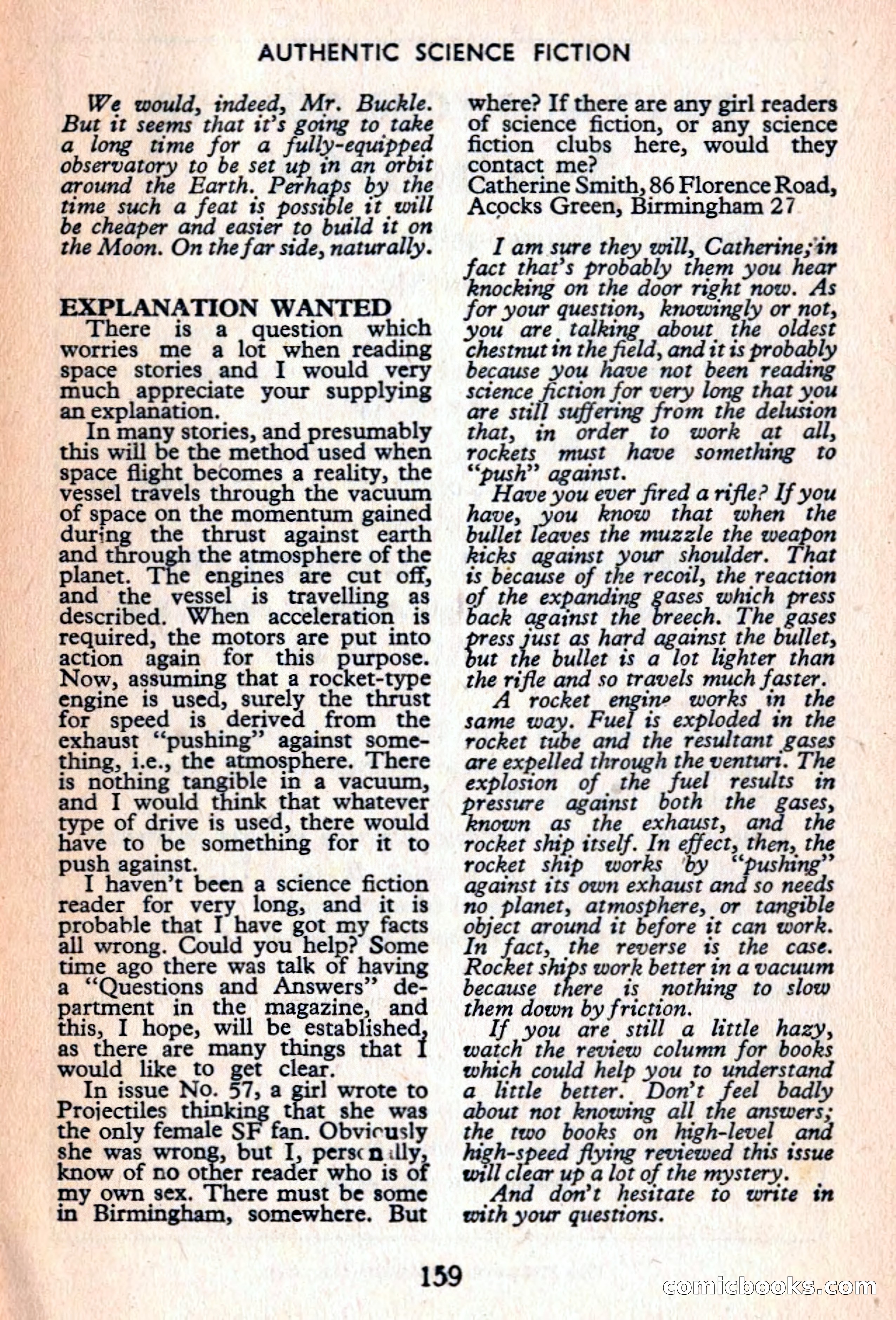
A restored page from Pulp Fiction, 1956. Page through the whole issue in the reader above.
📄 Transcribed text from this page (OCR, searchable)
Machine-transcribed from the original scan — historical spelling and the odd misread are preserved.
AUTHENTIC SCIENCE FICTION We would, indeed, Mr. Buckle. But it seems that it’s gotng to take a long time for a fully-equipped observatory to be set up in an orbit around the Earth. Perhaps by the time such a feat is possible it will be cheaper and easter to build it on the Moon. On the far side, naturally. EXPLANATION WANTED . There is a question which worries me a lot when reading space stories and I would very much appreciate your supplying an explanation. In many stories, and presumably this will be the method used when space flight becomes a reality, the vessel travels through the vacuum of space on the momentum gained during the thrust against earth and through the atmosphere of the planet. The engines are cut off, and the vessel is travelling as described. When acceleration is required, the motors are put into action again for this purpose. Now, assuming that a rocket-type engine is used, surely the thrust for speed is derived from the exhaust “‘pushing” against some- thing, i.e., the atmosphere. There is nothing ble in a vacuum, and I would | that whatever type of drive is used, there would have to be something for it to push against. . : I haven’t been a science fiction reader for very long, and it is probable that I have got my facts all wrong. Could you help? Some time_ago there was talk of having a “Questions and Answers” de- partment in the magazine, and this, I hope, will be established as there are many gs that would like to get clear. In issue No. 57, a girl wrote to Projectiles yt that_she was the only female SF fan. Obvicusly she was wrong, but I, perscnilly know of no other reader who is 0 my own sex. There must be some in Birmingham, somewhere. But 159 where? If there are any girl readers of science fiction, or any science fiction clubs here, would they contact me? | Catherine Smith, 86 Florence Road, Acocks Green, Birmingham 27 I am sure they will, Catherine;in fact that’s probably them you knocking on the door right now. As for your question, ngly or not, you are talking about. the oldest chestnut tn the field, and it is probably because you have not been reading sctence ype for very long that you are still suffering from the delusion that, in order to work at all, rockets must have something to “push” against. j Have you ever fired a rifle? If you have, you that when the bullet leaves the muzzle the weapon kicks against your shoulder. That ts because of the recoil, the reaction of the expanding gases which press ack against the breech. The gases ess just as hard against the bullet, ut the bullet ts a lot lighter than the rifle and so travels much faster. A rocket ine works in the same way. Fuel is exploded in the rocket tube and the resultant gases are expelled through the venturt. The explosion of the fuel results in — against both the gases, as the _ exhaust, the rocket ship itself. In effect, then, the rocket ship works ‘by “pushing’’ against its own exhaust so needs no planet, atmosphere, or tangible object around it before it can work. In fact, the reverse is the case. Rocket ships work better in a vacuum because there is nothing to slow them down by friction. If you are still a little hazy, watch the review column for books which could help you to understand a little better. Don’t feel badly about not knowing all the answers; el two Bye on igh eoe ; -s ng reviewed this issue i a up a lot of the mystery. . And don’t hesitate to write tn with your questions. comiclbooks.corn