
Pulp Fiction, 1956 · page 159 of 162
Authentic Science Fiction Monthly, No. 66 — page 159: what you’re looking at
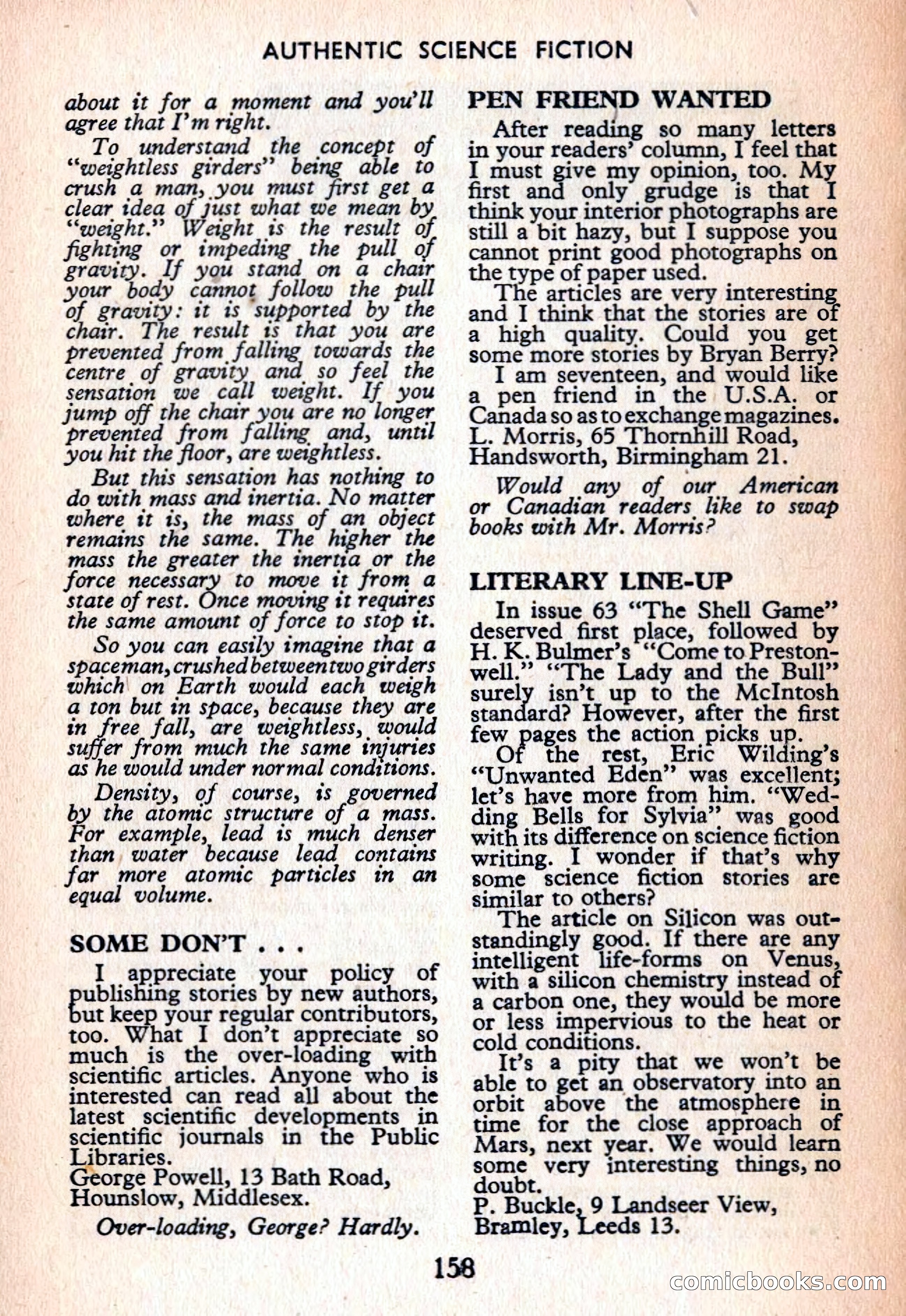
A restored page from Pulp Fiction, 1956. Page through the whole issue in the reader above.
📄 Transcribed text from this page (OCR, searchable)
Machine-transcribed from the original scan — historical spelling and the odd misread are preserved.
AUTHENTIC SCIENCE FICTION about it for a moment and you'll agree that I’m right. To understand the concept of “weightless girders’? being able to crush a man, you must first get a clear idea of just what we mean by “weight.” Weight is the result of. fighting or impeding the pull of gravity. If you stand on a chair your body cannot follow the pull of gravity: it is supported by the chair. The result 1s that you are prevented from falling towards the centre of gravity and so feel the sensation we call weight. If you jump off the chatr_you are no longer prevented from falling and, until you hit the floor, are weightless. But this sensation has nothing to do with mass and inertia. No matter where it is, the mass of an object remains the same. The higher the mass the greater the inertia or the force necessary to move it from a State of rest. Once moving tt requires the same amount of force to stop tt. So you can easily imagine that a spaceman, crushed betweentwo girders which on Earth would each weigh a ton but in space, because they are in free fall, are weightless, would suffer from much the same injuries as he would under normal condttions. Density, of course, 1s governed by the atomic structure of a mass. For example, lead 1s much denser than, water because lead contains far more atomic particles in an equal volume. SOME DON’T... I appreciate your policy of ublishing stories by new authors, ut keep your regular contributors, too. What I don’t appreciate so much is the over-loading with scientific articles. Anyone who is interested can read all about the latest scientific developments in scientific journals in the Public braries. rge Powell, 13 Bath Road, Hounslow, Middlesex. Over-loading, George? Hardly. 158 PEN FRIEND WANTED _ After reading so many_ letters in your readers’ column, I feel that I must give my opinion, too. M first and only grudge is that ink your interior photographs are still a bit hazy, but I suppose you cannot print good photographs on the type of paper used. | : The articles are very interesting and I think that the stories are of a high quality. Could you get some more stories by Bryan re I am seventeen, and would like a pen friend in the U.S.A. or Canada so as to exchange magazines. L. Morris, 65 Thornhill Road, Handsworth, Birmingham 21. Would any of our American or Canadian readers like to swap books with Mr. Morris? LITERARY LINE-UP In issue 63 ‘“The Shell Game” deserved first place, followed by H. K. er’s ““Come to Preston- well.” ‘‘The Lady and the Bull” surely isn’t up to the McIntosh standard? However, after the first few pages the action picks up. Of the rest, Eric Wilding’s “Unwanted Eden’ was excellent; let’s have more from him. “Wed- ding Bells for Sylvia” was good with its difference on science fiction writing. I wonder if that’s why some science fiction stories are similar to others? The article on Silicon was out- standingly good. If there are any intelligent life-forms on Venus, with a silicon chemistry instead of a carbon one, they would be more or less impervious to the heat or cold conditions. It’s a pity that we won't be able to get an observatory into an orbit above the atmosphere in time for the close approach of Mars, next year. We would learn some very interesting things, no doubt. f P. Buckle, 9 Landseer View, Bramley, Leeds 13. commicloooks.conhn)