
Pulp Fiction, 1956 · page 154 of 162
Authentic Science Fiction Monthly, No. 66 — page 154: what you’re looking at
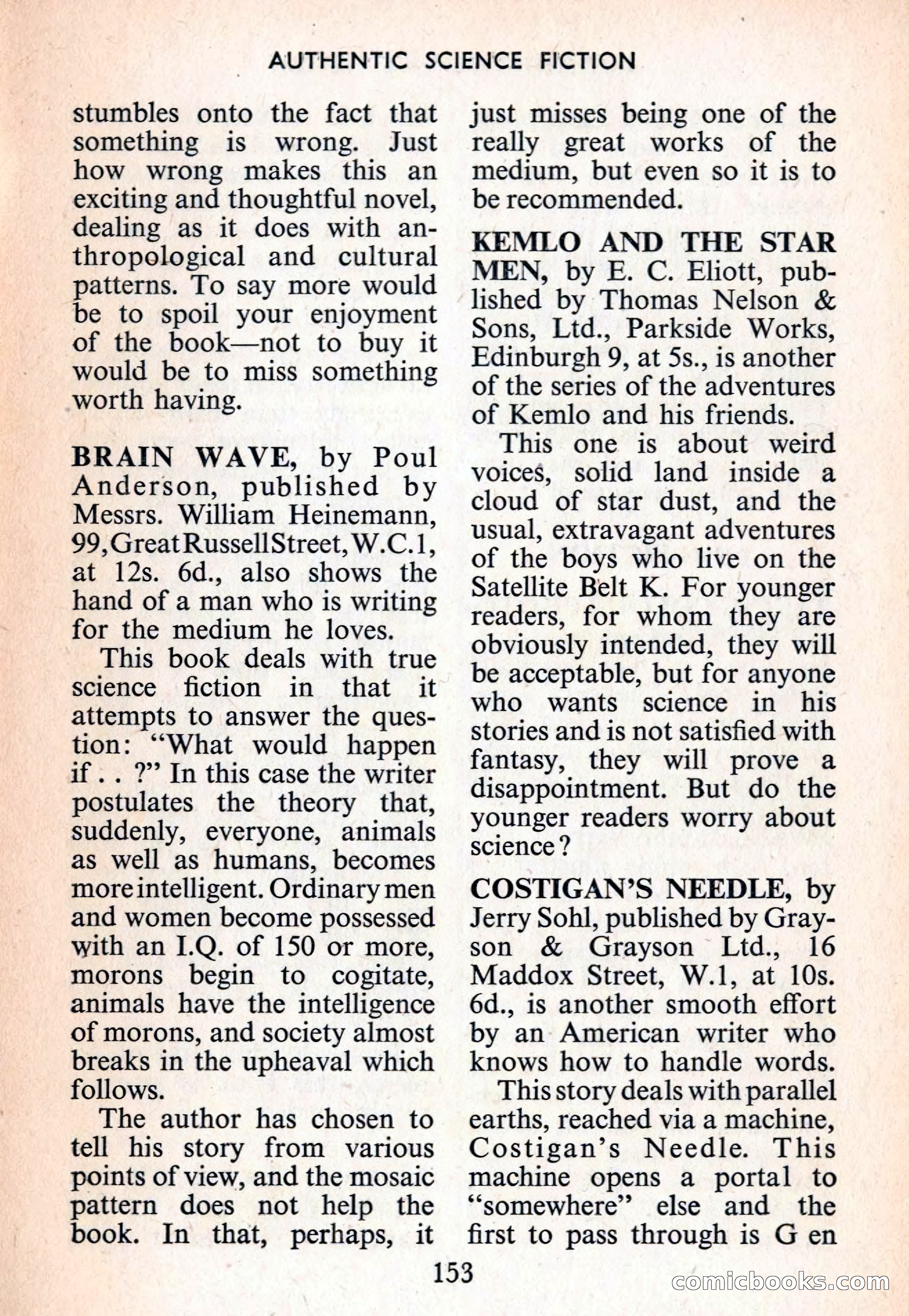
A restored page from Pulp Fiction, 1956. Page through the whole issue in the reader above.
📄 Transcribed text from this page (OCR, searchable)
Machine-transcribed from the original scan — historical spelling and the odd misread are preserved.
AUTHENTIC SCIENCE FICTION stumbles onto the fact that something is wrong. Just how wrong makes this an exciting and thoughtful novel, dealing as it does with an- thropological and cultural patterns. To say more would be to spoil your enjoyment of the book—not to buy it would be to miss something worth having. BRAIN WAVE, by Poul Anderson, published by Messrs. William Heinemann, 99,Great RussellStreet, W.C.1, at 12s. 6d., also shows the hand of a man who is writing for the medium he loves. This book deals with true science fiction in that it attempts to answer the ques- tion: ““What would happen if .. ?” In this case the writer postulates the theory that, suddenly, everyone, animals as well as humans, becomes more intelligent. Ordinary men and women become possessed with an I.Q. of 150 or more, morons begin to cogitate, animals have the intelligence of morons, and society almost breaks in the upheaval which follows. The author has chosen to tell his story from various points of view, and the mosaic pattern does not help the book. In that, perhaps, it 153 just misses being one of the really great works of the medium, but even so it is to be recommended. KEMLO AND THE STAR MEN, by E. C. Eliott, pub- lished by Thomas Nelson & Sons, Ltd., Parkside Works, Edinburgh 9, at 5s., is another of the series of the adventures of Kemlo and his friends. This one is about weird voices, solid land inside a cloud of star dust, and the usual, extravagant adventures of the boys who live on the Satellite Belt K. For younger readers, for whom they are obviously intended, they will be acceptable, but for anyone who wants science in his stories and is not satisfied with fantasy, they will prove a disappointment. But do the younger readers worry about science ? COSTIGAN’S NEEDLE, by Jerry Sohl, published by Gray- son & Grayson Ltd., 16 Maddox Street, W.1, at 10s. 6d., is another smooth effort by an American writer who knows how to handle words. This story deals with parallel earths, reached via a machine, Costigan’s Needle. This machine opens a portal to *‘somewhere”” else and the first to pass through is G en comiclooks.conn