
Pulp Fiction, 1956 · page 153 of 162
Authentic Science Fiction Monthly, No. 66 — page 153: what you’re looking at
A restored page from Pulp Fiction, 1956. Page through the whole issue in the reader above.
📄 Transcribed text from this page (OCR, searchable)
Machine-transcribed from the original scan — historical spelling and the odd misread are preserved.
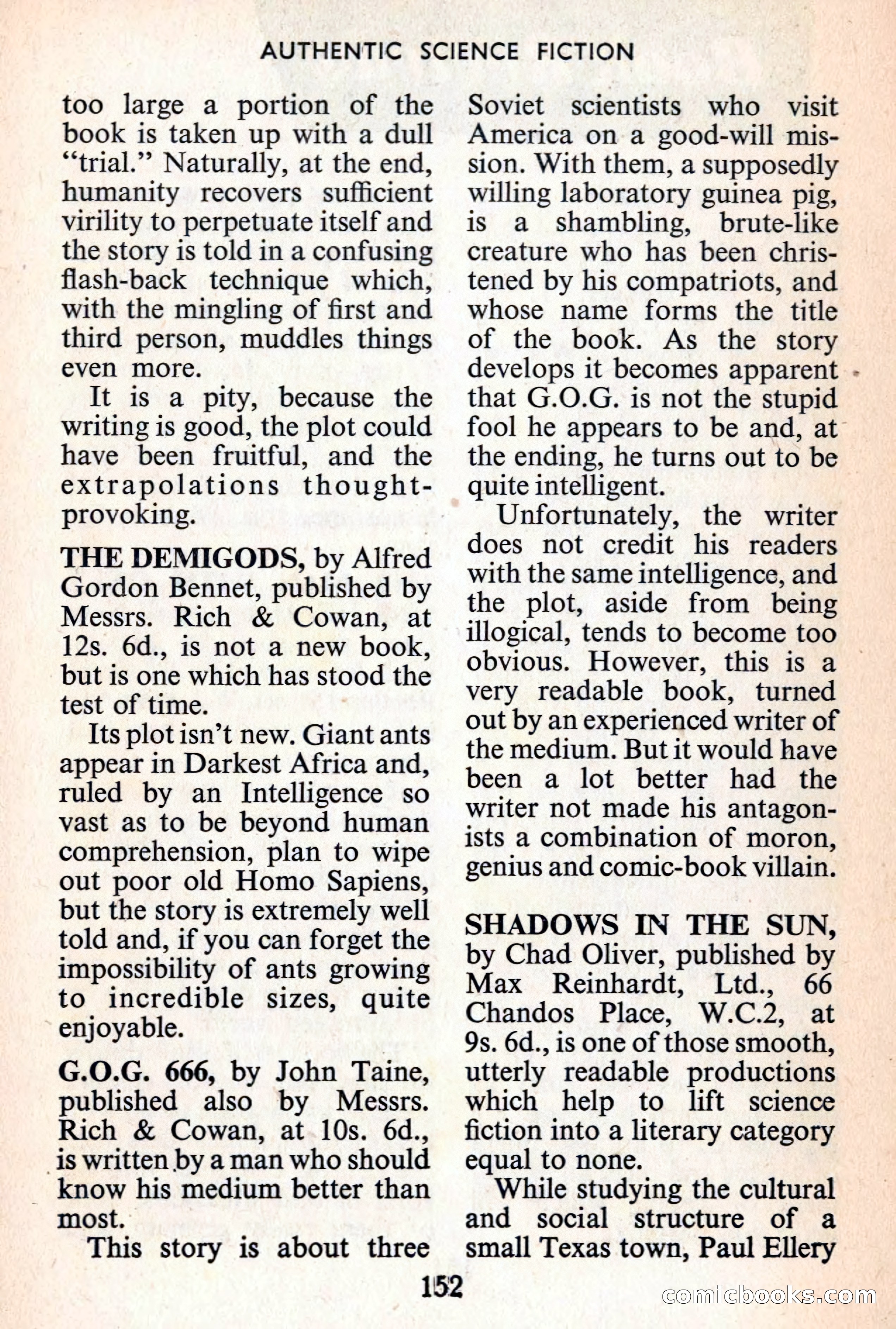
AUTHENTIC SCIENCE FICTION too large a portion of the book is taken up with a dull *‘trial.”? Naturally, at the end, humanity recovers sufficient virility to perpetuate itself and the story is told in a confusing flash-back technique which, with the mingling of first and third person, muddles things even more. It is a pity, because the writing is good, the plot could have been fruitful, and the extrapolations thought- provoking. THE DEMIGODS, by Alfred Gordon Bennet, published by Messrs. Rich & Cowan, at 12s. 6d., is not a new book, but is one which has stood the test of time. Its plot isn’t new. Giant ants appear in Darkest Africa and, ruled by an Intelligence so vast as to be beyond human comprehension, plan to wipe out poor old Homo Sapiens, but the story is extremely well told and, if you can forget the impossibility of ants growing to incredible sizes, quite enjoyable. G.O.G. 666, by John Taine, published also by Messrs. Rich & Cowan, at 10s. 6d., is written by a man who should _ know his medium better than most. This story is about three 152 Soviet scientists who visit America on a good-will mis- sion. With them, a supposedly willing laboratory guinea pig, is a shambling, brute-like creature who has been chris- tened by his compatriots, and whose name forms the title of the book. As the story develops it becomes apparent - that G.O.G. is not the stupid fool he appears to be and, at the ending, he turns out to be quite intelligent. Unfortunately, the writer does not credit his readers with the same intelligence, and the plot, aside from being illogical, tends to become too obvious. However, this is a — very readable book, turned out by an experienced writer of the medium. But it would have been a lot better had the writer not made his antagon- ists a combination of moron, genius and comic-book villain. SHADOWS IN THE SUN, by Chad Oliver, published by Max Reinhardt, Ltd., 66 Chandos Place, W.C.2, at 9s. 6d., is one of those smooth, utterly readable productions which help to lift science fiction into a literary category equal to none. While studying the cultural and social structure of a small Texas town, Paul Ellery comiclooks.conn