
Pulp Fiction, 1956 · page 112 of 162
Authentic Science Fiction Monthly, No. 66 — page 112: what you’re looking at
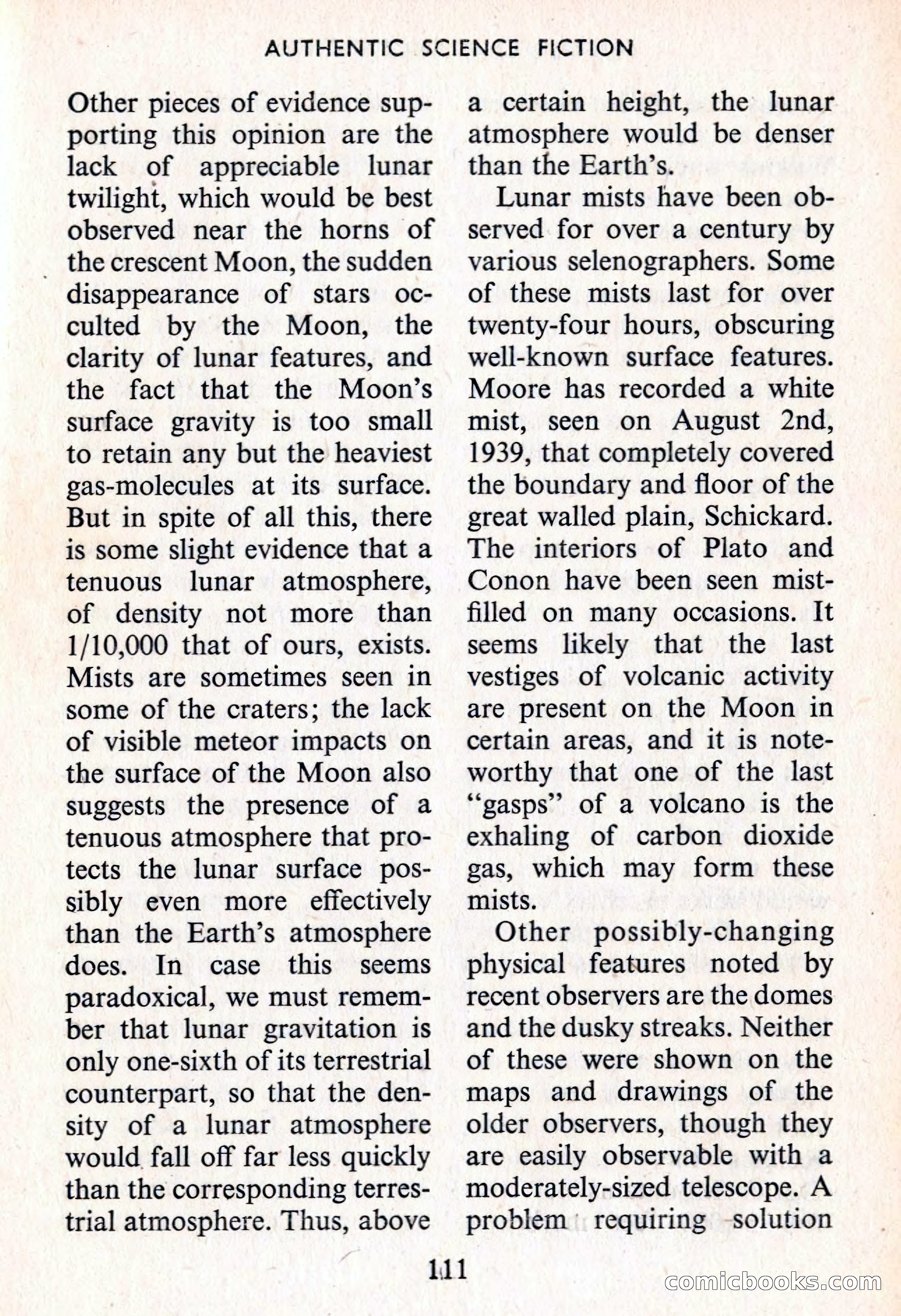
A restored page from Pulp Fiction, 1956. Page through the whole issue in the reader above.
📄 Transcribed text from this page (OCR, searchable)
Machine-transcribed from the original scan — historical spelling and the odd misread are preserved.
AUTHENTIC SCIENCE FICTION Other pieces of evidence sup- porting this opinion are the lack of appreciable lunar twilight, which would be best observed near the horns of _ the crescent Moon, the sudden disappearance of stars oc- culted by the Moon, the clarity of lunar features, and the fact that the Moon’s surface gravity is too small to retain any but the heaviest gas-molecules at its surface. But in spite of all this, there is some slight evidence that a tenuous lunar atmosphere, of density not more than 1/10,000 that of ours, exists. Mists are sometimes seen in some of the craters; the lack of visible meteor impacts on the surface of the Moon also suggests the presence of a tenuous atmosphere that pro- tects the lunar surface pos- sibly even more effectively than the Earth’s atmosphere does. In case this seems paradoxical, we must remem- ber that lunar gravitation is only one-sixth of its terrestrial counterpart, so that the den- sity of a lunar atmosphere would fall off far less quickly than the corresponding terres- trial atmosphere. Thus, above 111 a certain height, the lunar atmosphere would be denser than the Earth’s. Lunar mists have been ob- served for over a century by various selenographers. Some of these mists last for over twenty-four hours, obscuring well-known surface features. Moore has recorded a white mist, seen on August 2nd, 1939, that completely covered the boundary and floor of the great walled plain, Schickard. The interiors of Plato and Conon have been seen mist- filled on many occasions. It seems likely that the last vestiges of volcanic activity are present on the Moon in certain areas, and it is note- worthy that one of the last “‘gasps” of a volcano is the exhaling of carbon dioxide gas, which may form these mists. Other possibly-changing physical features noted by recent observers are the domes and the dusky streaks. Neither of these were shown on the maps and drawings of the older observers, though they are easily observable with a moderately-sized telescope. A problem’ requiring -solution comicloooks.com