
Pulp Fiction, 1956 · page 111 of 162
Authentic Science Fiction Monthly, No. 66 — page 111: what you’re looking at
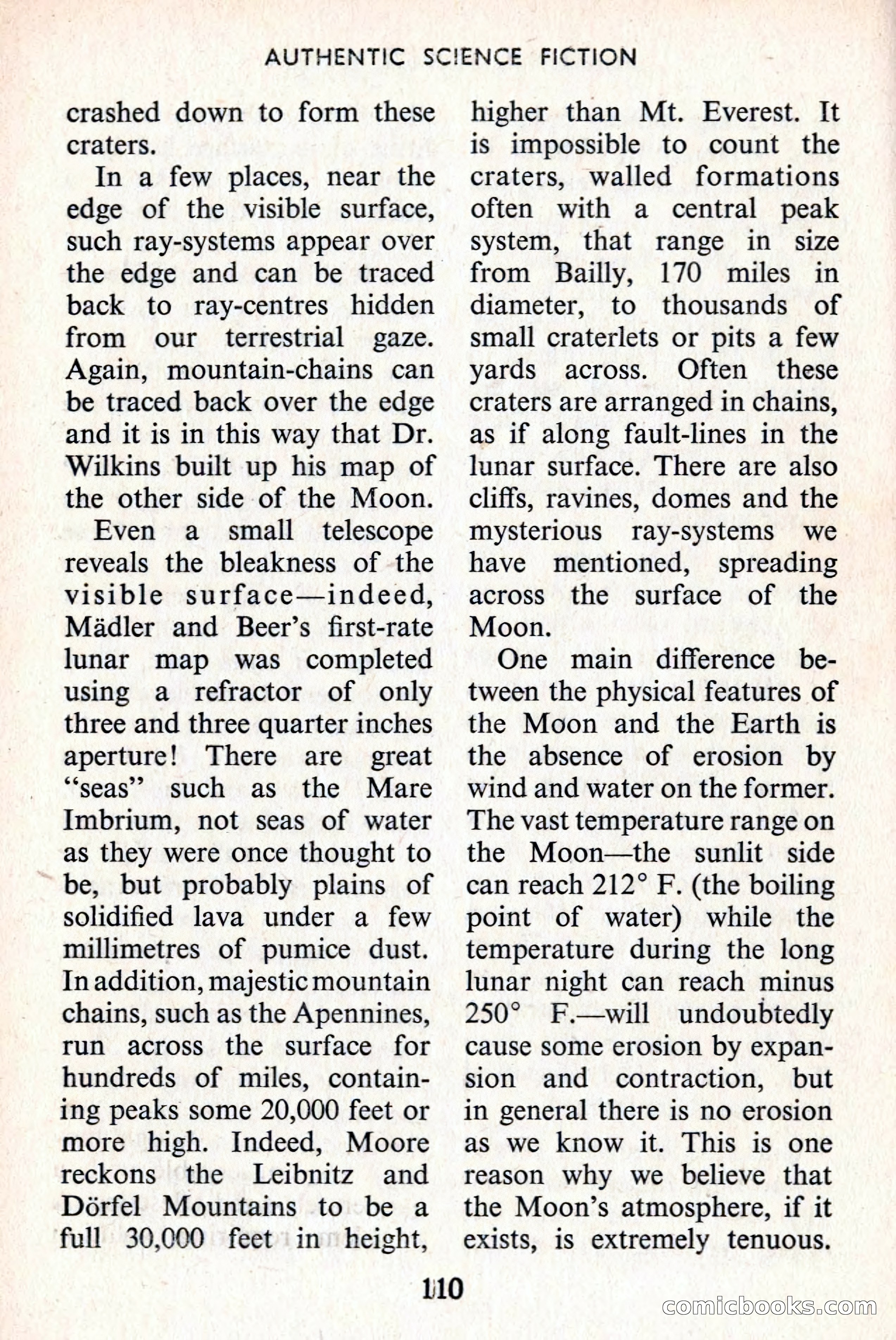
A restored page from Pulp Fiction, 1956. Page through the whole issue in the reader above.
📄 Transcribed text from this page (OCR, searchable)
Machine-transcribed from the original scan — historical spelling and the odd misread are preserved.
AUTHENTIC SCIENCE FICTION crashed down to form these craters. In a few places, near the edge of the visible surface, such ray-systems appear over the edge and can be traced back to ray-centres hidden from our terrestrial gaze. Again, mountain-chains can be traced back over the edge and it is in this way that Dr. Wilkins built up his map of the other side of the Moon. Even a_ small _ telescope reveals the bleakness of the visible surface—indeed, Madler and Beer’s first-rate lunar map was completed using a refractor of only three and three quarter inches aperture! There are _ great ‘“‘seas’”” such as the Mare Imbrium, not seas of water as they were once thought to be, but probably plains of solidified lava under a few millimetres of pumice dust. In addition, majestic mountain chains, such as the Apennines, run across the surface for hundreds of miles, contain- ing peaks some 20,000 feet or more high. Indeed, Moore reckons the Leibnitz and Dorfel Mountains to be a full 30,000 feet in height, 110 higher than Mt. Everest. It is impossible to count the craters, walled formations often with a central peak system, that range in size from Bailly, 170 miles in diameter, to thousands of small craterlets or pits a few yards across. Often these craters are arranged in chains, as if along fault-lines in the lunar surface. There are also cliffs, ravines, domes and the mysterious ray-systems we have mentioned, spreading across the surface of the Moon. One main difference be- tween the physical features of the Moon and the Earth is the absence of erosion by wind and water on the former. The vast temperature range on the Moon—the sunlit side can reach 212° F. (the boiling point of water) while the temperature during the long lunar night can reach minus 250° F.—will undoubtedly cause some erosion by expan- sion and contraction, but in general there is no erosion as we know it. This is one reason why we believe that the Moon’s atmosphere, if it exists, is extremely tenuous. comiclbooks.corn