
Pulp Fiction, 1956 · page 81 of 162
Authentic Science Fiction Monthly, No. 65 — page 81: what you’re looking at
A restored page from Pulp Fiction, 1956. Page through the whole issue in the reader above.
📄 Transcribed text from this page (OCR, searchable)
Machine-transcribed from the original scan — historical spelling and the odd misread are preserved.
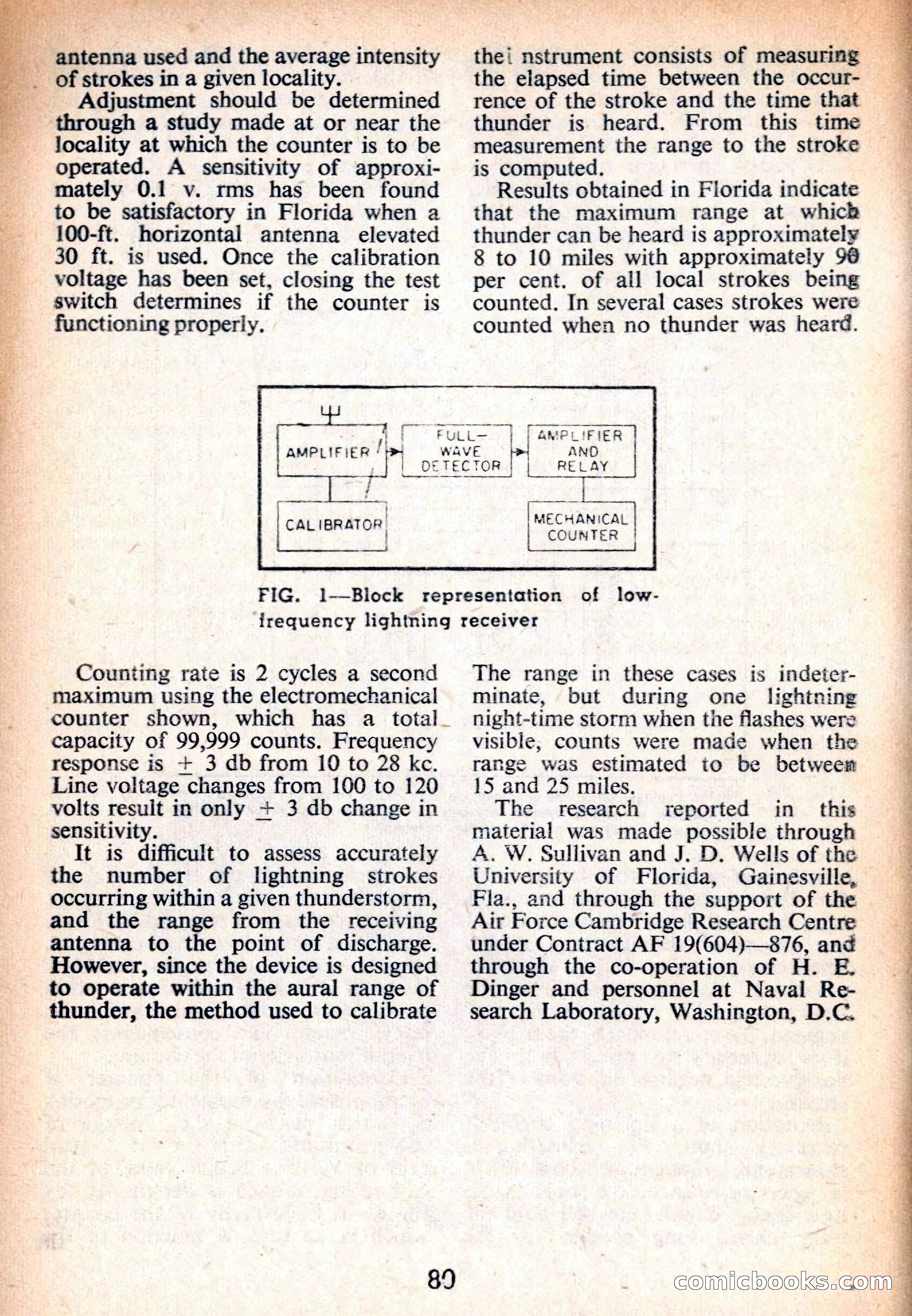
a VON peered AY * “ar, ete nw) * ie! ee ve aN ae 3 <a ae “antenna used ad the average intensity _ of strokes in a given locality. Adjustment should be determined through a study made at or near the locality at which the counter is to be operated. A sensitivity of approxi- mately 0.1 v. rms has been found to be satisfactory in Florida when a 100-ft. horizontal antenna elevated 30 ft. is used. Once the calibration voltage has been set, closing the test switch determines if the counter is functioning properly. 1m” P . thei nstrument consists of measuring the elapsed time between the occur- rence of the stroke and the time that thunder is heard. From this time measurement the range to the stroke is computed. Results obtained in Florida indicate that the maximum range at which thunder can be heard is approximately 8 to 10 miles with approximately 96 per cent. of all local strokes being counted. In several cases strokes were counted when no thunder was heard. AMPLIFIER / ae ULL |_ OF TEC TOR i | | CALIBRATOR: FIG. Counting rate is 2 cycles a second maximum using the electromechanical counter shown, which has a total_ capacity of 99,999 counts. Frequency response is + 3 db from 10 to 28 kc. Line voltage changes from 100 to 120 volts result in only + 3 db change in sensitivity. It is difficult to assess accurately the number of lightning strokes occurring within a given thunderstorm, and the range from the receiving antenna to the point of discharge. However, since the device is designed to operate within the aural range of thunder, the method used to calibrate 89 l1—Block representation of low- irequency lightning receiver [AMPLIFIER | ae ete MECHANICAL | EcHancal | oS ea Sr TO 2 To we oe —t- SS SPA Se The range in these cases is indeter- minate, but during one lightning night-time storm when the flashes were visible, counts were made when the range was estimated to be between 15 and 25 miles. The research reported in this material was made possible through A. W. Sullivan and J. D. Wells of the University of Florida, Gainesville, Fla., and through the support of the Air Force Cambridge Research Centre under Contract AF 19(604)—876, and through the co-operation of H. E. Dinger and personnel at Naval Re- search Laboratory, Washington, D.C. comliclbooks.conmn