
Pulp Fiction, 1956 · page 79 of 162
Authentic Science Fiction Monthly, No. 65 — page 79: what you’re looking at
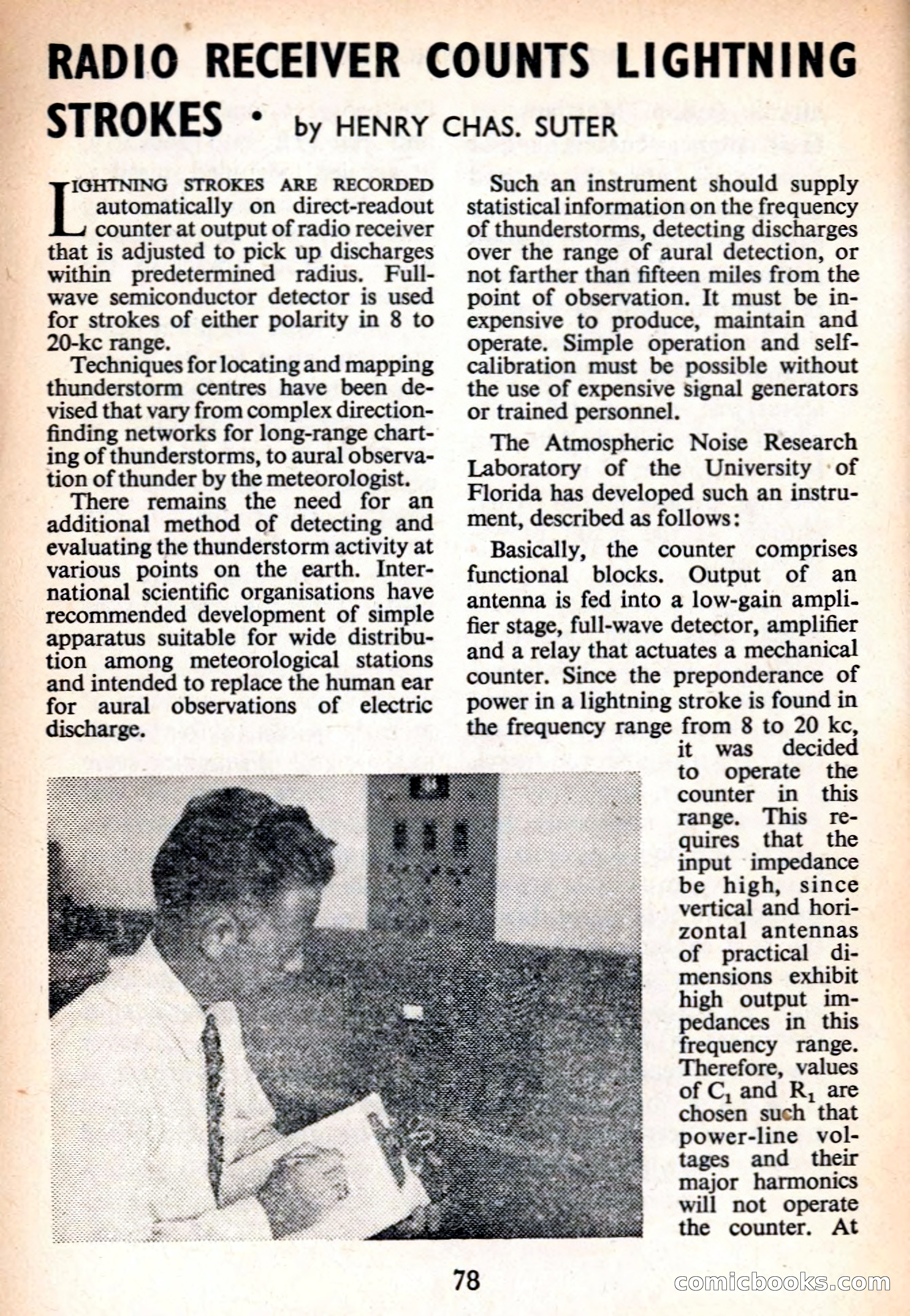
A restored page from Pulp Fiction, 1956. Page through the whole issue in the reader above.
📄 Transcribed text from this page (OCR, searchable)
Machine-transcribed from the original scan — historical spelling and the odd misread are preserved.
"7 se RADIO RECEIVER COUNTS LIGHTNING STROKES ° by HENRY CHAS. SUTER automatically on direct-readout counter at output of radio receiver that is adjusted to pick up discharges within predetermined radius. Full- wave semiconductor detector is used for strokes of either polarity in 8 to 20-kc range. Techniques for locating and mapping thunderstorm centres have been de- vised that vary from complex direction- finding networks for long-range chart- ing of thunderstorms, to aural observa- tion of thunder by the meteorologist. There remains the need for an additional method of detecting and evaluating the thunderstorm activity at various points on the earth. Inter- national scientific organisations have recommended development of simple apparatus suitable for wide distribu- tion among meteorological stations and intended to replace the human ear for aural observations of electric discharge. [| 0m STROKES ARE RECORDED 78 Such an instrument should supply statistical information on the frequency of thunderstorms, detecting discharges over the range of aural detection, or not farther than fifteen miles from the point of observation. It must be in- expensive to produce, maintain and operate. Simple operation and self- calibration must be possible without the use of expensive signal generators or trained personnel. The Atmospheric Noise Research Laboratory of the University of Florida has developed such an instru- ment, described as follows: Basically, the counter comprises functional blocks. Output of an antenna is fed into a low-gain ampli- fier stage, full-wave detector, amplifier and a relay that actuates a mechanical counter. Since the preponderance of power in a lightning stroke is found in the frequency range from 8 to 20 kc, it was decided to operate the counter in this range. This re- quires that the input impedance be high, since vertical and hori- zontal antennas of practical di- mensions exhibit high output im- pedances in this frequency range. Therefore, values of C, and R, are chosen such that power-line vol- tages and their major harmonics will not operate the counter. At comicbooks.conn