
Pulp Fiction, 1956 · page 76 of 162
Authentic Science Fiction Monthly, No. 65 — page 76: what you’re looking at
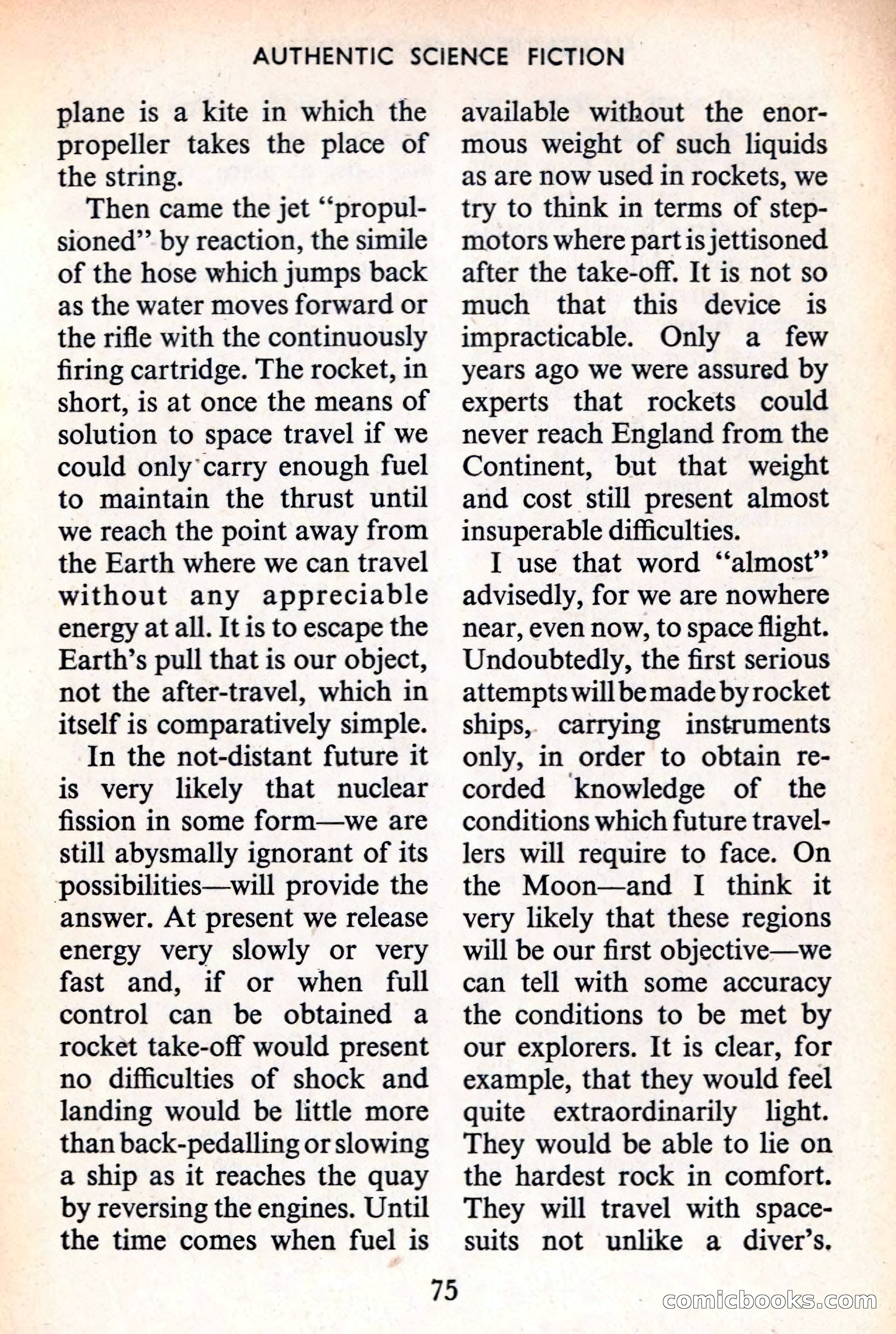
A restored page from Pulp Fiction, 1956. Page through the whole issue in the reader above.
📄 Transcribed text from this page (OCR, searchable)
Machine-transcribed from the original scan — historical spelling and the odd misread are preserved.
AUTHENTIC SCIENCE FICTION plane is a kite in which the propeller takes the place of the string. Then came the jet “‘propul- sioned”’ by reaction, the simile of the hose which jumps back as the water moves forward or the rifle with the continuously firing cartridge. The rocket, in short, is at once the means of solution to space travel if we could only carry enough fuel to maintain the thrust until we reach the point away from the Earth where we can travel without any appreciable energy at all. It is to escape the Earth’s pull that is our object, not the after-travel, which in itself is comparatively simple. In the not-distant future it is very likely that nuclear fission in some form—we are still abysmally ignorant of its possibilities—will provide the answer. At present we release energy very slowly or very fast and, if or when full control can be obtained a rocket take-off would present no difficulties of shock and landing would be little more than back-pedalling or slowing a ship as it reaches the quay by reversing the engines. Until the time comes when fuel is 75 available without the enor- mous weight of such liquids as are now used in rockets, we try to think in terms of step- motors where part is jettisoned after the take-off. It is not so much that this device is impracticable. Only a few years ago we were assured by experts that rockets could never reach England from the Continent, but that weight and cost still present almost insuperable difficulties. I use that word ‘‘almost” advisedly, for we are nowhere near, even now, to space flight. Undoubtedly, the first serious attempts will be made by rocket ships, carrying instruments only, in order to obtain re- corded knowledge of the conditions which future travel- lers will require to face. On the Moon—and I think it very likely that these regions will be our first objective—we can tell with some accuracy the conditions to be met by our explorers. It is clear, for example, that they would feel quite extraordinarily light. They would be able to lie on the hardest rock in comfort. They will travel with space- suits not unlike a diver’s, comiclbooks.cormn