
Pulp Fiction, 1956 · page 75 of 162
Authentic Science Fiction Monthly, No. 65 — page 75: what you’re looking at
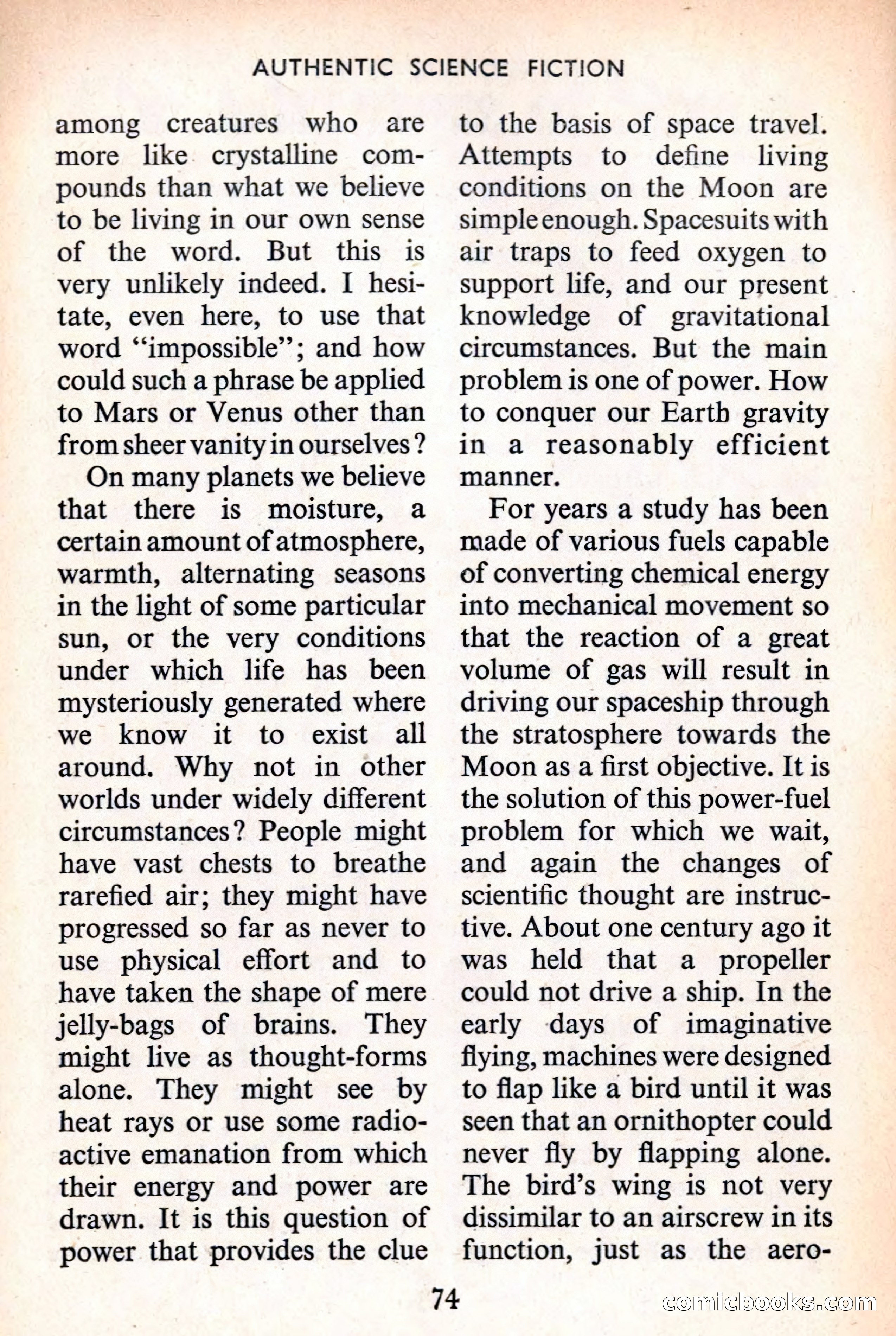
A restored page from Pulp Fiction, 1956. Page through the whole issue in the reader above.
📄 Transcribed text from this page (OCR, searchable)
Machine-transcribed from the original scan — historical spelling and the odd misread are preserved.
AUTHENTIC SCIENCE FICTION among creatures who are more like crystalline com- pounds than what we believe to be living in our own sense of the word. But this is very unlikely indeed. I hesi- tate, even here, to use that word “‘impossible’’; and how could such a phrase be applied to Mars or Venus other than from sheer vanity in ourselves ? On many planets we believe that there is moisture, a certain amount of atmosphere, warmth, alternating seasons in the light of some particular sun, or the very conditions under which life has been mysteriously generated where we know it to exist all around. Why not in other worlds under widely different circumstances? People might have vast chests to breathe rarefied air; they might have progressed so far as never to use physical effort and to have taken the shape of mere jelly-bags of brains. They might live as thought-forms alone. They might see by heat rays or use some radio- active emanation from which their energy and power are drawn. It is this question of power that provides the clue 74 to the basis of space travel. Attempts to define living conditions on the Moon are simple enough. Spacesuits with air traps to feed oxygen to support life, and our present knowledge of gravitational circumstances. But the main problem is one of power. How to conquer our Earth gravity in a reasonably efficient manner. For years a study has been made of various fuels capable of converting chemical energy into mechanical movement so that the reaction of a great volume of gas will result in driving our spaceship through the stratosphere towards the Moon as a first objective. It is the solution of this power-fuel problem for which we wait, and again the changes of scientific thought are instruc- tive. About one century ago it was held that a _ propeller could not drive a ship. In the early days of imaginative flying, machines were designed to flap like a bird until it was seen that an ornithopter could never fly by flapping alone. The bird’s wing is not very dissimilar to an airscrew in its function, just as the aero- comiclooks.corn