
Pulp Fiction, 1956 · page 25 of 162
Authentic Science Fiction Monthly, No. 65 — page 25: what you’re looking at
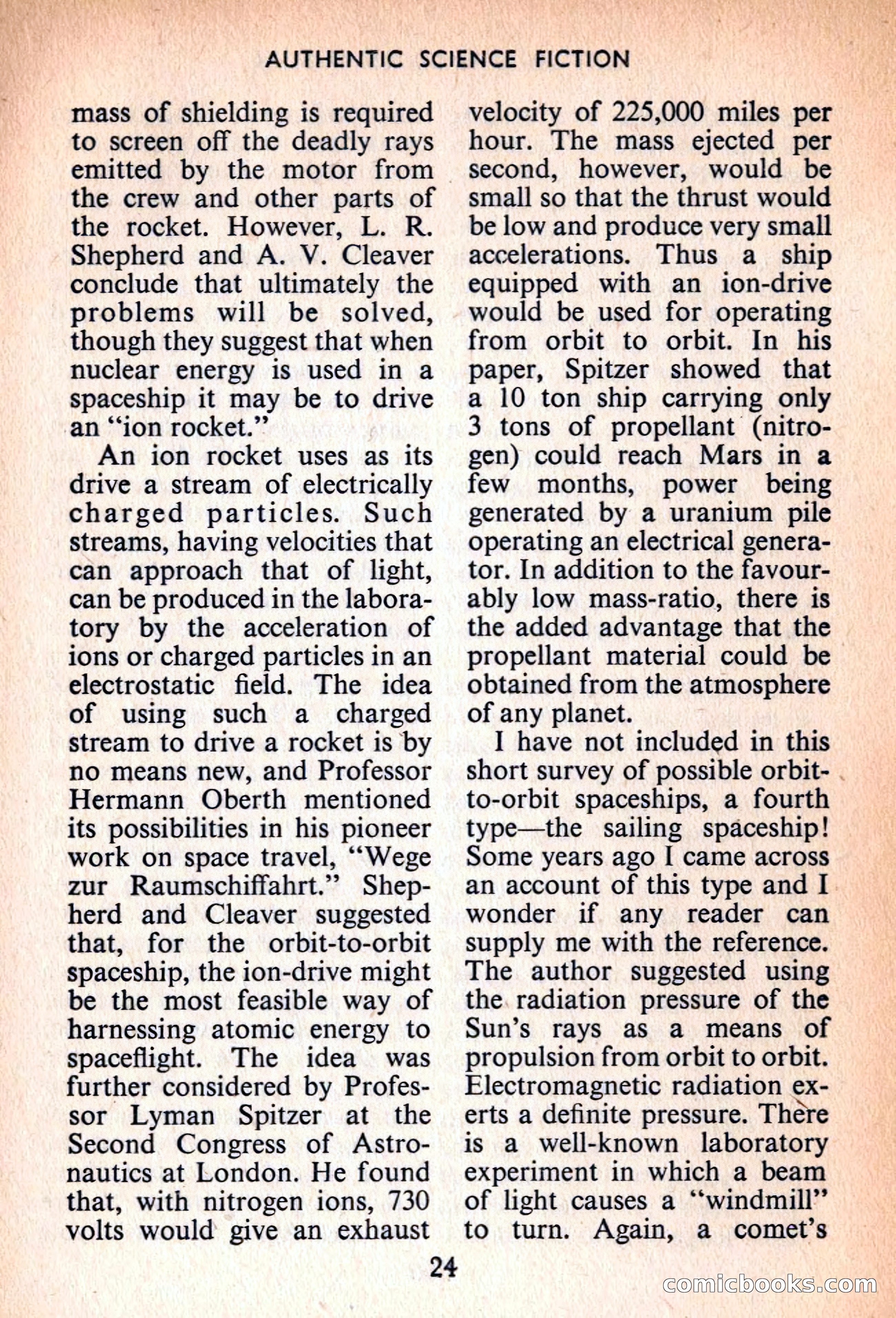
A restored page from Pulp Fiction, 1956. Page through the whole issue in the reader above.
📄 Transcribed text from this page (OCR, searchable)
Machine-transcribed from the original scan — historical spelling and the odd misread are preserved.
~ 2 eer pla AUTHENTIC SCIENCE FICTION mass of shielding is required to screen off the deadly rays emitted by the motor from the crew and other parts of the rocket. However, L. R. Shepherd and A. V. Cleaver conclude that ultimately the problems will be solved, though they suggest that when nuclear energy is used in a spaceship it may be to drive an “‘ion rocket.” An ion rocket uses as its drive a stream of electrically charged particles. Such streams, having velocities that can approach that of light, can be produced in the labora- tory by the acceleration of ions or charged particles in an electrostatic field. The idea of using such a _ charged stream to drive a rocket is by no means new, and Professor Hermann Oberth mentioned its possibilities in his pioneer work on space travel, ““Wege zur Raumschiffahrt.” Shep- herd and Cleaver suggested that, for the orbit-to-orbit spaceship, the ion-drive might be the most feasible way of harnessing atomic energy to spaceflight. The idea was further considered by Profes- sor Lyman Spitzer at the Second Congress of Astro- nautics at London. He found that, with nitrogen ions, 730 volts would give an exhaust 24 velocity of 225,000 miles per hour. The mass ejected per second, however, would be small so that the thrust would be low and produce very small accelerations. Thus a_ ship equipped with an ion-drive would be used for operating from orbit to orbit. In his paper, Spitzer showed that a 10 ton ship carrying only 3 tons of propellant (nitro- gen) could reach Mars in a few months, power being generated by a uranium pile operating an electrical genera- tor. In addition to the favour- ably low mass-ratio, there is the added advantage that the propellant material could be obtained from the atmosphere of any planet. I have not included in this short survey of possible orbit- . to-orbit spaceships, a fourth type—the sailing spaceship! Some years ago I came across an account of this type and I wonder if any reader can supply me with the reference. The author suggested using the. radiation pressure of the Sun’s rays aS a means of propulsion from orbit to orbit. Electromagnetic radiation ex- erts a definite pressure. There is a well-known laboratory experiment in which a beam of light causes a “‘windmill” to turn. Again, a comet’s connicloooks.Ccomn