
Pulp Fiction, 1956 · page 24 of 162
Authentic Science Fiction Monthly, No. 65 — page 24: what you’re looking at
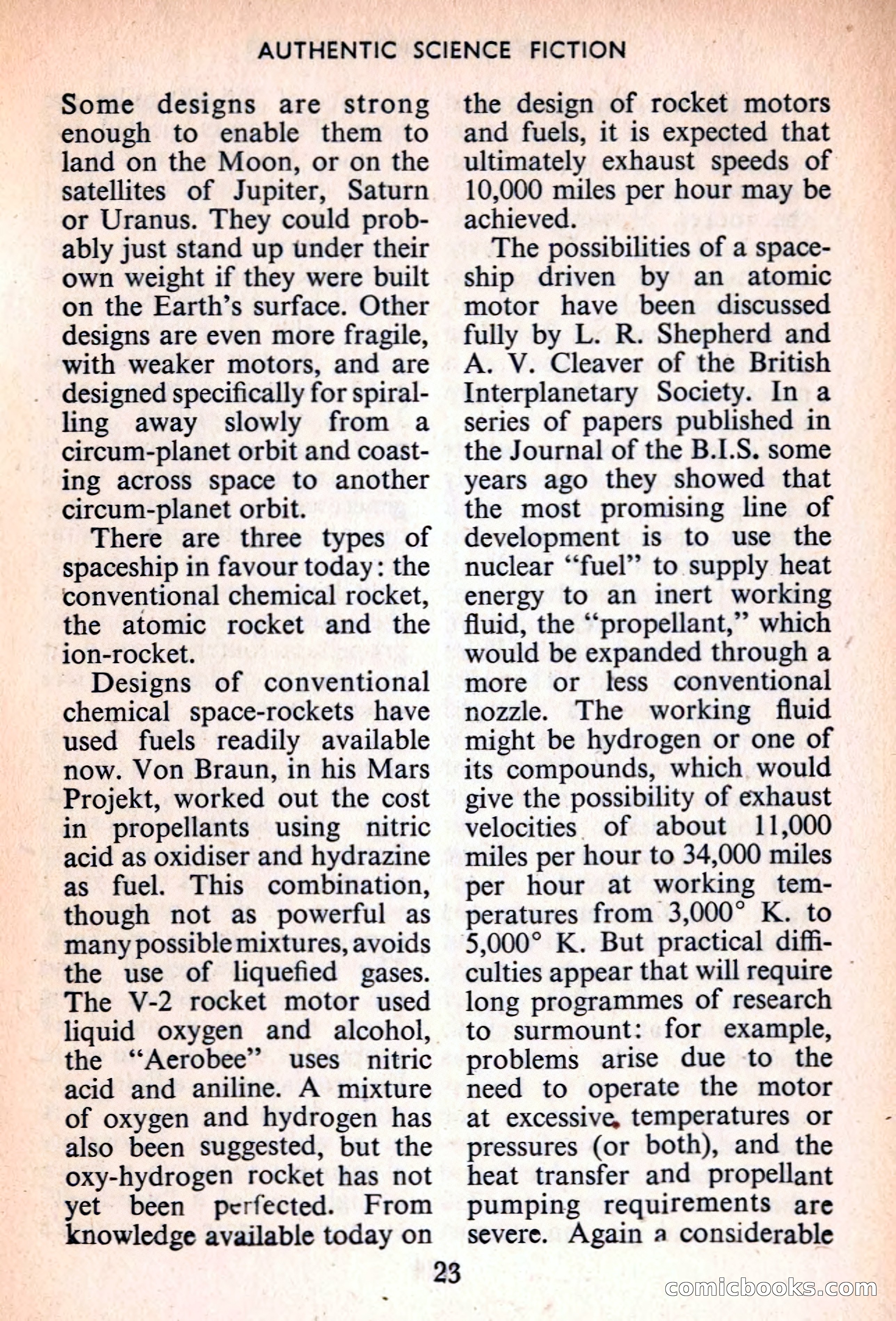
A restored page from Pulp Fiction, 1956. Page through the whole issue in the reader above.
📄 Transcribed text from this page (OCR, searchable)
Machine-transcribed from the original scan — historical spelling and the odd misread are preserved.
AUTHENTIC SCIENCE FICTION Some designs are strong enough to enable them to land on the Moon, or on the satellites of Jupiter, Saturn or Uranus. They could prob- ably just stand up under their own weight if they were built on the Earth’s surface. Other designs are even more fragile, with weaker motors, and are _ designed specifically for spiral- ling away slowly from a circum-planet orbit and coast- ing across space to another circum-planet orbit. There are three types of spaceship in favour today: the conventional chemical rocket, the atomic rocket and the ion-rocket. Designs of conventional chemical space-rockets have used fuels readily available now. Von Braun, in his Mars Projekt, worked out the cost in propellants using nitric acid as oxidiser and hydrazine as fuel. This combination, though not as powerful as many possible mixtures, avoids the use of liquefied gases. The V-2 rocket motor used liquid oxygen and alcohol, the ‘“‘Aerobee” uses nitric acid and aniline. A mixture of oxygen and hydrogen has also been suggested, but the oxy-hydrogen rocket has not yet been perfected. From knowledge available today on 23 the design of rocket motors and fuels, it is expected that ultimately exhaust speeds of 10,000 miles per hour may be achieved. The possibilities of a space- ship driven by an atomic motor have been discussed fully by L. R. Shepherd and A. V. Cleaver of the British Interplanetary Society. In a series of papers published in the Journal of the B.I.S. some years ago they showed that the most promising line of development is to use the nuclear “fuel”? to supply heat energy to an inert working fluid, the “propellant,” which would be expanded through a more or less conventional nozzle. The working fluid might be hydrogen or one of its compounds, which would give the possibility of exhaust velocities of about 11,000 miles per hour to 34,000 miles per hour at working tem- peratures from 3,000° K. to 5,000° K. But practical diffi- culties appear that will require ~ long programmes of research to surmount: for example, problems arise due to the need to operate the motor at excessive, temperatures or pressures (or both), and the heat transfer and propellant pumping requirements are severe. Again a considerable comiclooks.corn