
Pulp Fiction, 1956 · page 121 of 162
Authentic Science Fiction Monthly, No. 65 — page 121: what you’re looking at
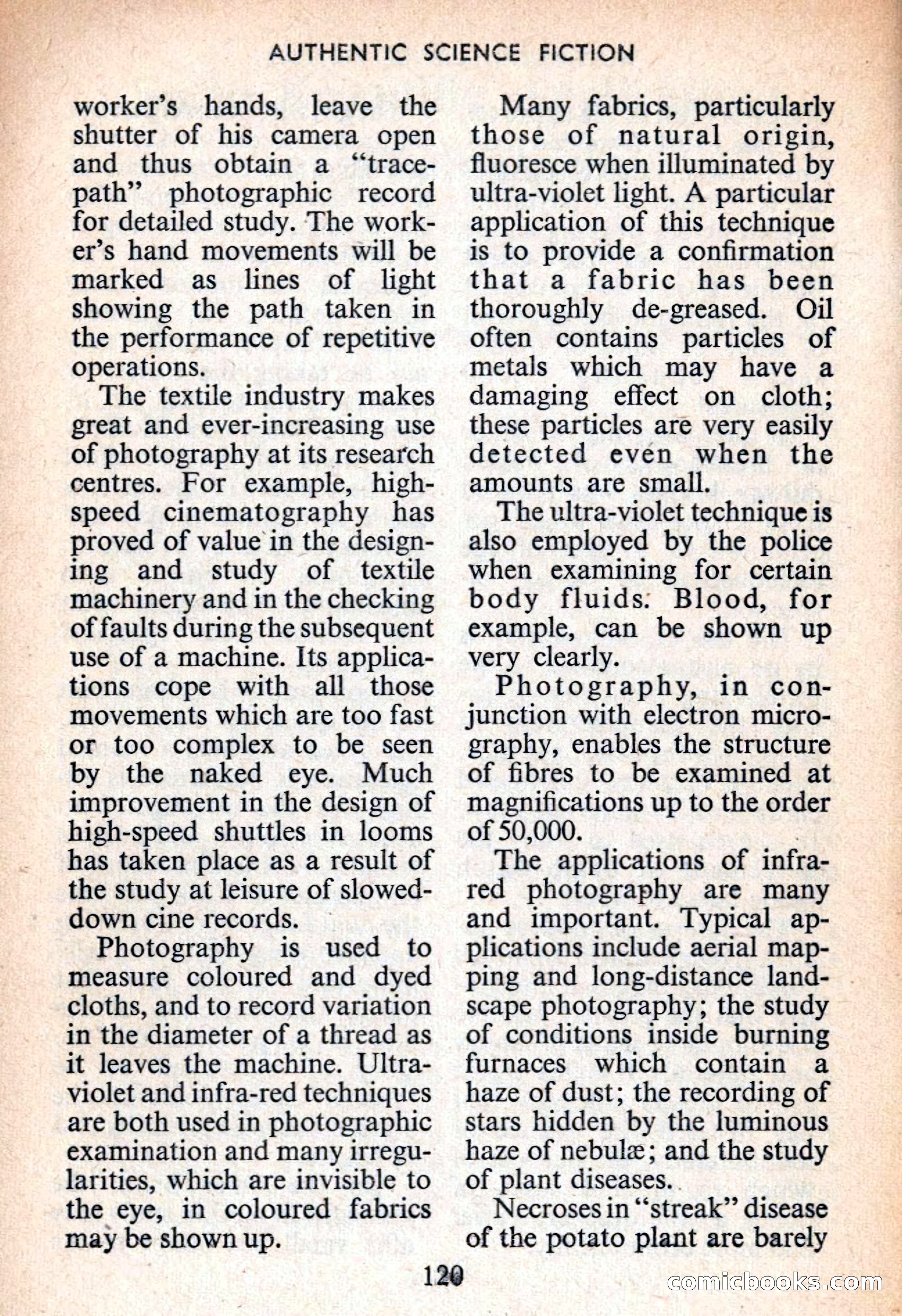
A restored page from Pulp Fiction, 1956. Page through the whole issue in the reader above.
📄 Transcribed text from this page (OCR, searchable)
Machine-transcribed from the original scan — historical spelling and the odd misread are preserved.
AUTHENTIC SCIENCE FICTION worker’s hands, leave the shutter of his camera open and thus obtain a “‘trace- path” photographic record for detailed study. The work- er’s hand movements will be marked as lines of light showing the path taken in the performance of repetitive operations. The textile industry makes great and ever-increasing use of photography at its research centres. For example, high- speed cinematography has proved of value in the design- ing and study of textile machinery and in the checking of faults during the subsequent use of a machine. Its applica- tions cope with all those movements which are too fast or too complex to be seen by the naked eye. Much improvement in the design of high-speed shuttles in looms has taken place as a result of the study at leisure of slowed- down cine records. Photography is used to measure coloured and dyed cloths, and to record variation in the diameter of a thread as it leaves the machine. Ultra- violet and infra-red techniques are both used in photographic examination and many irregu- larities, which are invisible to the eye, in coloured fabrics may be shown up. 12@ Many fabrics, particularly those of natural origin, fluoresce when illuminated by ultra-violet light. A particular application of this technique is to provide a confirmation that a fabric has been thoroughly de-greased. Oil often contains particles of metals which may have a damaging effect on cloth; these particles are very easily detected even when the amounts are small. The ultra-violet technique is also employed by the police when examining for certain body fluids: Blood, for example, can be shown up very clearly. Photography, in con- junction with electron micro- graphy, enables the structure of fibres to be examined at magnifications up to the order of 50,000. : The applications of infra- red photography are many and important. Typical ap- plications include aerial map- ping and long-distance land- | scape photography; the study of conditions inside burning furnaces which contain a haze of dust; the recording of stars hidden by the luminous haze of nebulz; and the study of plant diseases. . Necroses in “‘streak”’ disease of the potato plant are barely Je ‘Zi comicloooks.Ccomn) ~