
Pulp Fiction, 1955 · page 67 of 146
Authentic Science Fiction Monthly, No. 56 — page 67: what you’re looking at
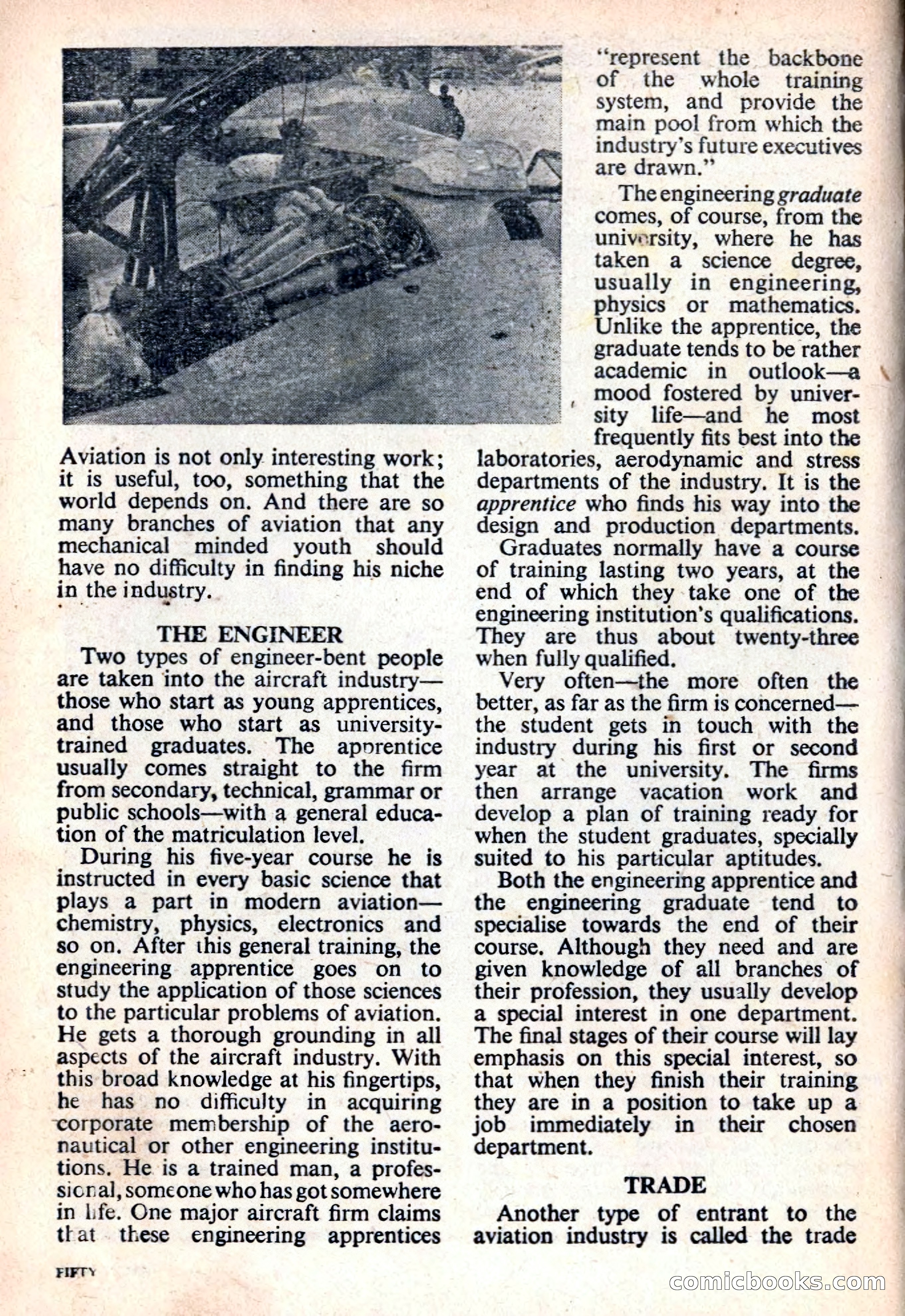
A restored page from Pulp Fiction, 1955. Page through the whole issue in the reader above.
📄 Transcribed text from this page (OCR, searchable)
Machine-transcribed from the original scan — historical spelling and the odd misread are preserved.
Aviation is not only. interesting work; it is useful, too, something that the world depends on. And there are so many branches of aviation that any mechanical minded youth should have no difficulty in finding his niche in the industry. THE ENGINEER Two types of engineer-bent people are taken into the aircraft industry— those who start as young apprentices, and those who start as university- trained graduates. The apoprentice usually comes straight to the firm from secondary, technical, grammar or public schools—with a general educa- tion of the matriculation level. During his five-year course he is instructed in every basic science that plays a part in modern aviation— chemistry, physics, electronics and so on. After this general training, the engineering apprentice goes on to study the application of those sciences to the particular problems of aviation. He gets a thorough grounding in all aspects of the aircraft industry. With this broad knowledge at his fingertips, he has no difficulty in acquiring ‘corporate membership of the aero- nautical or other engineering institu- tions. He is a trained man, a profes- sicnal, someone who has got somewhere in life. One major aircraft firm claims that these engineering apprentices FIFTY ‘represent the backbone of the whole training system, and provide the main pool from which the industry’s future executives are drawn.” The engineering graduate comes, of course, from the university, where he has taken a science degree, usually in engineering, physics or mathematics. Unlike the apprentice, the graduate tends to be rather academic in outlook—a mood fostered by univer- ~~ «sity life—and he most frequently fits best into the laboratories, aerodynamic and stress departments of the industry. It is the apprentice who finds his way into the design and production departments. Graduates normally have a course of training lasting two years, at the end of which they take one of the engineering institution's qualifications. They are thus about twenty-three when fully qualified. Very often—the more often the better, as far as the firm is concerned— the student gets in touch with the industry during his first or second year at the university. The firms then arrange vacation work and develop a plan of training ready for when the student graduates, specially suited to his particular aptitudes. Both the engineering apprentice and the engineering graduate tend to specialise towards the end of their course. Although they need and are given knowledge of all branches of their profession, they usually develop a special interest in one department. The final stages of their course will lay emphasis on this special interest, so that when they finish their training they are in a position to take up a job immediately in their chosen department. TRADE Another type of entrant to the aviation industry is called the trade comlicloooks.com CO ee —_ ee