
Pulp Fiction, 1955 · page 65 of 146
Authentic Science Fiction Monthly, No. 56 — page 65: what you’re looking at
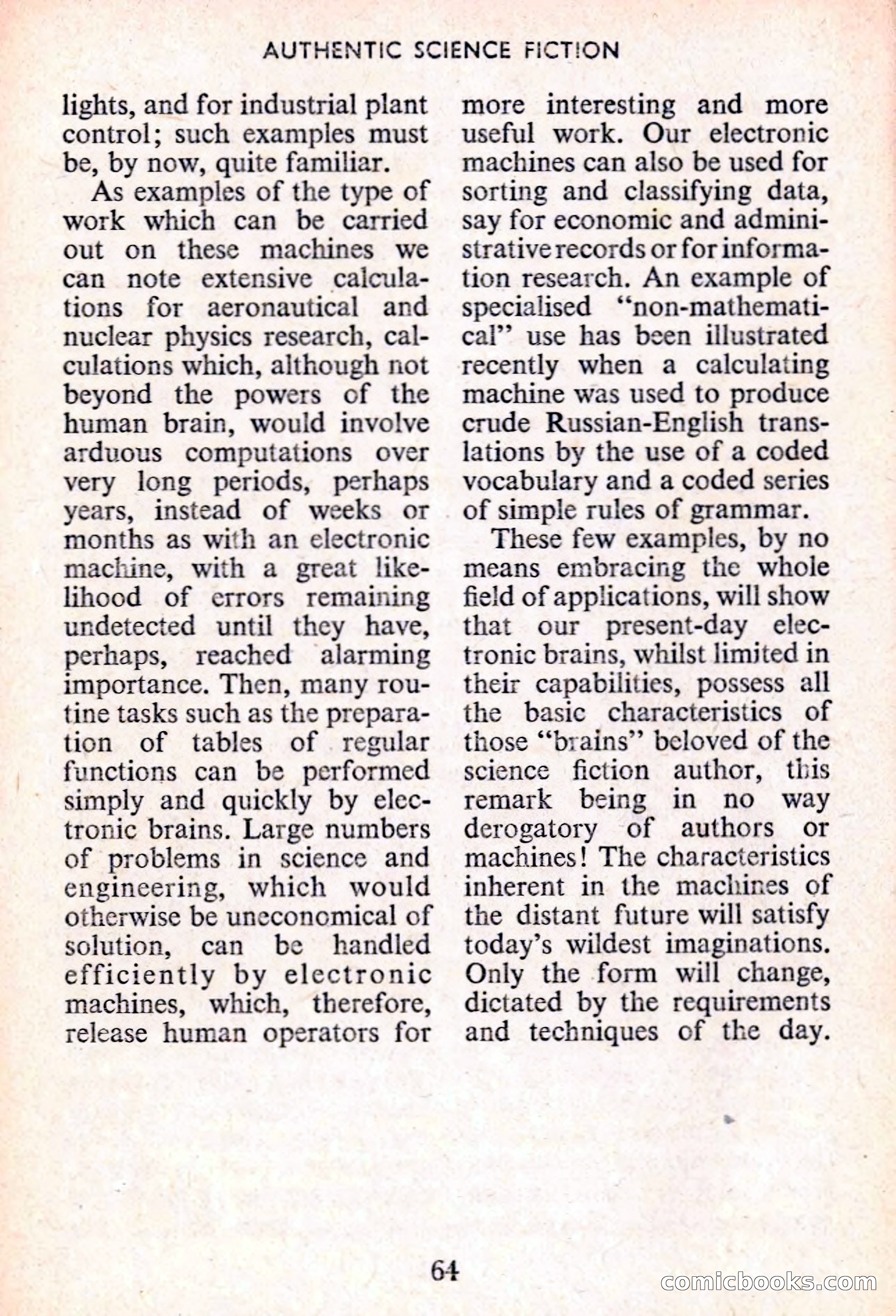
A restored page from Pulp Fiction, 1955. Page through the whole issue in the reader above.
📄 Transcribed text from this page (OCR, searchable)
Machine-transcribed from the original scan — historical spelling and the odd misread are preserved.
AUTHENTIC SCIENCE FICTION lights, and for industrial plant control; such examples must be, by now, quite familiar. As examples of the type of work which can be carried out on these machines we can note extensive caicula- tions for aeronautical and nuclear physics research, cal- culations which, although not beyond the powers of the human brain, would involve arduous computations over very long periods, perhaps years, instead of weeks or months as with an electronic machine, with a great like- lihood of errors remaining undetected until they have, perhaps, reached alarming importance. Then, many rou- tine tasks such as the prepara- tion of tables of regular functions can be performed simply and quickly by elec- tronic brains. Large numbers of problems in science and engineering, which would otherwise be uneconomical of solution, can be handled efficiently by electronic machines, which, therefore, release human operators for 64 more interesting and more useful work. Our electronic machines can also be used for sorting and classifying data, say for economic and admini- strative records or for informa- tion research. An example of specialised ‘“‘non-mathemati- cal’’ use has been illustrated recently when a calculating machine was used to produce crude Russian-English trans- lations by the use of a coded vocabulary and a coded series of simple rules of grammar. These few examples, by no means embracing the whole eld of applications, will show that our present-day elec- tronic brains, whilst limited in their capabilities, possess all the basic characteristics of those “‘brains’’ beloved of the science fiction author, this remark being in no way derogatory of authors or machines! The characteristics inherent in the machines of the distant future will satisfy today’s wildest imaginations. Only the form will change, dictated by the requirements and techniques of the day. comicloooks.conm