
Pulp Fiction, 1955 · page 62 of 146
Authentic Science Fiction Monthly, No. 56 — page 62: what you’re looking at
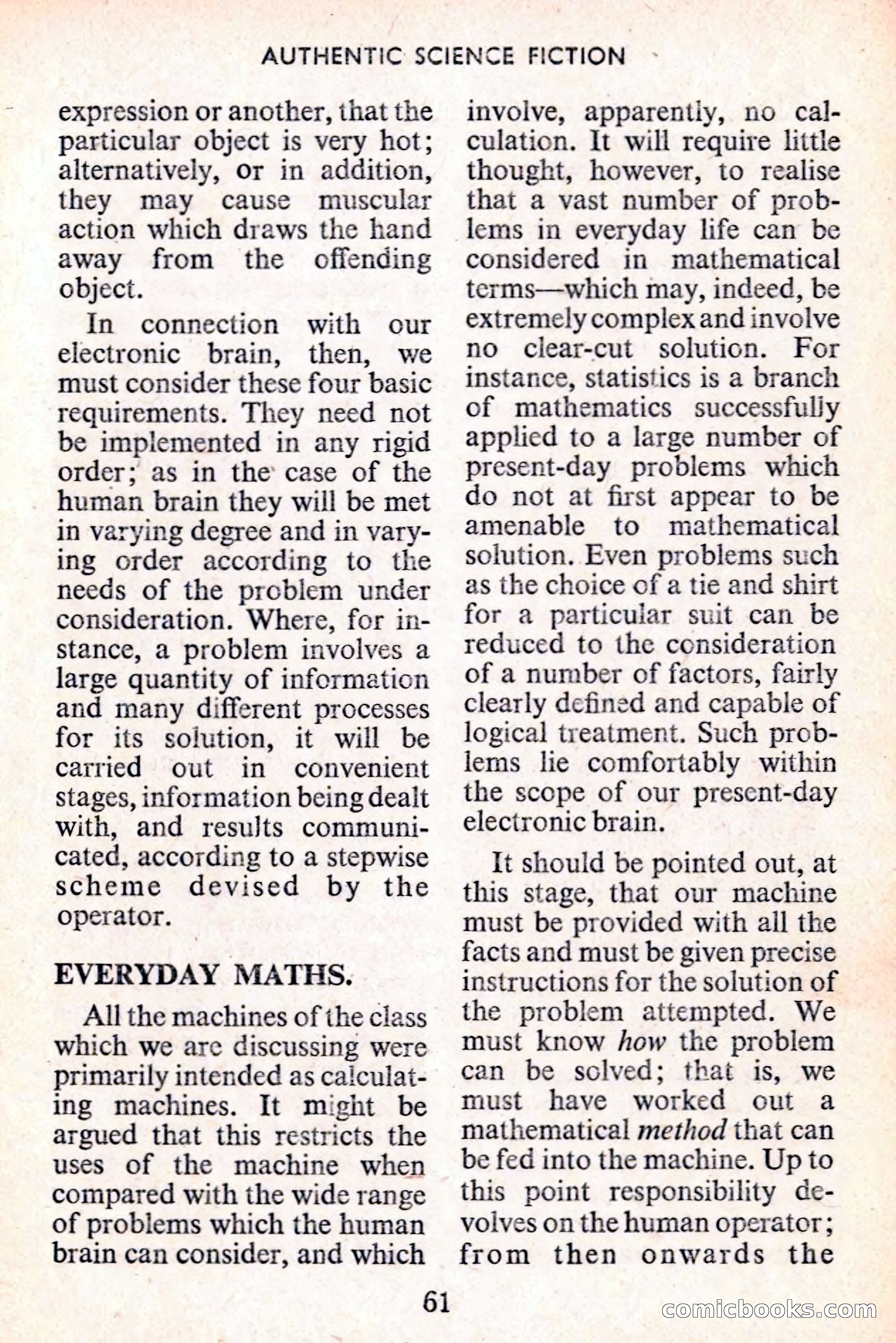
A restored page from Pulp Fiction, 1955. Page through the whole issue in the reader above.
📄 Transcribed text from this page (OCR, searchable)
Machine-transcribed from the original scan — historical spelling and the odd misread are preserved.
AUTHENTIC SCIENCE FICTION expression or another, that the particular object is very hot; alternatively, or in addition, they may cause muscular action which draws the hand away from the offending object. In connection with our electronic brain, then, we must consider these four basic requirements. They need not be implemented in any rigid order; as in the case of the human brain they will be met in varying degree and in vary- ing order according to the needs of the problem under consideration. Where, for in- stance, a problem involves a large quantity of information and many different processes for its solution, it will be carried out in convenient stages, information being dealt with, and results communi- cated, according to a stepwise scheme devised by the operator. EVERYDAY MATHS. All the machines of the class which we are discussing were primarily intended as caiculat- ing machines. It might be argued that this restricts the uses of the machine when compared with the wide range of problems which the human brain can consider, and which 61 involve, apparentiy, no cal- culation. It will require little thought, however, to realise that a vast number of prob- lems in everyday life can be considered in mathematical terms—which may, indeed, be extremely complex and involve no clear-cut solution. For instance, statistics is a branch of mathematics successfully applied to a large number of present-day problems which do not at first appear to be amenable to mathematical solution. Even problems such as the choice of a tie and shirt for a particuiar suit can be reduced to the consideration of a number of factors, fairly clearly defined and capable of logical treatment. Such prob- lems lie comfortably within the scope of our present-day electronic brain. It should be pointed out, at this stage, that our machine must be provided with ail the facts and must be given precise instructions for the solution of the problem attempted. We must know how the problem can be solved; that is, we must have worked out a mathematical method that can be fed into the machine. Up to this point responsibility de- volves on the human operator; from then onwards the comicloooks.com