
Pulp Fiction, 1955 · page 61 of 146
Authentic Science Fiction Monthly, No. 56 — page 61: what you’re looking at
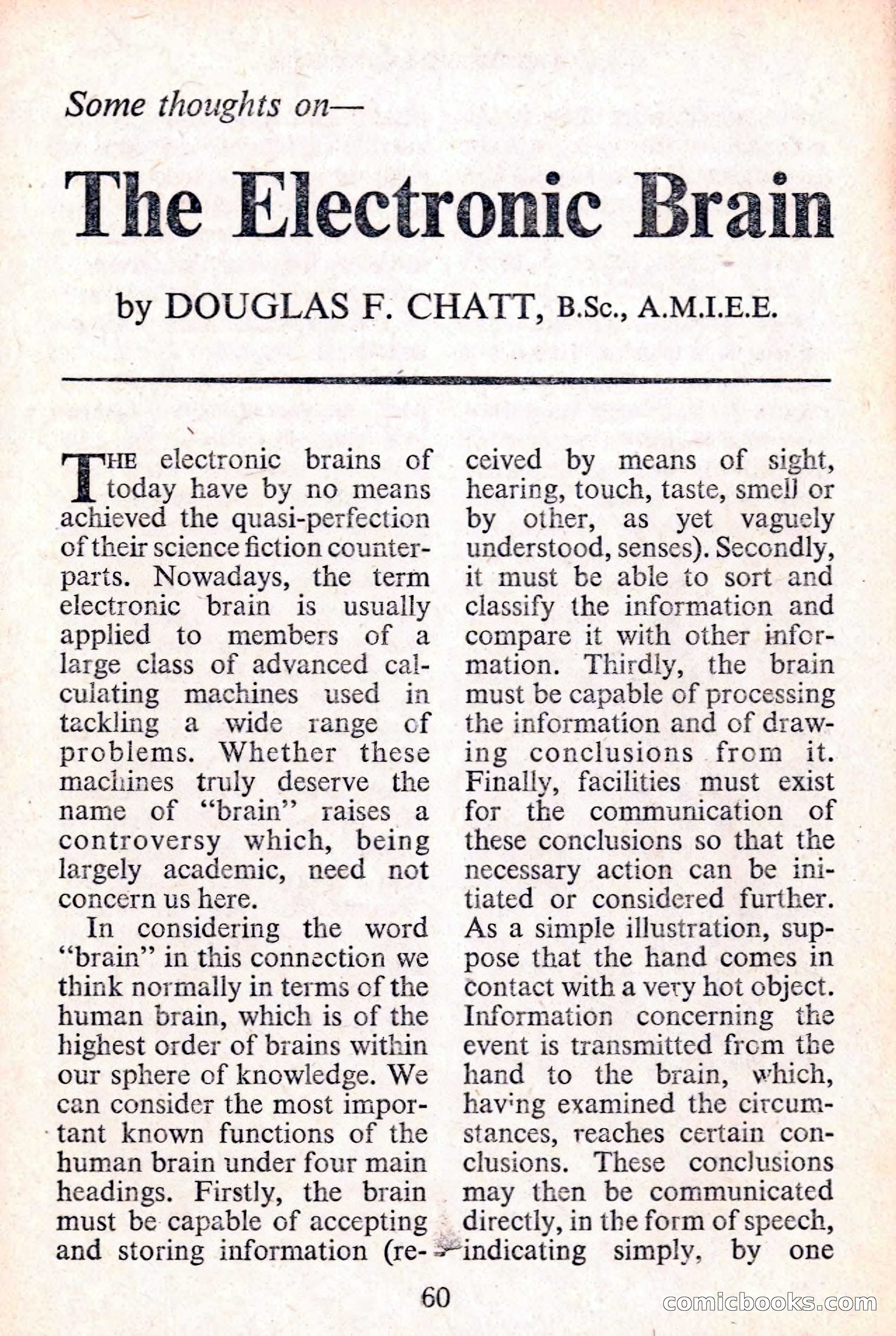
A restored page from Pulp Fiction, 1955. Page through the whole issue in the reader above.
📄 Transcribed text from this page (OCR, searchable)
Machine-transcribed from the original scan — historical spelling and the odd misread are preserved.
Some thoughts on— The Electronic Brain by DOUGLAS F. CHATT, B.Sc., A.M.LE.E. \ HE electronic brains of today have by no means achieved the quasi-perfection of their science fiction counter- parts. Nowadays, the term electronic brain is usually applied to members of a large class of advanced cal- cuiating machines used in tackling a wide range of probiems. Whether these machines truly deserve the name of “brain” raises a controversy which, being largely academic, need not concern us here. In considering the word “brain” in this connection we think normally in terms of the human brain, which is of the highest order of brains within our sphere of knowledge. We can consider the most impor- ‘tant known functions of the human brain under four main headings. Firstly, the brain must be capable of accepting - and storing information (re-=> indicating simply, 60 ceived by means of sight, hearing, touch, taste, smelJ or by other, as yet vaguely understood, senses). Secondly, it must be able to sort and classify the information and compare it with other infcr- mation. Thirdly, the brain must be capable of processing the information and of draw- ing conclusions from it. Finally, facilities must exist for the communication of these conclusions so that the necessary action can be ini- tiated or considered further. As a simple illustration, sup- pose that the hand comes in contact with a very hot object. Information concerning the event is transmitted from the hand to the brain, which, having examined the citcum- stances, reaches certain con- clusions. These conclusions _may then be communicated directly, in the form of speech, by one comiclooks.cormn