
Pulp Fiction, 1955 · page 57 of 146
Authentic Science Fiction Monthly, No. 56 — page 57: what you’re looking at
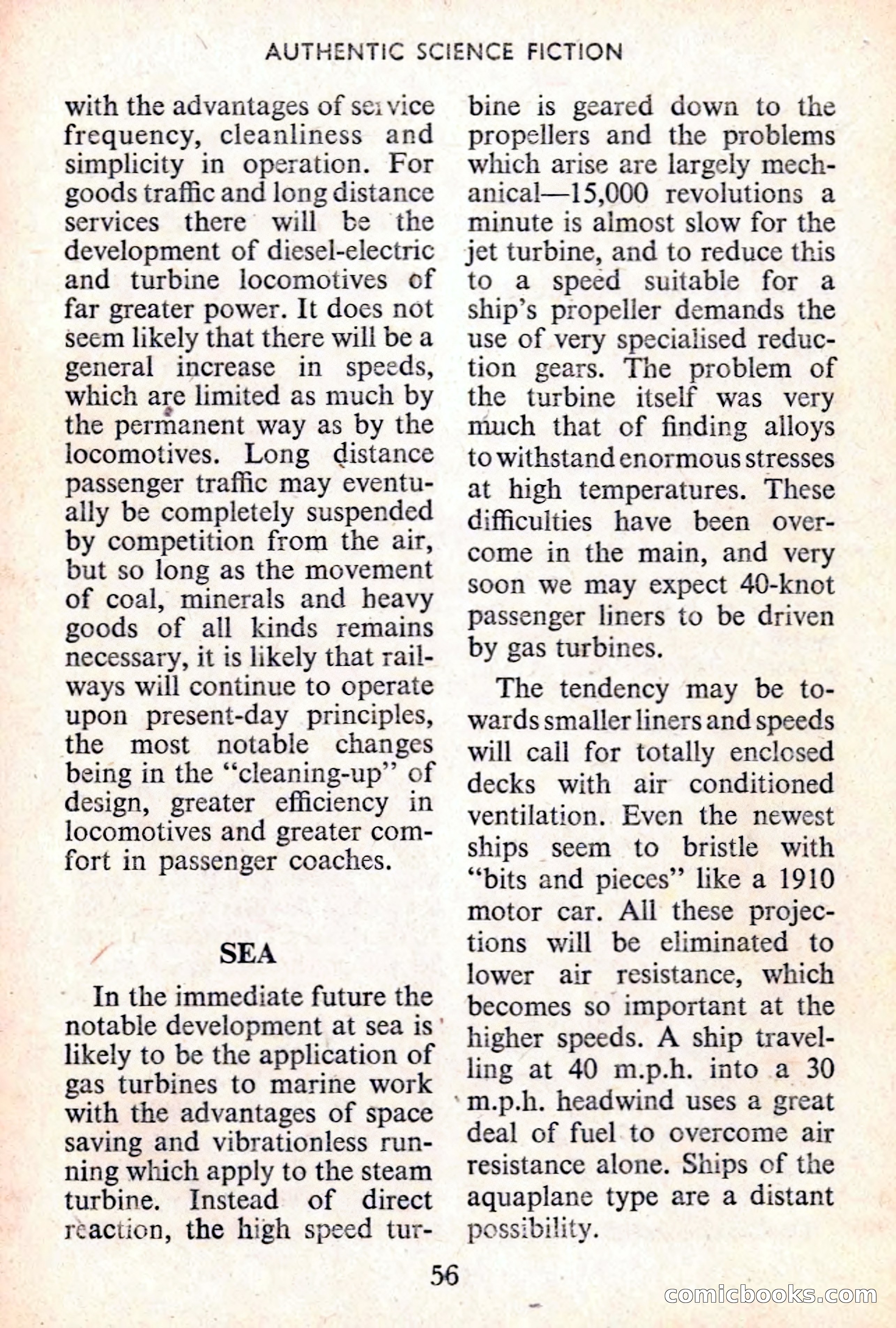
A restored page from Pulp Fiction, 1955. Page through the whole issue in the reader above.
📄 Transcribed text from this page (OCR, searchable)
Machine-transcribed from the original scan — historical spelling and the odd misread are preserved.
AUTHENTIC SCIENCE FICTION with the advantages of sei vice frequency, cleanliness and simplicity in operation. For goods traffic and long distance services there will be the development of diesel-electric and turbine locomotives of far greater power. It does not seem likely that there will be a general increase in speeds, which are limited as much by the permanent way as by the locomotives. Long distance passenger traffic may eventu- ally be completely suspended by competition from the air, but so long as the movement of coal, minerals and heavy goods of all kinds remains necessary, it is likely that rail- ways will continue to operate upon present-day principles, the most notable changes being in the “‘cleaning-up”’ of design, greater efficiency in locomotives and greater com- fort in passenger coaches. SEA In the immediate future the notable development at sea is’ likely to be the application of gas turbines to marine work with the advantages of space saving and vibrationless run- ning which apply to the steam turbine. Instead of direct reaction, the high speed tur- 56 bine is geared down to the propellers and the problems which arise are largely mech- anical—15,000 revolutions a minute is almost slow for the jet turbine, and to reduce this to a speed suitable for a ship’s propeller demands the use of very specialised reduc- tion gears. The problem of the turbine itself was very much that of finding alloys to withstand enormous stresses at high temperatures. These difficulties have been over- come in the main, and very soon we may expect 40-knot passenger liners to be driven by gas turbines. The tendency may be to- wards smaller liners and speeds will call for totally enclosed decks with air conditioned ventilation. Even the newest ships seem to bristle with ‘bits and pieces” like a 1910 motor car. All these projec- tions will be eliminated to lower air resistance, which becomes so important at the higher speeds. A ship travel- ling at 40 m.p.h. into a 30 ‘m.p.h. headwind uses a great deal of fuel to overcome air resistance alone. Ships of the aquaplane type are a distant possibility. comiclooks.cormn