
Pulp Fiction, 1955 · page 56 of 146
Authentic Science Fiction Monthly, No. 56 — page 56: what you’re looking at
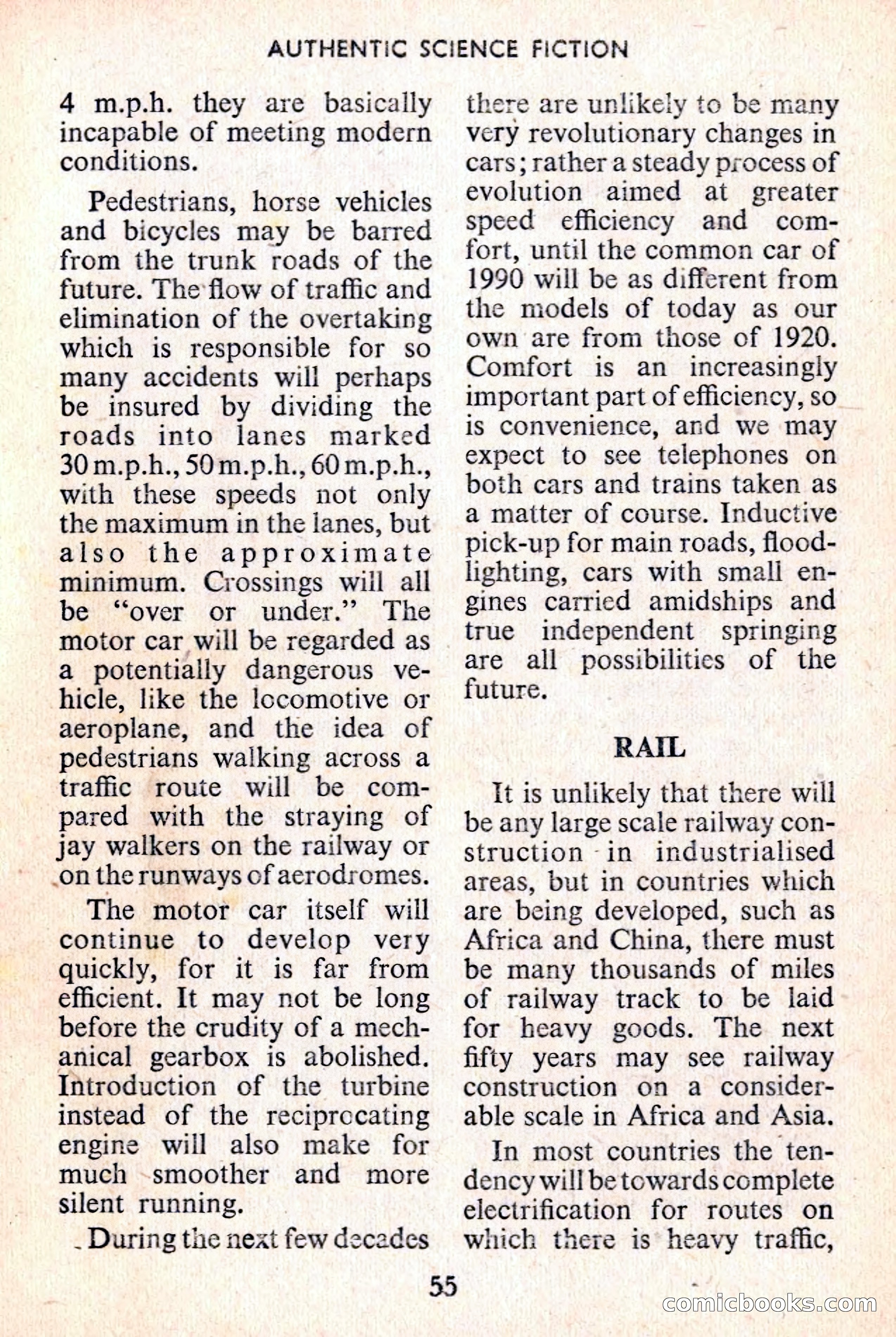
A restored page from Pulp Fiction, 1955. Page through the whole issue in the reader above.
📄 Transcribed text from this page (OCR, searchable)
Machine-transcribed from the original scan — historical spelling and the odd misread are preserved.
AUTHENTIC SCIENCE FICTION 4 m.p.h. they are basically incapable of meeting modern conditions. Pedestrians, horse vehicles and bicycles may be barred from the trunk roads of the future. The flow of traffic and elimination of the overtaking which is responsible for so many accidents will perhaps be insured by dividing the roads into lanes marked 30 m.p.h., 50m.p.h., 60 m.p.h., With these speeds not only the maximum in the janes, but also the approximate minimum. Crossings wiil all be “over or under.” The motor car will be regarded as a potentially dangerous ve- hicle, like the locomotive or aeroplane, and the idea of pedestrians walking across a traffic route will be com- pared with the straying of jay walkers on the railway or on the runways of aerodromes. The motor car itself will continue to develop very quickly, for it is far from efficient. It may not be long before the crudity of a mech- anical gearbox is abolished. Introduction of the turbine instead of the reciprocating engine will also make for much -smoother and more silent running. . During the next few decades 55 there are unlikely to be many very revolutionary changes in cars; rather a steady process of evolution aimed at greater speed efficiency and com- fort, until the common car of 1990 will be as different from the models of today as our own are from those of 1920. Comfort is an increasingly important part of efficiency, so is convenience, and we may expect to see telephones on both cars and trains taken as a matter of course. Inductive pick-up for main roads, flood- lighting, cars with small en- gines carried amidships and true independent springing are all possibilities of the future. RAIL It is unlikely that there will be any large scale railway con- struction in industrialised areas, but in countries which are being developed, such as Africa and China, there must be many thousands of miles of railway track to be laid for heavy goods. The next fifty years may see railway construction on a consider- able scale in Africa and Asia. In most countries the ten- dency will be towards complete electrification for routes on which there is heavy traffic, comiclbooks.corn