
Pulp Fiction, 1955 · page 69 of 146
Authentic Science Fiction Monthly No. 54 — page 69: what you’re looking at
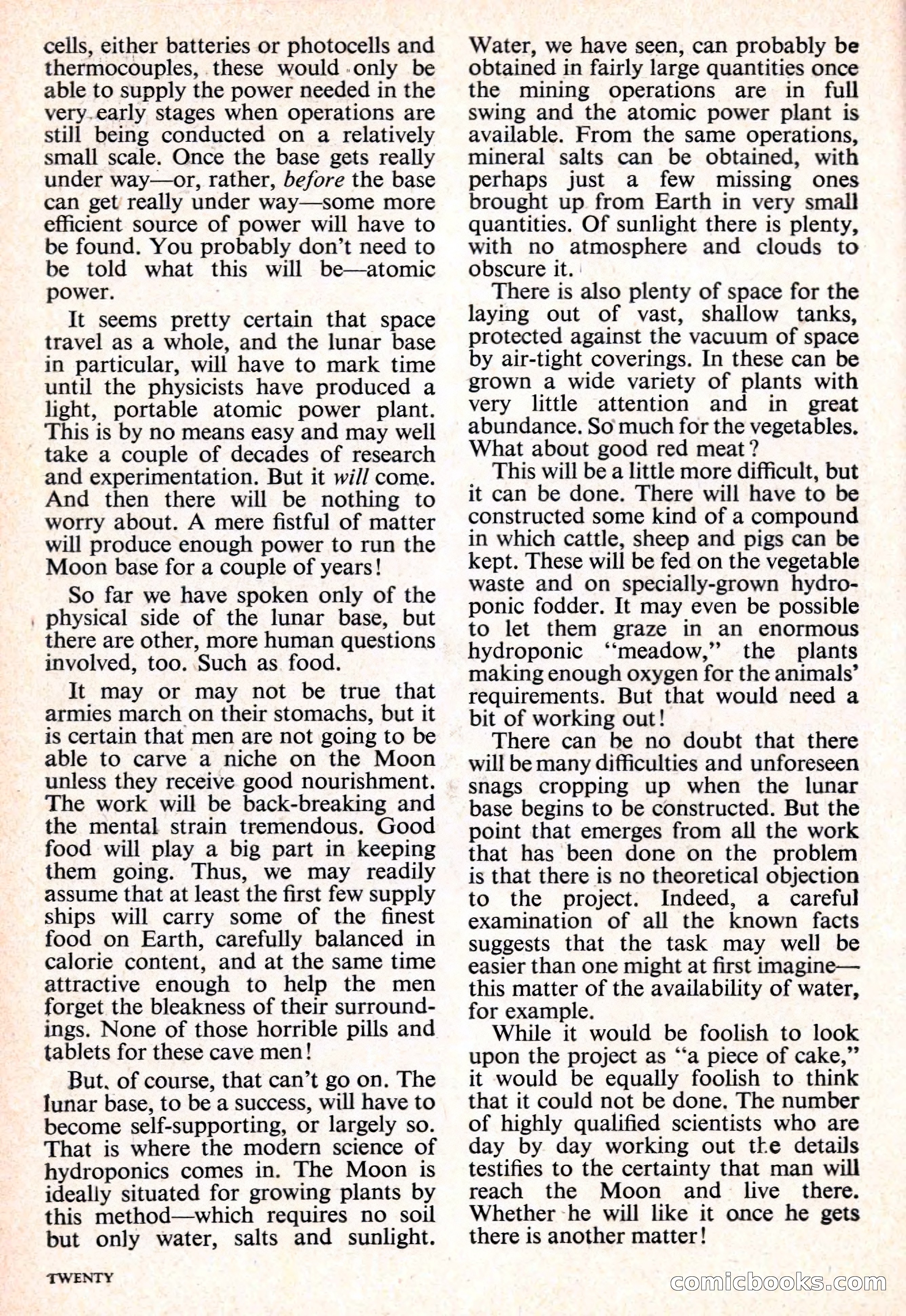
A restored page from Pulp Fiction, 1955. Page through the whole issue in the reader above.
📄 Transcribed text from this page (OCR, searchable)
Machine-transcribed from the original scan — historical spelling and the odd misread are preserved.
cells, either batteries or photocells and thermocouples, these would only be able to supply the power needed in the very.early stages when operations are still being conducted on a relatively small scale. Once the base gets really under way—or, rather, before the base can get really under way—some more efficient source of power will have to be found. You probably don’t need to be told what this will be—atomic power. It seems pretty certain that space travel as a whole, and the lunar base in particular, will have to mark time until the physicists have produced a light, portable atomic power plant. This is by no means easy and may well take a couple of decades of research and experimentation. But it wi// come. And then there will be nothing to worry about. A mere fistful of matter will produce enough power to run the Moon base for a couple of years! So far we have spoken only of the _ physical side of the lunar base, but there are other, more human questions involved, too. Such as food. It may or may not be true that armies march on their stomachs, but it is certain that men are not going to be able to carve a niche on the Moon unless they receive good nourishment. The work will be back-breaking and the mental strain tremendous. Good food will play a big part in keeping them going. Thus, we may readily assume that at least the first few supply ships will carry some of the finest food on Earth, carefully balanced in calorie content, and at the same time attractive enough to help the men forget the bleakness of their surround- ings. None of those horrible pills and tablets for these cave men! But. of course, that can’t go on. The lunar base, to be a success, will have to become self-supporting, or largely so. That is where the modern science of hydroponics comes in. The Moon is ideally situated for growing plants by this method—which requires no soil but only water, salts and sunlight. TWENTY Water, we have seen, can probably be obtained in fairly large quantities once the mining operations are in full swing and the atomic power plant is available. From the same operations, mineral salts can be obtained, with perhaps just a few missing ones brought up from Earth in very small quantities. Of sunlight there is plenty, with no atmosphere and clouds to obscure it. There is also plenty of space for the laying out of vast, shallow tanks, protected against the vacuum of space by air-tight coverings. In these can be grown a wide variety of plants with very little attention and in great abundance. So much for the vegetables. What about good red meat? This will be a little more difficult, but it can be done. There will have to be constructed some kind of a compound in which cattle, sheep and pigs can be kept. These will be fed on the vegetable waste and on specially-grown hydro- ponic fodder. It may even be possible to let them graze in an enormous hydroponic ‘‘meadow,” the plants making enough oxygen for the animals’ requirements. But that would need a bit of working out! There can be no doubt that there will be many difficulties and unforeseen snags cropping up when the lunar base begins to be constructed. But the point that emerges from all the work that has been done on the problem is that there is no theoretical objection to the project. Indeed, a careful examination of all the known facts suggests that the task may well be easier than one might at first imagine— this matter of the availability of water, for example. While it would be foolish to look upon the project as “‘a piece of cake,” it would be equally foolish to think that it could not be done. The number of highly qualified scientists who are day by day working out tke details testifies to the certainty that man will reach the Moon and live there. Whether -he will like it once he gets there is another matter! comiclbooks.con