
Pulp Fiction, 1955 · page 68 of 146
Authentic Science Fiction Monthly No. 54 — page 68: what you’re looking at
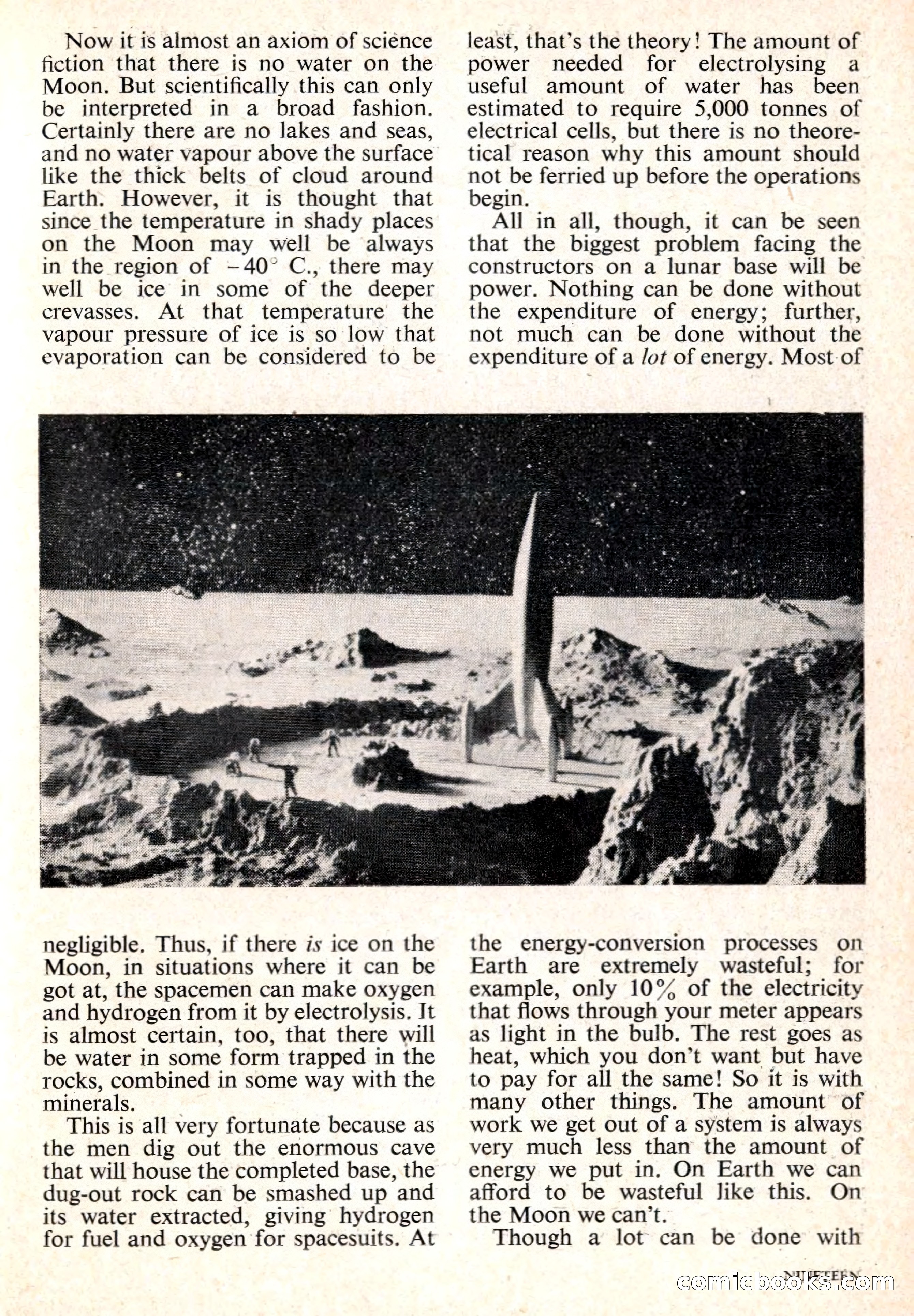
A restored page from Pulp Fiction, 1955. Page through the whole issue in the reader above.
📄 Transcribed text from this page (OCR, searchable)
Machine-transcribed from the original scan — historical spelling and the odd misread are preserved.
Now it is almost an axiom of science fiction that there is no water on the Moon. But scientifically this can only be interpreted in a broad fashion. Certainly there are no lakes and seas, and no water vapour above the surface like the thick belts of cloud around Earth. However, it is thought that since the temperature in shady places on the Moon may well be always in the region of —40° C., there may well be ice in some of the deeper crevasses. At that temperature the vapour pressure of ice is so low that evaporation can be considered to be negligible. Thus, if there is ice on the Moon, in situations where it can be got at, the spacemen can make oxygen and hydrogen from it by electrolysis. It is almost certain, too, that there will be water in some form trapped in the rocks, combined in some way with the minerals. This is all very fortunate because as the men dig out the enormous cave that will house the completed base, the dug-out rock can be smashed up and its water extracted, giving hydrogen for fuel and oxygen for spacesuits. At least, that’s the theory! The amount of power needed for electrolysing a useful amount of water has _ been estimated to require 5,000 tonnes of electrical cells, but there is no theore- tical reason why this amount should not be ferried up before the operations begin. All in all, though, it can be seen that the biggest problem facing the constructors on a lunar base will be power. Nothing can be done without the expenditure of energy; further, not much can be done without the expenditure of a /ot of energy. Most of the energy-conversion processes on Earth are extremely wasteful; for example, only 10° of the electricity that flows through your meter appears as light in the bulb. The rest goes as heat, which you don’t want but have to pay for all the same! So it is with many other things. The amount of work we get out of a system is always very much less than the amount of energy we put in. On Earth we can afford to be wasteful Jike this. On the Moon we can’t. Though a Jot can be done with comicloaordRStteonn