
Pulp Fiction, 1955 · page 108 of 146
Authentic Science Fiction Monthly No. 54 — page 108: what you’re looking at
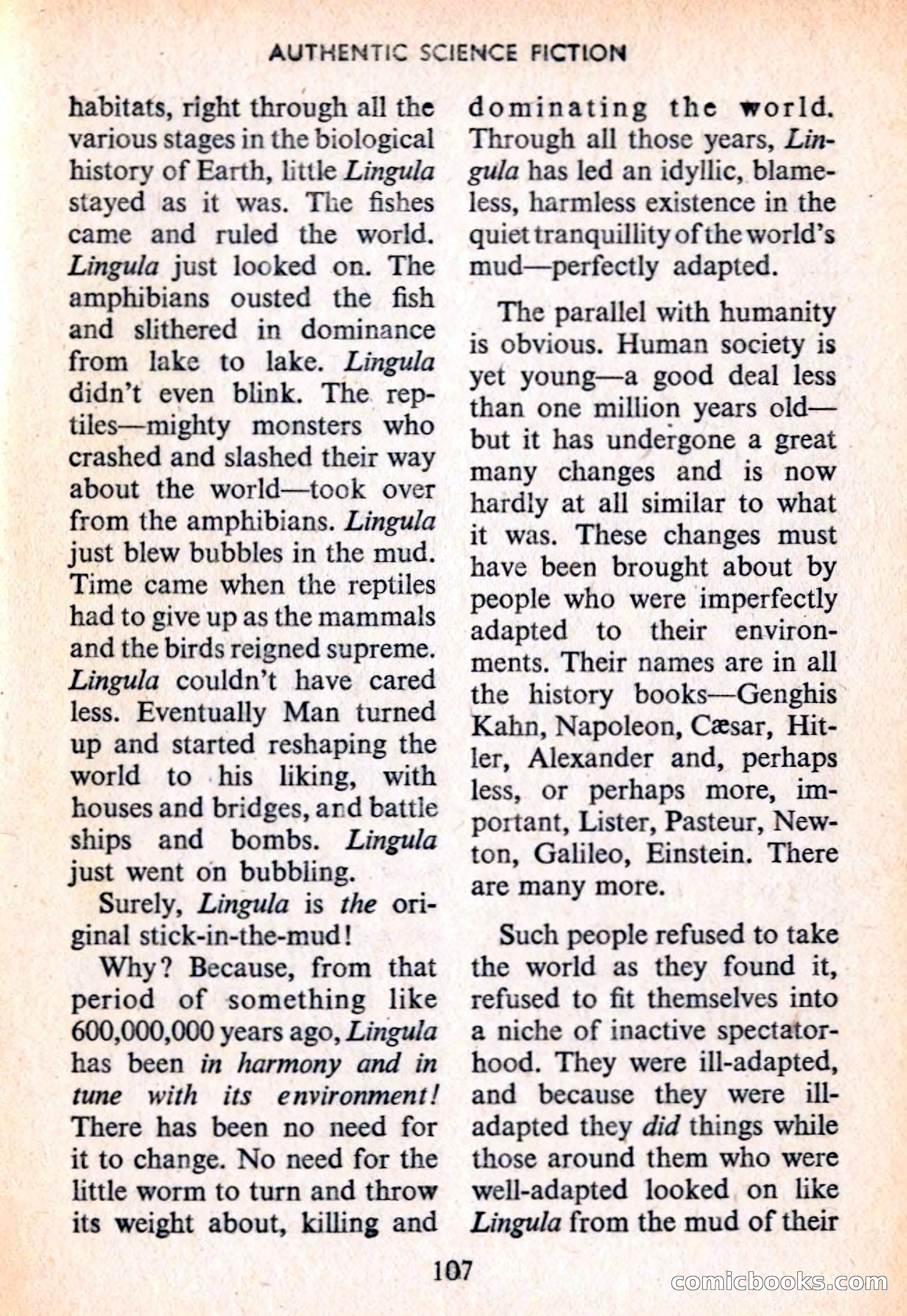
A restored page from Pulp Fiction, 1955. Page through the whole issue in the reader above.
📄 Transcribed text from this page (OCR, searchable)
Machine-transcribed from the original scan — historical spelling and the odd misread are preserved.
AUTHENTIC SCIENCE FICTION habitats, right through all the various stages in the biological history of Earth, little Lingula stayed as it was. The fishes came and ruled the world. Lingula just looked on. The amphibians ousted the fish and slithered in dominance from lake to lake. Lingula didn’t even blink. The rep- tiles—mighty monsters who crashed and slashed their way about the world—took over from the amphibians. Lingula just blew bubbles in the mud. Time came when the reptiles had to give up as the mammals and the birds reigned supreme. Lingula couldn’t have cared less. Eventually Man turned up and started reshaping the world to his liking, with houses and bridges, and battle ships and bombs. Lingula just went on bubbling. Surely, Lingula is the ori- ginal stick-in-the-mud! Why? Because, from that period of something like 600,000,000 years ago, Lingula has been in harmony and in tune with its environment! There has been no need for it to change. No need for the little worm to turn and throw its weight about, killing and 107 dominating the world. Through all those years, Lin- gula has led an idyllic, blame- less, harmless existence in the quiet tranquillity of the world’s mud—perfectly adapted. The parallel with humanity is obvious. Human society is yet young—a good deal less than one million years old— but it has undergone a great many changes and is now hardly at all similar to what it was. These changes must have been brought about by people who were imperfectly adapted to their environ- ments. Their names are in all the history books—Genghis Kahn, Napoleon, Cesar, Hit- ler, Alexander and, perhaps less, or perhaps more, im- portant, Lister, Pasteur, New- ton, Galileo, Einstein. There are many more. Such people refused to take the world as they found it, refused to fit themselves into a niche of inactive spectator- hood. They were ill-adapted, and because they were ill- adapted they did things while those around them who were well-adapted looked on like Lingula from the mud of their comicloooks.con