
Pulp Fiction, 1955 · page 107 of 146
Authentic Science Fiction Monthly No. 54 — page 107: what you’re looking at
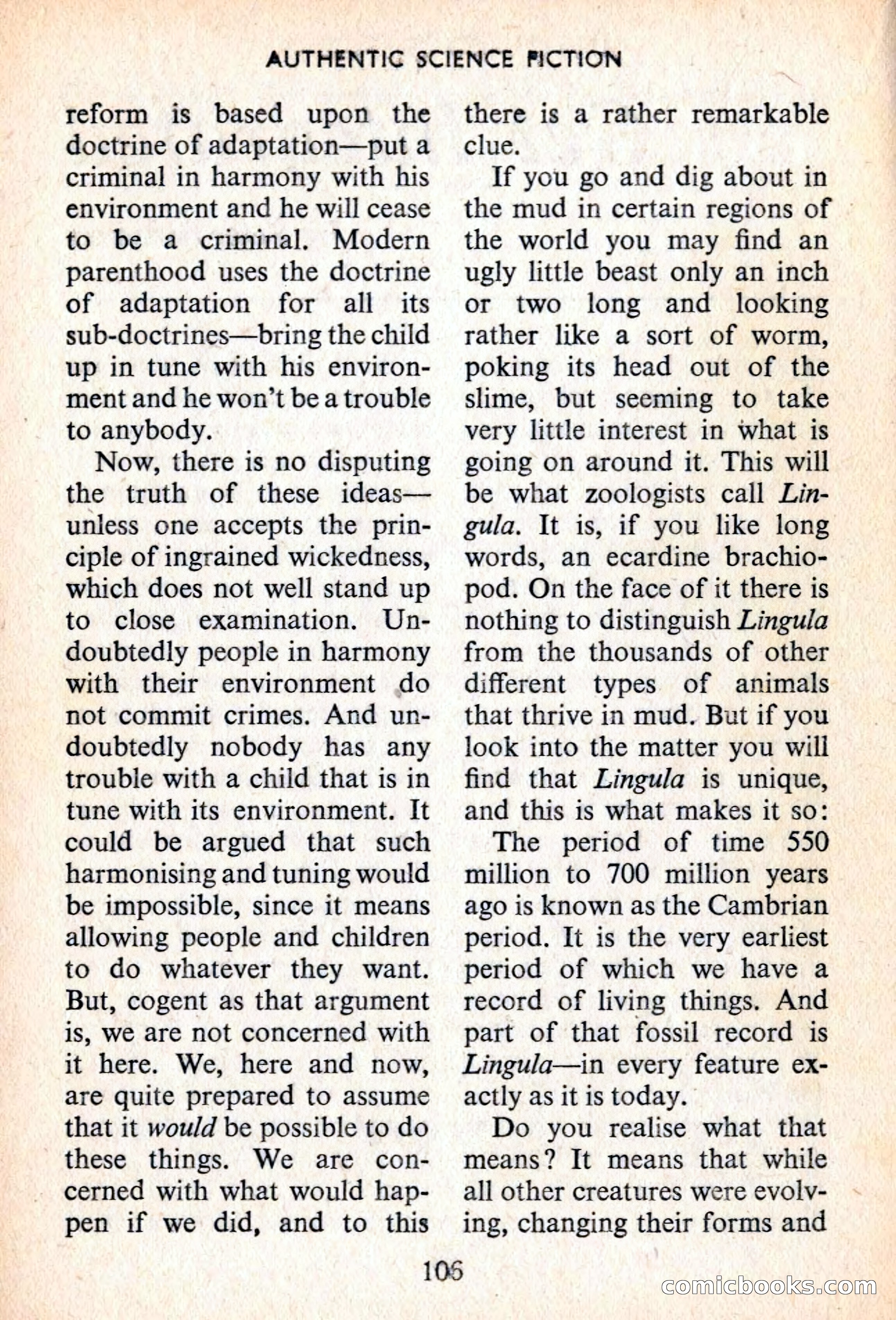
A restored page from Pulp Fiction, 1955. Page through the whole issue in the reader above.
📄 Transcribed text from this page (OCR, searchable)
Machine-transcribed from the original scan — historical spelling and the odd misread are preserved.
AUTHENTIC SCIENCE FICTION reform is based upon the doctrine of adaptation—put a criminal in harmony with his environment and he will cease to be a criminal. Modern parenthood uses the doctrine of adaptation for all its sub-doctrines—bring the child up in tune with his environ- ment and he won’t bea trouble to anybody. Now, there is no disputing the truth of these ideas— unless one accepts the prin- ciple of ingrained wickedness, which does not well stand up to close examination. Un- doubtedly people in harmony with their environment do not commit crimes. And un- doubtedly nobody has any trouble with a child that is in tune with its environment. It could be argued that such harmonising and tuning would be impossible, since it means allowing people and children to do whatever they want. But, cogent as that argument is, we are not concerned with it here. We, here and now, are quite prepared to assume that it would be possible to do these things. We are con- cerned with what would hap- pen if we did, and to this 105 there is a rather remarkable clue. If you go and dig about in the mud in certain regions of the world you may find an ugly little beast only an inch or two long and looking rather like a sort of worm, poking its head out of the slime, but seeming to take very little interest in what is going on around it. This will be what zoologists call Lin- gula. It is, if you like long words, an ecardine brachio- pod. On the face of it there is nothing to distinguish Lingula from the thousands of other different types of animals that thrive in mud. But if you look into the matter you will find that Lingula is unique, and this is what makes it so: The period of time 550 million to 700 million years ago is known as the Cambrian period. It is the very earliest period of which we have a record of living things. And part of that fossil record is Lingula—in every feature ex- actly as it is today. Do you realise what that means? It means that while all other creatures were evolv- ing, changing their forms and conmmicloooks.com