
Pulp Fiction, 1955 · page 19 of 146
Authentic Science Fiction Monthly No. 53 — page 19: what you’re looking at
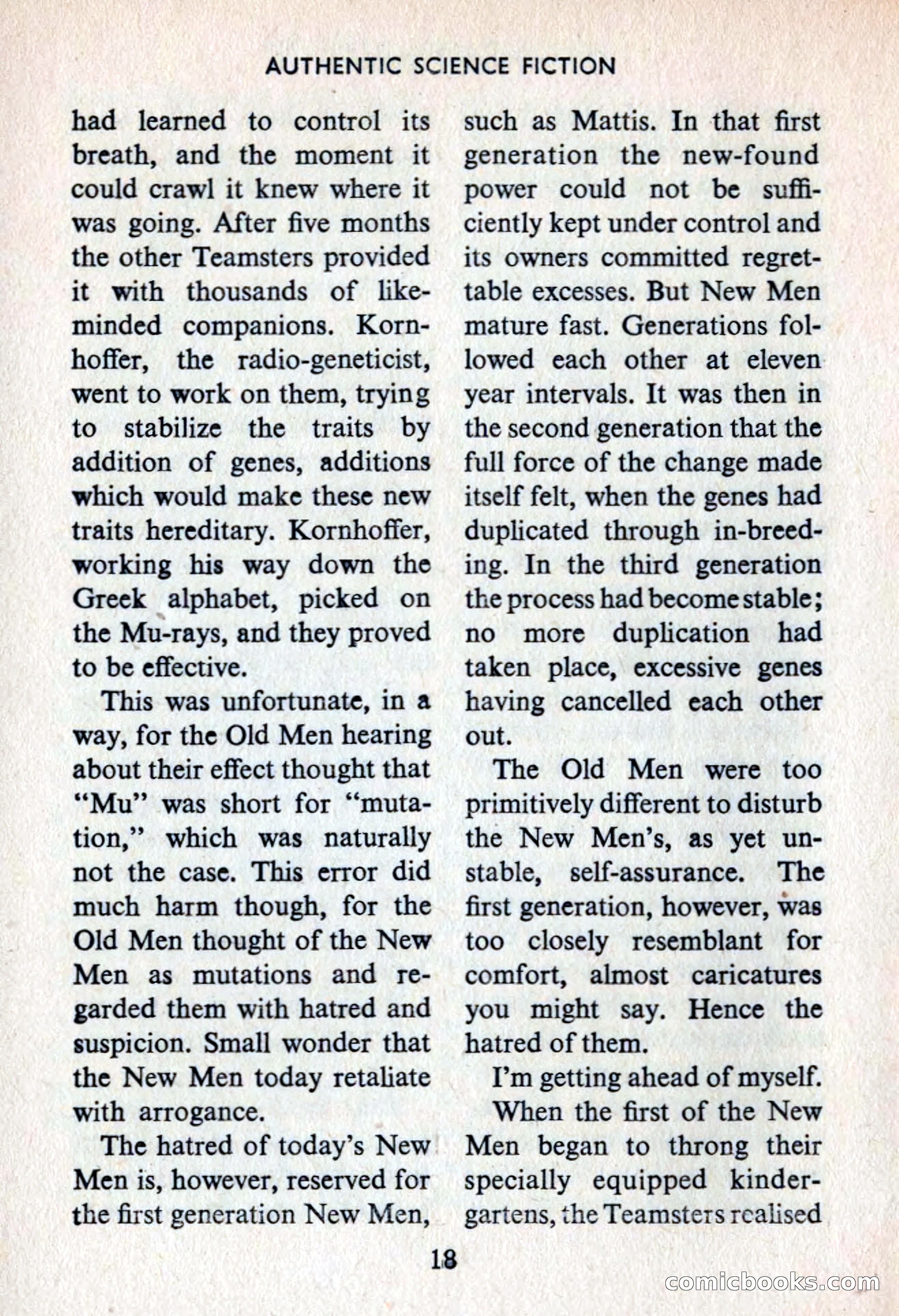
A restored page from Pulp Fiction, 1955. Page through the whole issue in the reader above.
📄 Transcribed text from this page (OCR, searchable)
Machine-transcribed from the original scan — historical spelling and the odd misread are preserved.
AUTHENTIC SCIENCE FICTION had learned to control its breath, and the moment it could crawl it knew where it was going. After five months the other Teamsters provided it with thousands of like- minded companions. Korn- hoffer, the radio-geneticist, went to work on them, trying to stabilize the traits by addition of genes, additions which would make these new traits hereditary. Kornhofier, working his way down the Greek alphabet, picked on the Mu-rays, and they proved to be effective. This was unfortunate, in a way, for the Old Men hearing about their effect thought that *“Mu”’ was short for “muta- tion,” which was naturally not the case. This error did much harm though, for the Old Men thought of the New Men as mutations and re- garded them with hatred and suspicion. Small wonder that the New Men today retaliate with arrogance. The hatred of today’s New Men is, however, reserved for the first generation New Men, 18 such as Mattis. In that first generation the new-found power could not be suffi- ciently kept under control and its Owners committed regret- table excesses. But New Men mature fast. Generations fol- lowed each other at eleven year intervals. It was then in the second generation that the full force of the change made itself felt, when the genes had duplicated through in-breed- ing. In the third generation the process had becomestable; no more duplication had taken place, excessive genes having cancelled each other out. The Old Men were too primitively different to disturb the New Men’s, as yet un- stable, self-assurance. The first generation, however, was too closely resemblant for comfort, almost caricatures you might say. Hence the hatred of them. I’m getting ahead of myself. When the first of the New Men began to throng their specially equipped kinder- gartens, the Teamsters realised commclooks.comn)