
Pulp Fiction, 1955 · page 124 of 146
Authentic Science Fiction Monthly No. 53 — page 124: what you’re looking at
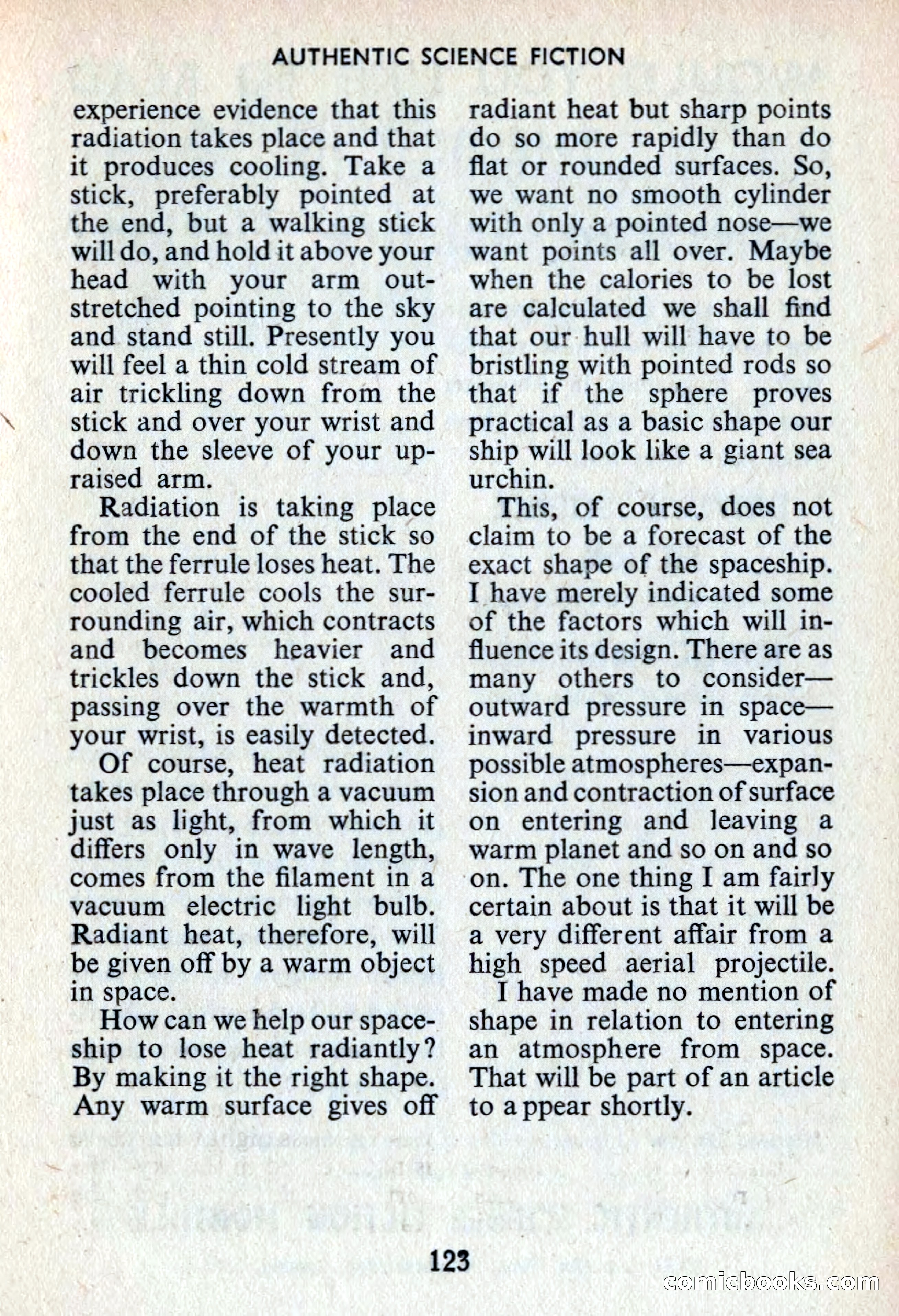
A restored page from Pulp Fiction, 1955. Page through the whole issue in the reader above.
📄 Transcribed text from this page (OCR, searchable)
Machine-transcribed from the original scan — historical spelling and the odd misread are preserved.
AUTHENTIC SCIENCE FICTION experience evidence that this radiation takes place and that it produces cooling. Take a stick, preferably pointed at the end, but a walking stick will do, and hold it above your head with your arm out- stretched pointing to the sky and stand still. Presently you will feel a thin cold stream of air trickling down from the stick and over your wrist and down the sleeve of your up- raised arm. Radiation is taking place from the end of the stick so that the ferrule loses heat. The cooled ferrule cools the sur- rounding air, which contracts and becomes heavier and trickles down the stick and, passing over the warmth of your wrist, is easily detected. Of course, heat radiation takes place through a vacuum just as light, from which it differs only in wave length, comes from the filament in a vacuum electric light bulb. Radiant heat, therefore, will be given off by a warm object in space. How can we help our space- ship to lose heat radiantly? By making it the right shape. Any warm surface gives off radiant heat but sharp points do so more rapidly than do flat or rounded surfaces. So, we want no smooth cylinder with only a pointed nose—we want points all over. Maybe when the calories to be lost are calculated we shall find that our hull will have to be bristling with pointed rods so that if the sphere proves practical as a basic shape our ship will look like a giant sea urchin. This, of course, does not claim to be a forecast of the exact shape of the spaceship. I have merely indicated some of the factors which will in- fluence its design. There are as many others to consider— outward pressure in space— inward pressure in various possible atmospheres—expan- sion and contraction of surface on entering and leaving a warm planet and so on and so on. The one thing I am fairly certain about is that it will be a very different affair from a high speed aerial projectile. I have made no mention of shape in relation to entering an atmosphere from space. That will be part of an article to appear shortly. 123 comiclooks.conm