
Pulp Fiction, 1955 · page 122 of 146
Authentic Science Fiction Monthly No. 53 — page 122: what you’re looking at
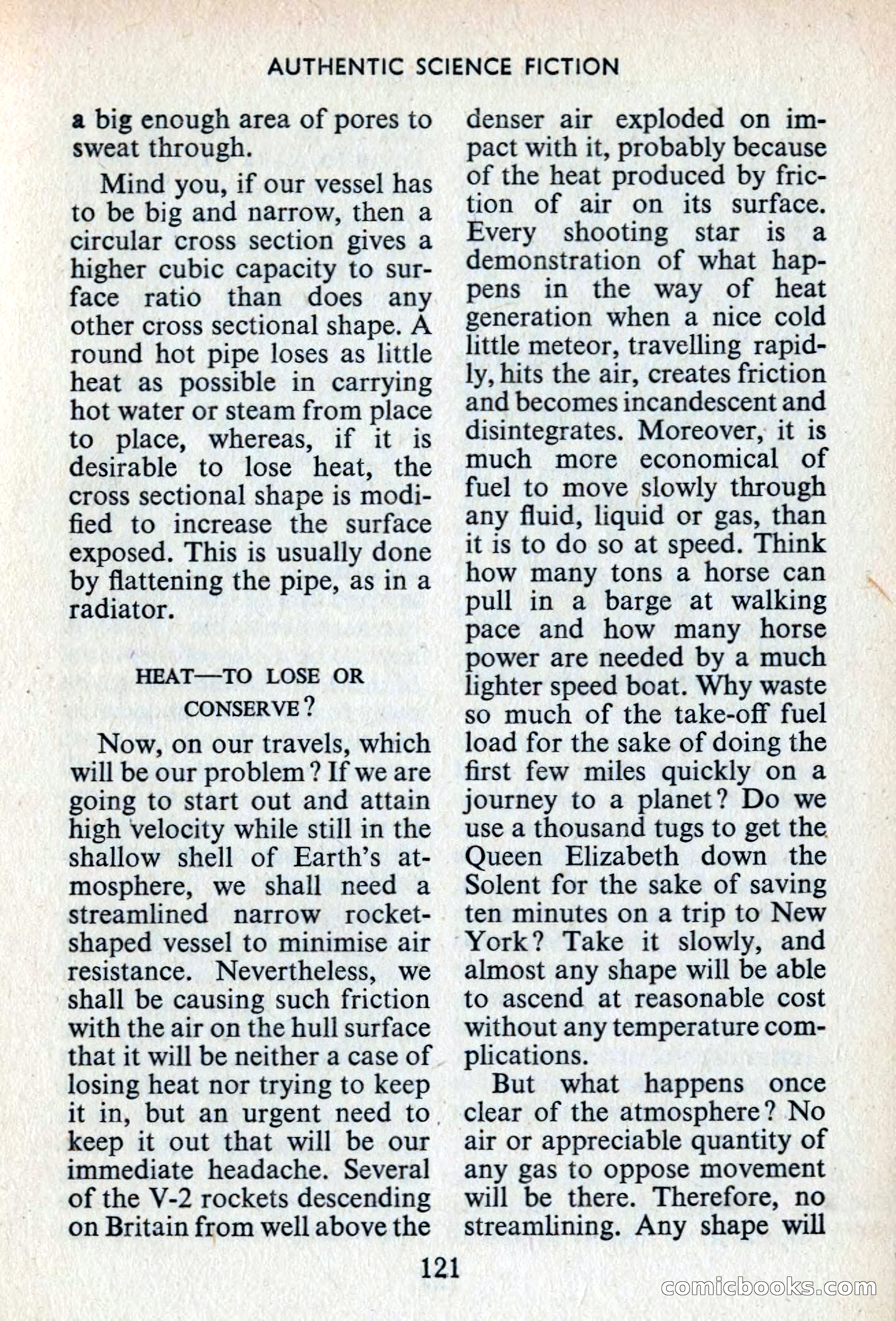
A restored page from Pulp Fiction, 1955. Page through the whole issue in the reader above.
📄 Transcribed text from this page (OCR, searchable)
Machine-transcribed from the original scan — historical spelling and the odd misread are preserved.
AUTHENTIC SCIENCE FICTION a big enough area of pores to sweat through. Mind you, if our vessel has to be big and narrow, then a circular cross section gives a higher cubic capacity to sur- face ratio than does any other cross sectional shape. A round hot pipe loses as little heat as possible in carrying hot water or steam from place to place, whereas, if it is desirable to lose heat, the cross sectional shape is modi- fied to increase the surface exposed. This is usually done by flattening the pipe, as in a radiator. HEAT—TO LOSE OR CONSERVE ? Now, on our travels, which will be our problem ? If we are going to start out and attain high velocity while still in the shallow shell of Earth’s at- mosphere, we shall need a streamlined narrow rocket- shaped vessel to minimise air resistance. Nevertheless, we shall be causing such friction with the air on the hull surface that it will be neither a case of losing heat nor trying to keep it in, but an urgent need to, keep it out that will be our immediate headache. Several of the V-2 rockets descending on Britain from well above the 121 denser air exploded on im- pact with it, probably because of the heat produced by fric- tion of air on its surface. Every shooting star is a demonstration of what hap- pens in the way of heat generation when a nice cold little meteor, travelling rapid- ly, hits the air, creates friction and becomes incandescent and disintegrates. Moreover, it is much more economical of fuel to move slowly through any fluid, liquid or gas, than it is to do so at speed. Think how many tons a horse can pull in a barge at walking pace and how many horse power are needed by a much lighter speed boat. Why waste so much of the take-off fuel load for the sake of doing the first few miles quickly on a journey to a planet? Do we use a thousand tugs to get the Queen Elizabeth down the Solent for the sake of saving ten minutes on a trip to New York? Take it slowly, and almost any shape will be able to ascend at reasonable cost without any temperature com- plications. But what happens once clear of the atmosphere? No air or appreciable quantity of any gas to oppose movement will be there. Therefore, no streamlining. Any shape will comiclooks.con