
Pulp Fiction, 1954 · page 68 of 146
Authentic Science Fiction Monthly No. 52 — page 68: what you’re looking at
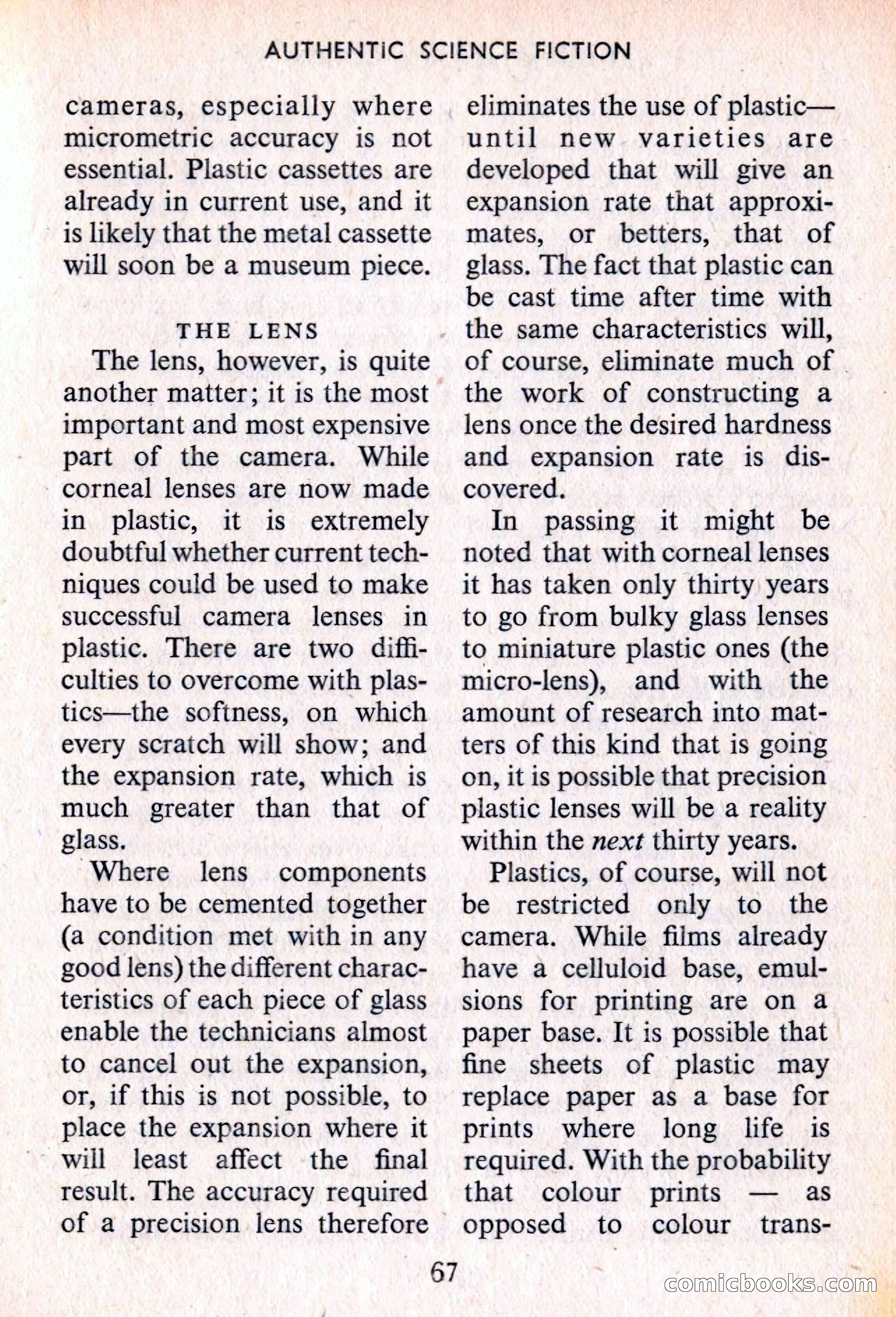
A restored page from Pulp Fiction, 1954. Page through the whole issue in the reader above.
📄 Transcribed text from this page (OCR, searchable)
Machine-transcribed from the original scan — historical spelling and the odd misread are preserved.
AUTHENTIC SCIENCE FICTION cameras, especially where micrometric accuracy is not essential. Plastic cassettes are already in current use, and it 1s likely that the metal cassette will soon be a museum piece. THE LENS The lens, however, is quite another matter; it is the most important and most expensive part of the camera. While corneal lenses are now made in plastic, it is extremely doubtful whether current tech- niques could be used to make successful camera lenses in plastic. There are two diffi- culties to overcome with plas- tics—the softness, on which every scratch will show; and the expansion rate, which is much greater than that of glass. “Where lens components have to be cemented together (a condition met with in any good lens) the different charac- teristics of each piece of glass enable the technicians almost to cancel out the expansion, or, if this is not possible, to place the expansion where it will least affect the final result. The accuracy required of a precision lens therefore 67 eliminates the use of plastic— until new varieties are developed that will give an expansion rate that approxi- mates, or betters, that of glass. The fact that plastic can be cast time after time with the same characteristics will, of course, eliminate much of . the work of constructing a lens once the desired hardness and expansion rate is dis- covered. In passing it might be noted that with corneal lenses it has taken only thirty years to go from bulky glass lenses to miniature plastic ones (the micro-lens), and with the amount of research into mat- ters of this kind that is going on, it is possible that precision plastic lenses will be a reality within the next thirty years. Plastics, of course, will not be restricted only to the camera. While films already have a celluloid base, emul- sions for printing are on a paper base. It is possible that fine sheets of plastic may replace paper as a base for prints where long life is required. With the probability that colour prints as opposed to colour trans- comiclooks.conrn