
Pulp Fiction, 1954 · page 67 of 146
Authentic Science Fiction Monthly No. 52 — page 67: what you’re looking at
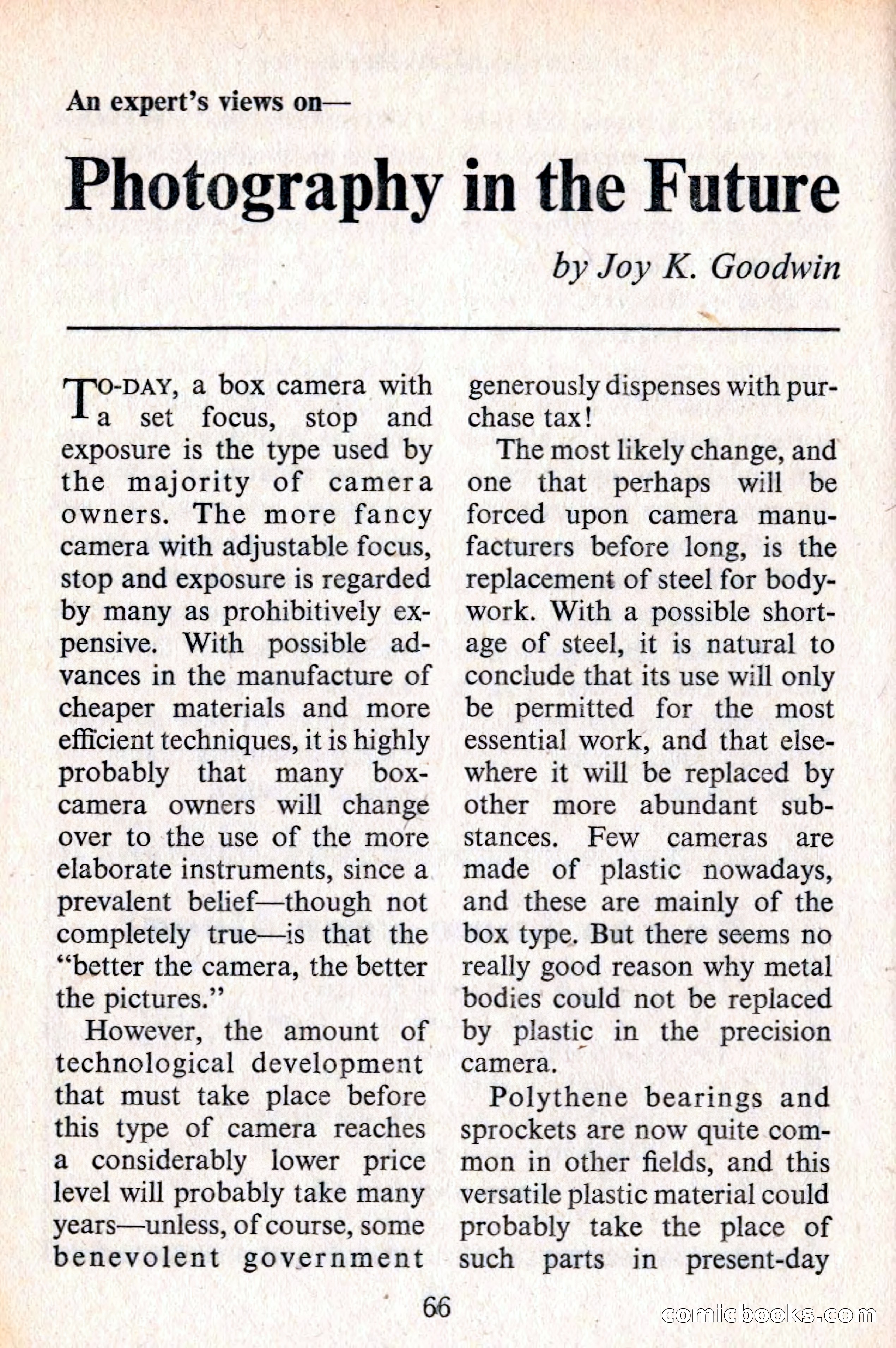
A restored page from Pulp Fiction, 1954. Page through the whole issue in the reader above.
📄 Transcribed text from this page (OCR, searchable)
Machine-transcribed from the original scan — historical spelling and the odd misread are preserved.
An expert’s views on— a mevoerenny | in the Future O-DAY, a box camera with a set focus, stop and exposure is the type used by the majority of camera owners. The more fancy camera with adjustable focus, stop and exposure is regarded by many as prohibitively ex- pensive. With possible ad- vances in the manufacture of cheaper materials and more efficient techniques, it is highly probably that many box- camera owners will change over to the use of the more elaborate instruments, since a prevalent belief—though not completely true—is that the “better the camera, the better the pictures.” However, the amount of technological development that must take place before this type of camera reaches a considerably lower price level will probably take many years—unless, of course, some benevolent government 66 by Joy K. Goodwin = generously dispenses with pur- chase tax! The most likely change, and one that perhaps will be forced upon camera manu- facturers before long, is the replacement of steel for body- work. With a possible short- age of steel, it is natural to conclude that its use will only be permitted for the most essential work, and that else- where it will be replaced by other more abundant sub- stances. Few cameras are made of plastic nowadays, and these are mainly of the box type. But there seems no really good reason why metal bodies could not be replaced by plastic in the precision camera. Polythene bearings and sprockets are now quite com- mon in other fields, and this versatile plastic material could probably take the place of such parts in present-day comiclbooks.cormn