
Pulp Fiction, 1954 · page 64 of 146
Authentic Science Fiction Monthly, No. 51 — page 64: what you’re looking at
A restored page from Pulp Fiction, 1954. Page through the whole issue in the reader above.
📄 Transcribed text from this page (OCR, searchable)
Machine-transcribed from the original scan — historical spelling and the odd misread are preserved.
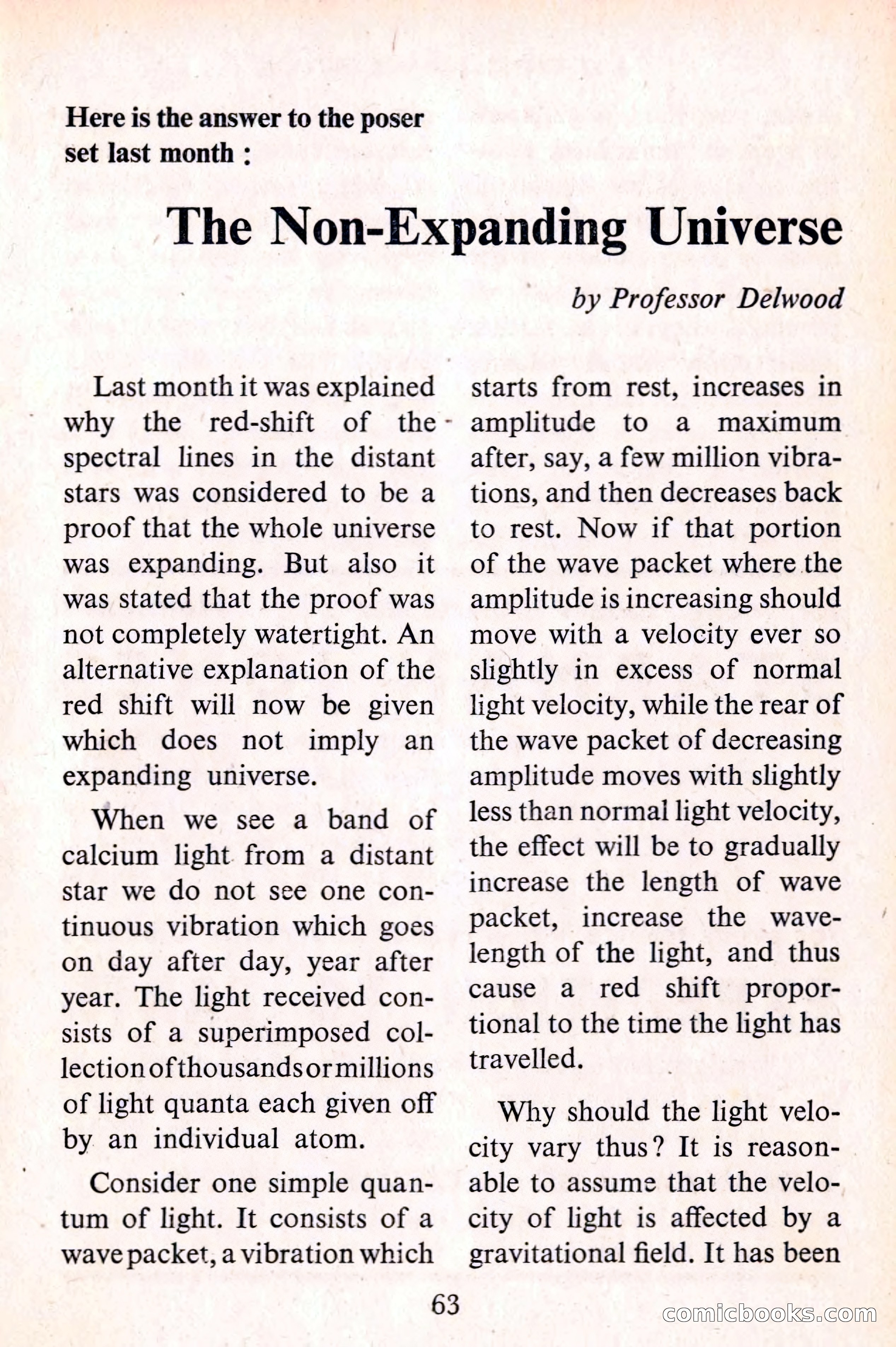
Here is the answer to the poser set last month : The Non-Expanding Universe Last month it was explained why the red-shift of the- spectral lines in the distant stars was considered to be a proof that the whole universe was expanding. But also it was stated that the proof was not completely watertight. An alternative explanation of the red shift will now be given which does not imply an expanding universe. When we see a band of calcium light. from a distant star we do not see one con- tinuous vibration which goes on day after day, year after year. The light received con- sists of a superimposed col- lectionofthousandsormillions of light quanta each given off by. an individual atom. Consider one simple quan- tum of light. It consists of a wave packet, a vibration which 63 by Professor Delwood starts from rest, increases in amplitude to a maximum after, say, a few million vibra- tions, and then decreases back to rest. Now if that portion of the wave packet where the amplitude is increasing should move with a velocity ever so slightly in excess of normal light velocity, while the rear of the wave packet of decreasing amplitude moves with slightly less than normal light velocity, the effect will be to gradually increase the length of wave packet, increase the wave- length of the light, and thus cause a red shift propor- tional to the time the light has travelled. Why should the light velo- city vary thus? It is reason- able to assume that the velo- city of light is affected by a gravitational field. It has been commicloooks.com