
Pulp Fiction, 1954 · page 141 of 146
Authentic Science Fiction Monthly, No. 51 — page 141: what you’re looking at
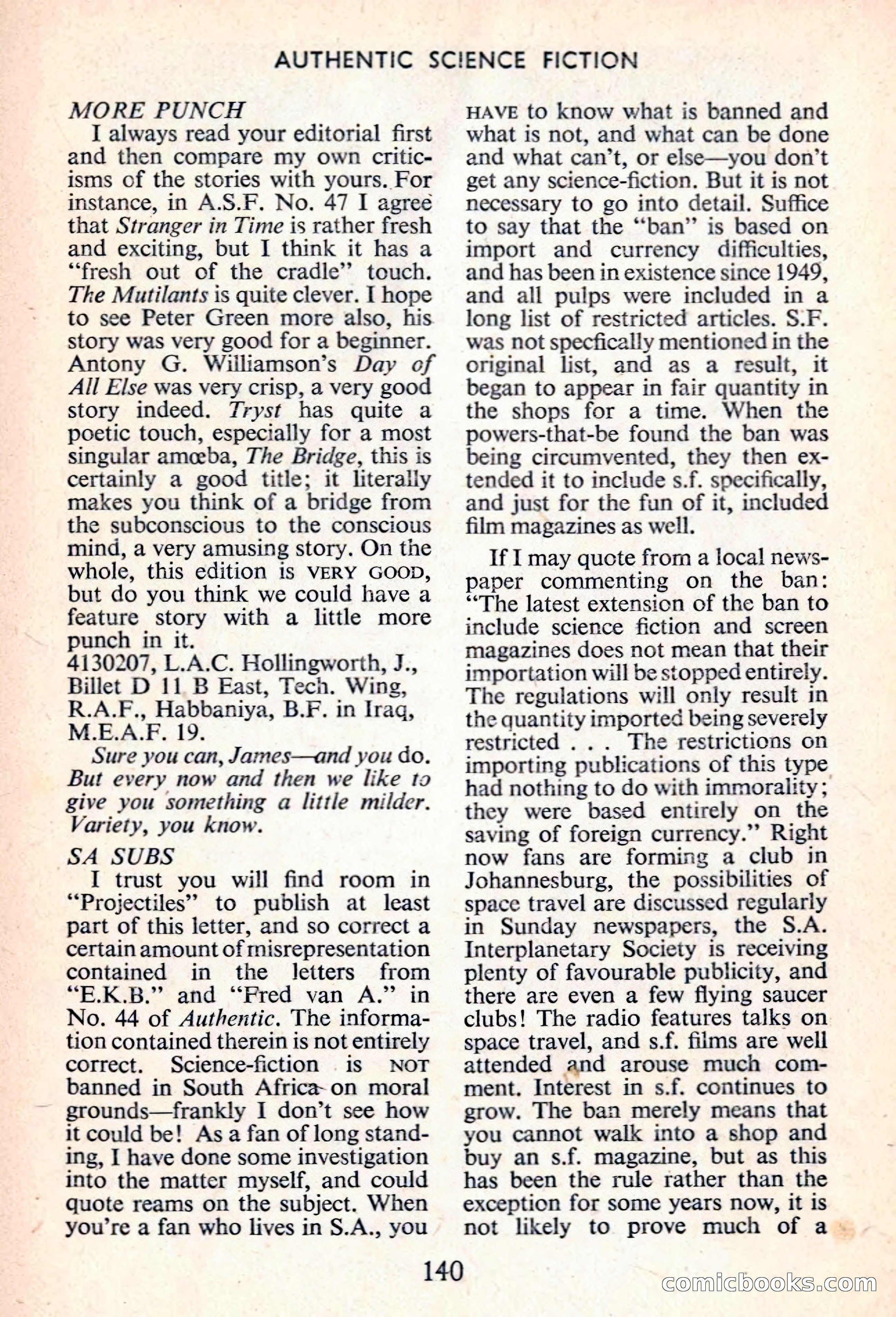
A restored page from Pulp Fiction, 1954. Page through the whole issue in the reader above.
📄 Transcribed text from this page (OCR, searchable)
Machine-transcribed from the original scan — historical spelling and the odd misread are preserved.
AUTHENTIC SCIENCE FICTION MORE PUNCH I always read your editorial first and then compare my own critic- isms of the stories with yours. For instance, in A.S.F. No. 47 I agree that Stranger in Time is rather fresh and exciting, but I think it has a “fresh out of the cradle’? touch. The Mutilants is quite clever. I hope to see Peter Green more also, his story was very good for a beginner. Antony G. Wiiliamson’s Day of All Else was very crisp, a very good story indeed. Tryst has quite a poetic touch, especially for a most singular amoeba, The Bridge, this is certainly a good title; it literally makes you think of a bridge from the subconscious to the conscious mind, a very amusing story. On the whole, this edition is VERY GOOD, but do you think we could have a feature story with a little more punch in it. 4130207, L.A.C. Hollingworth, J., Billet D 11. B East, Tech. Wing, R.A.F., Habbaniya, B.F. in Iraq, M.E.A.F. 19. Sure you can, James—and you do. But every now and then we like ta give you something a little milder. Variety, you know. SA SUBS I trust you will find room in “*Projectiles’”’ to publish at least part of this letter, and so correct a certain amount of misrepresentation contained in the letters from “E.K.B.”” and “Fred van A.” in No. 44 of Authentic. The informa- tion contained therein is not entirely correct. Science-fiction is NOT banned in South Africa-on moral grounds—frankly I don’t see how it could be! As a fan of long stand- ing, I have done some investigation into the matter myself, and could quote reams on the subject. When you’re a fan who lives in S.A., you 140 HAVE to know what is banned and what is not, and what can be done and what can’t, or else—you don’t get any science-fiction. But it is not necessary to go into detail. Suffice to say that the “ban” is based on import and currency difficulties, and has been in existence since 1949, and all pulps were included in a long list of restricted articles. S.F. was not specfically mentioned in the original list, and as a result, it began to appear in fair quantity in the shops for a time. When the powers-that-be found the ban was being circumvented, they then ex- tended it to include s.f. specifically, and just for the fun of it, included film magazines as well. If I may quote from a loca! news- paper commenting on the ban: ‘The latest extension of the ban to include science fiction and screen magazines does not mean that their importation will be stopped entirely. The regulations will only result in the quantity imported being severely restricted ... The restrictions on importing publications of this type had nothing to do with immorality; they were based entirely on the saving of foreign currency.” Right now fans are forming a club in Johannesburg, the possibilities of space travel are discussed regularly in Sunday newspapers, the S.A. Interplanetary Society is receiving plenty of favourable publicity, and there are even a few flying saucer clubs! The radio features talks on space travel, and s.f. films are well attended and arouse much com- ment. Interest in s.f. continues to grow. The ban merely means that you cannot walk into a shop and buy an s.f. magazine, but as this has been the rule rather than the exception for some years now, it is not likely to prove much of a comicloooks.con