
Pulp Fiction, 1954 · page 130 of 146
Authentic Science Fiction Monthly, No. 51 — page 130: what you’re looking at
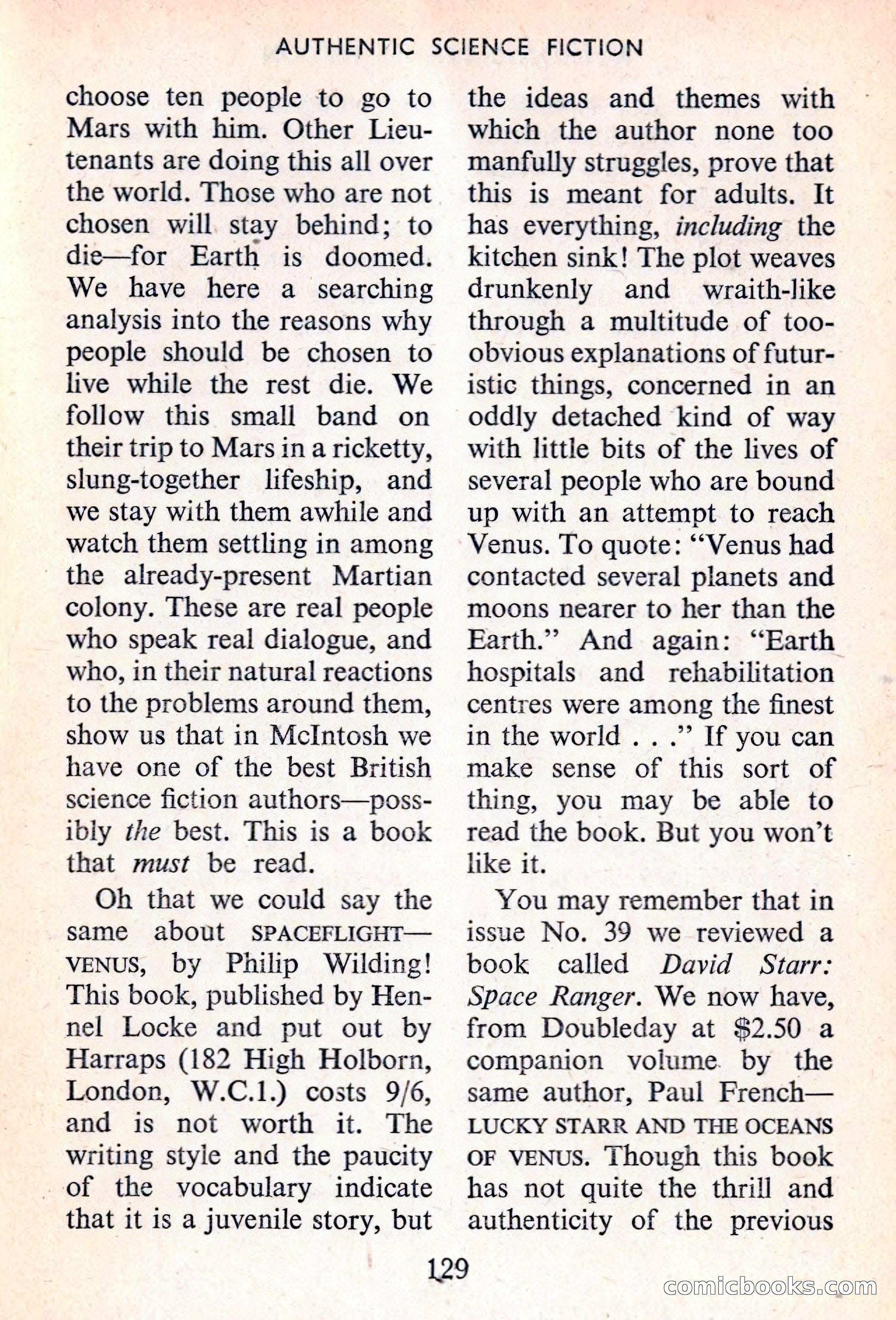
A restored page from Pulp Fiction, 1954. Page through the whole issue in the reader above.
📄 Transcribed text from this page (OCR, searchable)
Machine-transcribed from the original scan — historical spelling and the odd misread are preserved.
AUTHENTIC SCIENCE FICTION choose ten people to go to Mars with him. Other Lieu- tenants are doing this all over the world. Those who are not chosen will stay behind; to die—for Earth is doomed. We have here a searching analysis into the reasons why people should be chosen to live while the rest die. We follow this small band on their trip to Mars in a ricketty, slung-together lifeship, and we stay with them awhile and watch them settling in among the already-present Martian colony. These are real people who speak real dialogue, and who, in their natural reactions to the problems around them, show us that in McIntosh we have one of the best British science fiction authors—poss- ibly the best. This is a book that must be read. Oh that we could say the same about SPACEFLIGHT— VENUS, by Philip Wilding! This book, published by Hen- nel Locke and put out by Harraps (182 High Holborn, London, W.C.1.) costs 9/6, and is not worth it. The writing style and the paucity of the vocabulary indicate that it is a juvenile story, but 129 the ideas and themes with which the author none too manfully struggles, prove that this is meant for adults. It has everything, including the kitchen sink! The plot weaves drunkenly and _ wraith-like through a multitude of too- obvious explanations of futur- istic things, concerned in an oddly detached kind of way with little bits of the lives of several people who are bound up with an attempt to reach Venus. To quote: “‘Venus had contacted several planets and moons nearer to her than the Earth.” And again: “Earth hospitals and rehabilitation centres were among the finest in the world...” If you can make sense of this sort of thing, you may be able to read the book. But you won’t like it. ) You may remember that in issue No. 39 we reviewed a book called David Starr: Space Ranger. We now have, from Doubleday at $2.50 a companion volume. by the same author, Paul French— LUCKY STARR AND THE OCEANS OF VENUS. Though this book has not quite the thrill and authenticity of the previous comiclbooks.corn