
Pulp Fiction, 1954 · page 62 of 146
Authentic Science Fiction Monthly No. 50 — page 62: what you’re looking at
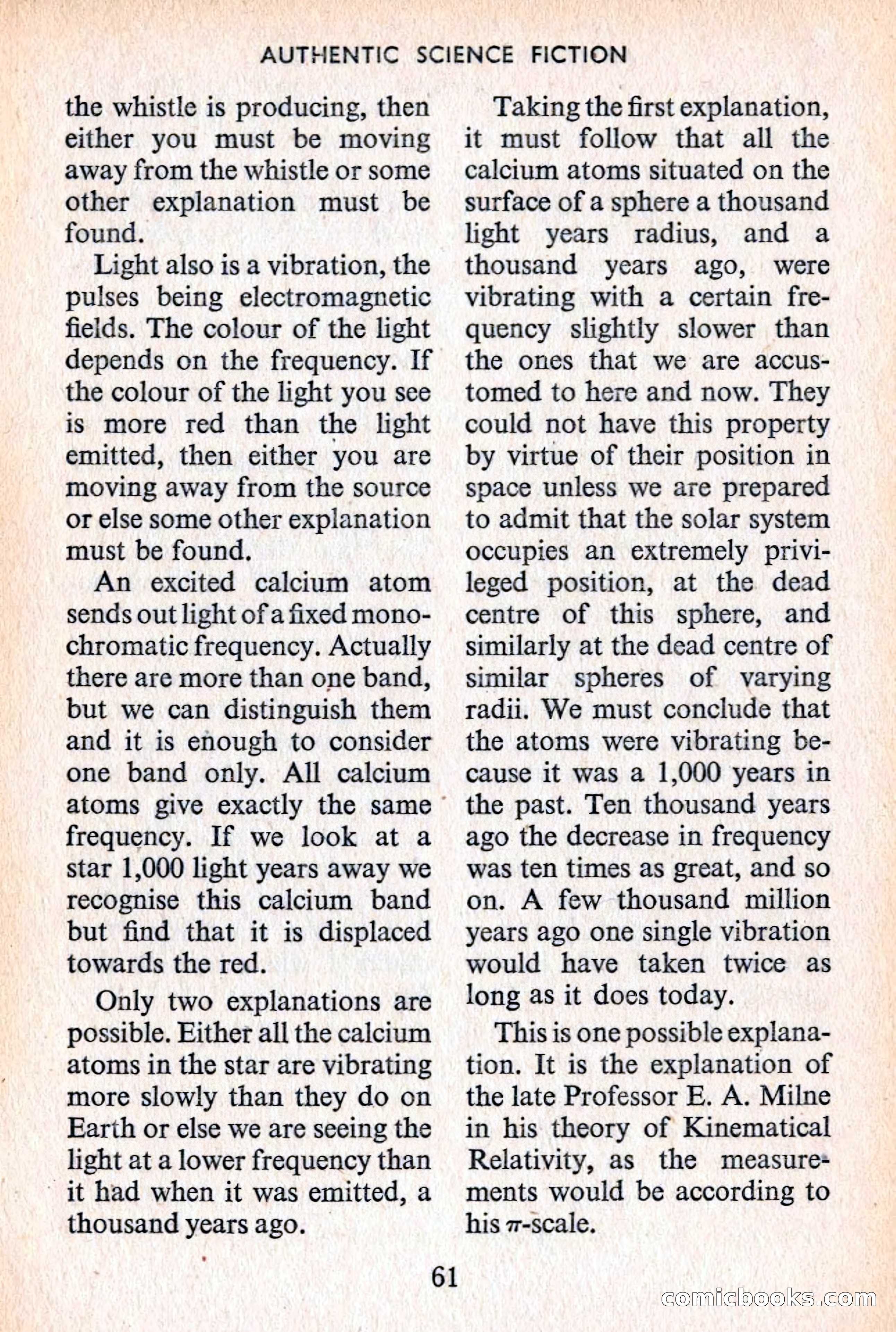
A restored page from Pulp Fiction, 1954. Page through the whole issue in the reader above.
📄 Transcribed text from this page (OCR, searchable)
Machine-transcribed from the original scan — historical spelling and the odd misread are preserved.
AUTHENTIC SCIENCE FICTION the whistle is producing, then either you must be moving away from the whistle or some Other explanation must be found. Light also is a vibration, the pulses being electromagnetic fields. The colour of the light depends on the frequency. If the colour of the light you see is more red than the light emitted, then either you are moving away from the source or else some other explanation must be found. An excited calcium atom sends out light ofa fixed mono- chromatic frequency. Actually there are more than one band, but we can distinguish them and it is enough to consider one band only. All calcium atoms give exactly the same ™ frequency. If we look at a star 1,000 light years away we recognise this calcium band but find that it is displaced towards the red. Only two explanations are possible. Either all the calcium atoms in the star are vibrating more slowly than they do on Earth or else we are seeing the light at a lower frequency than ' it had when it was emitted, a thousand years ago. 61 Taking the first explanation, it must follow that all the calcium atoms situated on the surface of a sphere a thousand light years radius, and a thousand years ago, were vibrating with a certain fre- quency slightly slower than the ones that we are accus- tomed to here and now. They could not have this property by virtue of their position in space unless we are prepared to admit that the solar system occupies an extremely privi- leged position, at the dead centre of this sphere, and similarly at the dead centre of similar spheres of varying radii. We must conclude that the atoms were vibrating be- cause it was a 1,000 years in the past. Ten thousand years ago the decrease in frequency was ten times as great, and so on. A few thousand million years ago one single vibration would have taken twice as long as it does today. This is one possible explana- tion. It is the explanation of the late Professor E. A. Milne in his theory of Kinematical Relativity, as the measure+ ments would be according to his 7-scale. conicloooks.com