
Pulp Fiction, 1954 · page 135 of 162
Authentic Science Fiction Monthly No. 46 — page 135: what you’re looking at
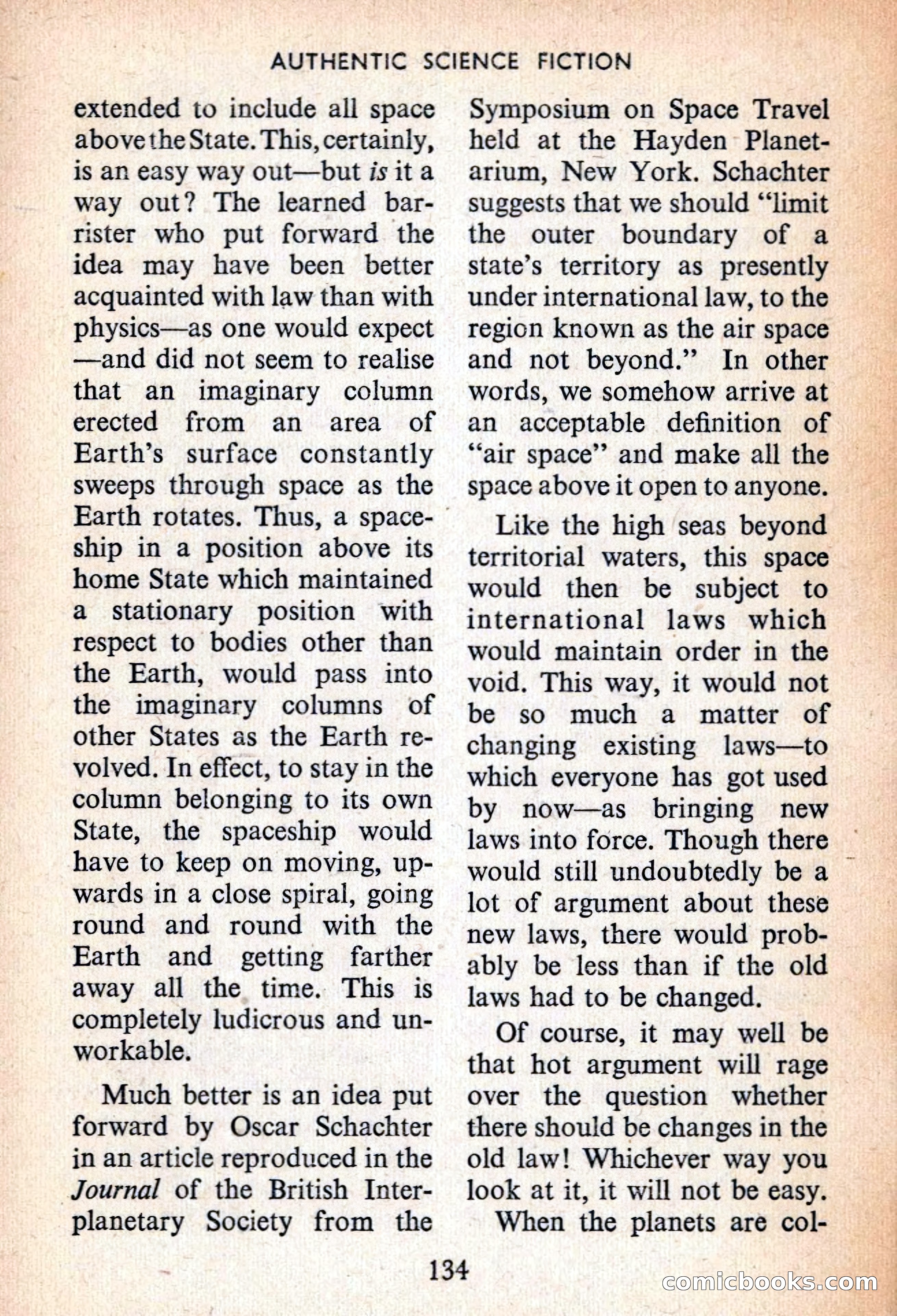
A restored page from Pulp Fiction, 1954. Page through the whole issue in the reader above.
📄 Transcribed text from this page (OCR, searchable)
Machine-transcribed from the original scan — historical spelling and the odd misread are preserved.
AUTHENTIC SCIENCE FICTION extended to include all space above the State. This, certainly, is an easy way out—but isita way out? The learned bar- rister who put forward the idea may have been better acquainted with law than with physics—as one would expect —and did not seem to realise that an imaginary column erected from an area of Earth’s surface constantly sweeps through space as the Earth rotates. Thus, a space- | ship in a position above its home State which maintained a Stationary position with respect to bodies other than the Earth, would pass into the imaginary columns of other States as the Earth re- volved. In effect, to stay in the column belonging to its own State, the spaceship would have to keep on moving, up- wards in a close spiral, going round and round with the Earth and getting farther away all the time. This is completely ludicrous and un- workable. Much better is an idea put forward by Oscar Schachter in an article reproduced in the Journal of the British Inter- planetary Society from the 134 Symposium on Space Travel held at the Hayden Planet- arium, New York. Schachter suggests that we should “‘limit the outer boundary of a state’s territory as presently under international law, to the region known as the air space and not beyond.” In other words, we somehow arrive at an acceptable definition of ‘“‘air space”’ and make all the space above it open to anyone. Like the high seas beyond territorial waters, this space would then be subject to international laws which would maintain order in the void. This way, it would not be so much a matter of changing existing laws—to which everyone has got used by now—as bringing new laws into force. Though there would still undoubtedly be a lot of argument about these new laws, there would prob- ably be less than if the old laws had to be changed. Of course, it may well be that hot argument will rage over the question whether there should be changes in the old law! Whichever way you look at it, it will not be easy. When the planets are col- conmicbooks.comil » :