
Pulp Fiction, 1954 · page 134 of 162
Authentic Science Fiction Monthly No. 46 — page 134: what you’re looking at
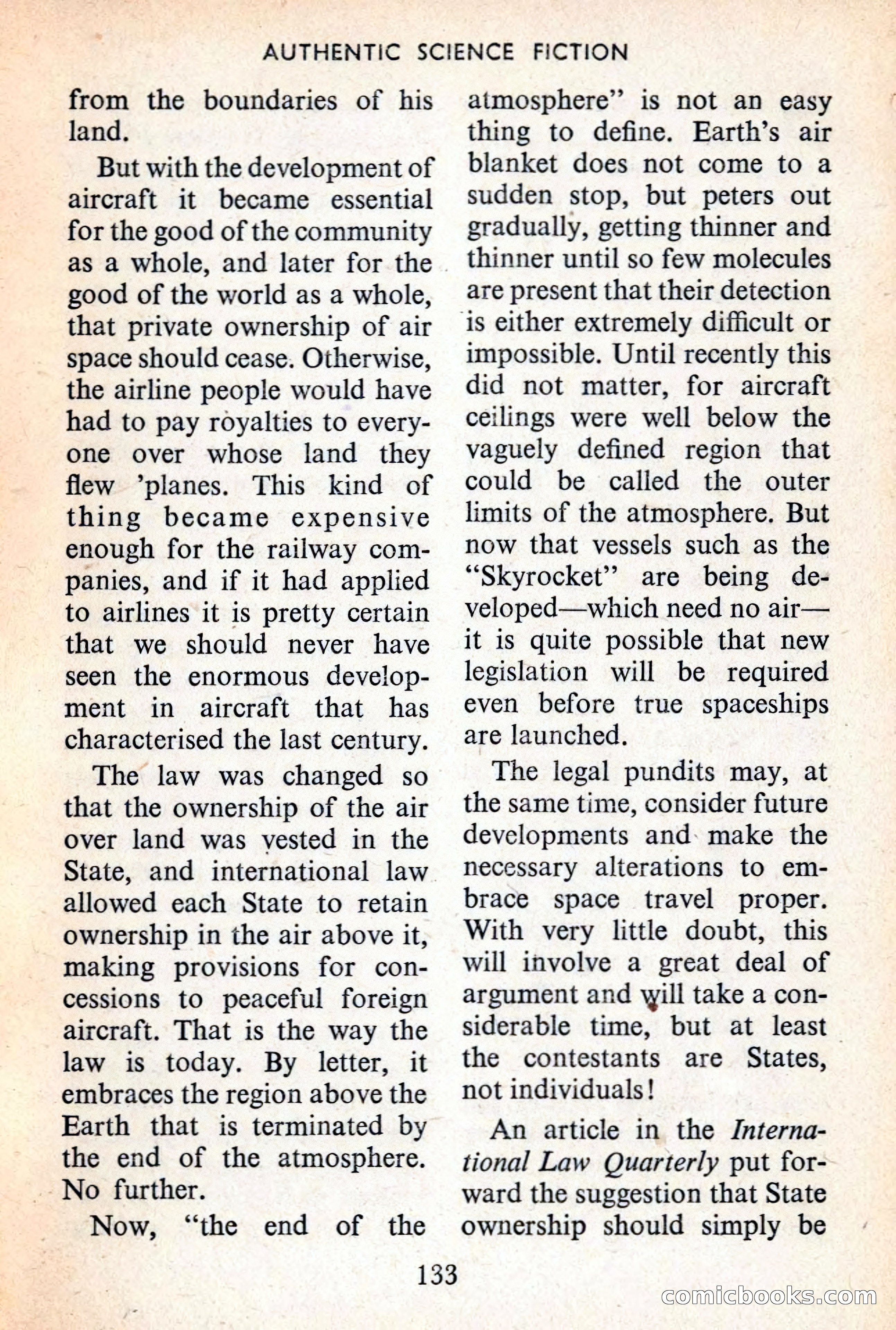
A restored page from Pulp Fiction, 1954. Page through the whole issue in the reader above.
📄 Transcribed text from this page (OCR, searchable)
Machine-transcribed from the original scan — historical spelling and the odd misread are preserved.
AUTHENTIC SCIENCE FICTION from the boundaries of his land. But with the development of aircraft it became essential for the good of the community as a whole, and later for the good of the world as a whole, that private ownership of air space should cease. Otherwise, the airline people would have had to pay royalties to every- one over whose land they flew ’planes. This kind of thing became expensive enough for the railway com- panies, and if it had applied to airlines it is pretty certain that we should never have seen the enormous develop- ment in aircraft that has characterised the last century. The law was changed so that the ownership of the air over land was vested in the State, and international law allowed each State to retain ownership in the air above it, making provisions for con- cessions to peaceful foreign aircraft. That is the way the law is today. By letter, it embraces the region above the Earth that is terminated by the end of the atmosphere. No further. Now, “the end of the 133 atmosphere” is not an easy thing to define. Earth’s air blanket does not come to a sudden stop, but peters out gradually, getting thinner and thinner until so few molecules are present that their detection is either extremely difficult or impossible. Until recently this did not matter, for aircraft ceilings were well below the vaguely defined region that could be called the outer limits of the atmosphere. But now that vessels such as the “Skyrocket”? are being de- veloped—which need no air— it is quite possible that new legislation will be required even before true spaceships are launched. The legal pundits may, at the same time, consider future developments and: make the necessary alterations to em- brace space travel proper. With very little doubt, this will involve a great deal of argument and will take a con- siderable time, but at least the contestants are States, not individuals! An article in the IJnterna- tional Law Quarterly put for- ward the suggestion that State ownership should simply be comiclbooks.com