
Pulp Fiction, 1954 · page 126 of 162
Authentic Science Fiction Monthly No. 46 — page 126: what you’re looking at
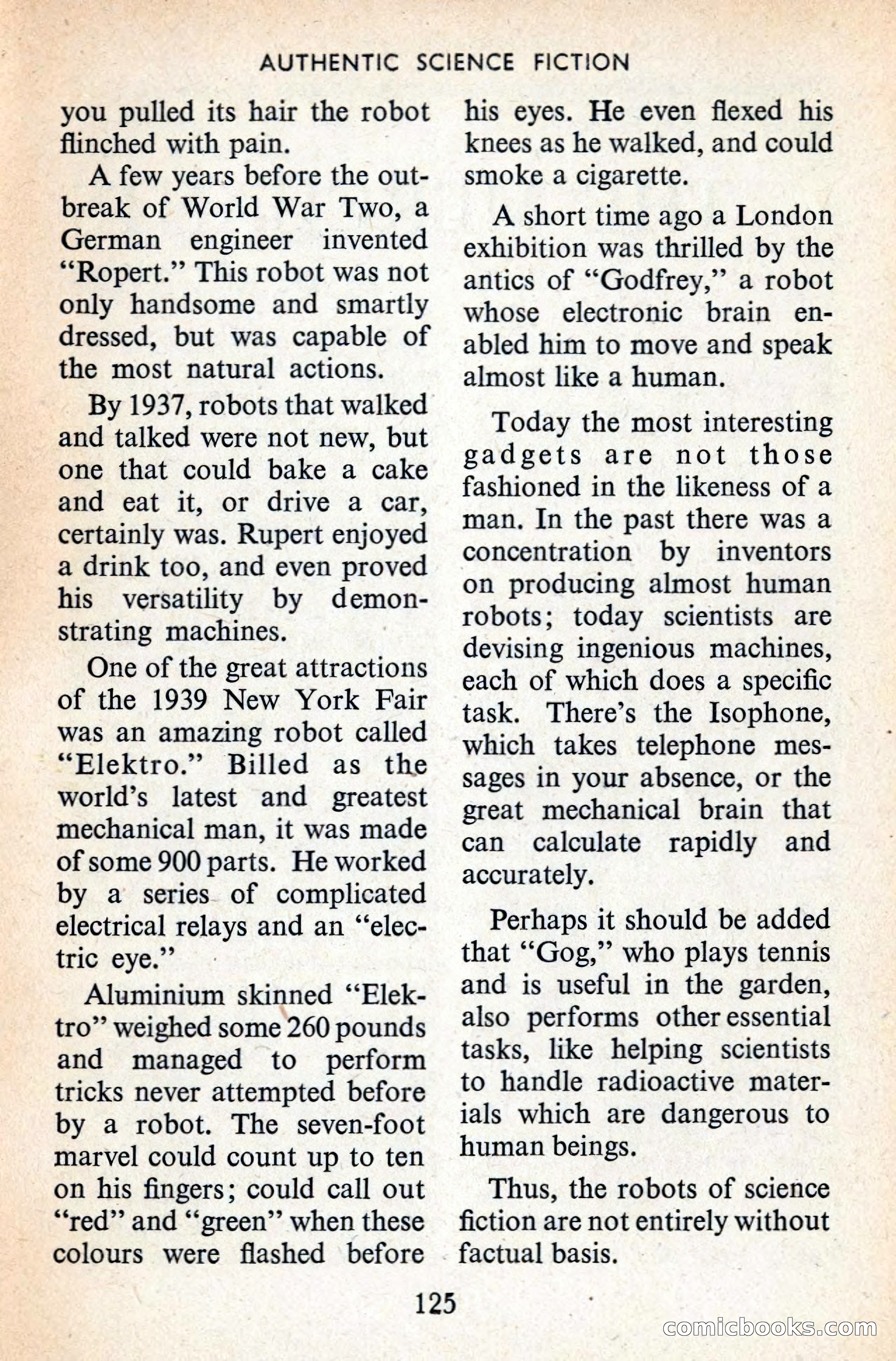
A restored page from Pulp Fiction, 1954. Page through the whole issue in the reader above.
📄 Transcribed text from this page (OCR, searchable)
Machine-transcribed from the original scan — historical spelling and the odd misread are preserved.
AUTHENTIC SCIENCE FICTION you pulled its hair the robot flinched with pain. A few years before the out- break of World War Two, a German engineer invented *“‘Ropert.”’ This robot was not only handsome and smartly dressed, but was capable of the most natural actions. By 1937, robots that walked and talked were not new, but one that could bake a cake and eat it, or drive a car, certainly was. Rupert enjoyed a drink too, and even proved his versatility by demon- strating machines. One of the great attractions of the 1939 New York Fair was an amazing robot called “Elektro.” Billed as the world’s latest and greatest mechanical man, it was made of some 900 parts. He worked by a series. of complicated electrical relays and an “‘elec- tric eye.” Aluminium skinned “Elek- tro” weighed some 260 pounds and managed to perform tricks never attempted before by a robot. The seven-foot marvel could count up to ten on his fingers; could call out “‘red”’ and “‘green’’ when these colours were flashed before 125 his eyes. He even flexed his knees as he walked, and could smoke a cigarette. A short time ago a London exhibition was thrilled by the antics of “Godfrey,” a robot whose electronic brain en- abled him to move and speak almost like a human. Today the most interesting gadgets are not those fashioned in the likeness of a man. In the past there was a concentration by inventors on producing almost human robots; today scientists are devising ingenious machines, each of which does a specific task. There’s the Isophone, which takes telephone mes- sages in your absence, or the great mechanical brain that can calculate rapidly and accurately. Perhaps it should be added that “‘Gog,” who plays tennis and is useful in the garden, also performs other essential tasks, like helping scientists to handle radioactive mater- ials which are dangerous to human beings. Thus, the robots of science fiction are not entirely without factual basis. comiclooks.corn