
Pulp Fiction, 1954 · page 148 of 162
Authentic Science Fiction Monthly, Issue 45 — page 148: what you’re looking at
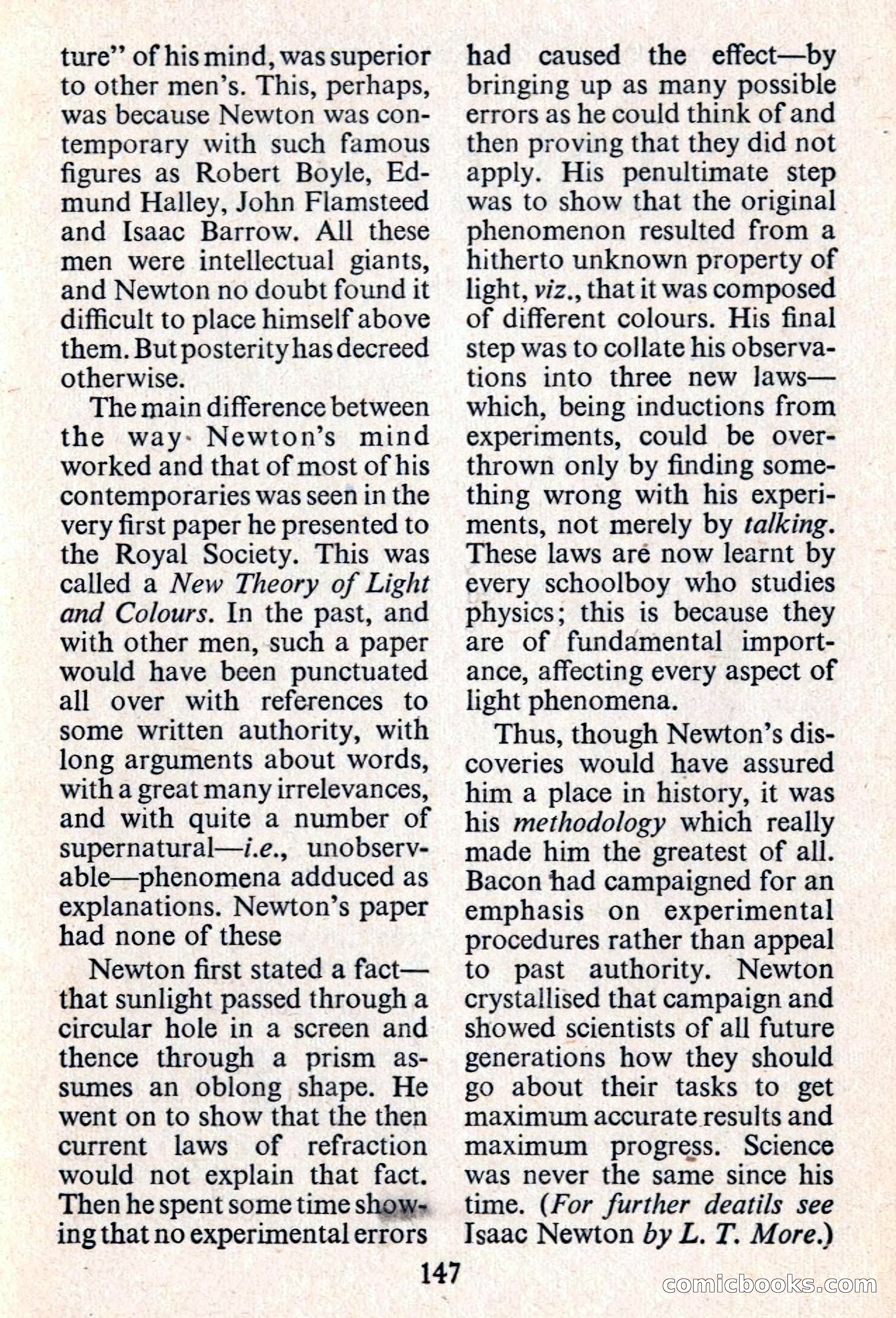
A restored page from Pulp Fiction, 1954. Page through the whole issue in the reader above.
📄 Transcribed text from this page (OCR, searchable)
Machine-transcribed from the original scan — historical spelling and the odd misread are preserved.
ture’’ of his mind, was superior to other men’s. This, perhaps, was because Newton was con- temporary with such famous figures as Robert Boyle, Ed- mund Halley, John Flamsteed and Isaac Barrow. All these men were intellectual giants, and Newton no doubt found it difficult to place himself above them. But posterity has decreed otherwise. The main difference between the way: Newton’s mind worked and that of most of his contemporaries was seen in the very first paper he presented to the Royal Society. This was called a New Theory of Light and Colours. In the past, and with other men, such a paper would have been punctuated all over with references to some written authority, with long arguments about words, with a great many irrelevances, and with quite a number of supernatural—i.e., unobserv- able—phenomena adduced as explanations. Newton’s paper had none of these Newton first stated a fact— that sunlight passed through a circular hole in a screen and thence through a prism as- sumes an oblong shape. He went on to show that the then current laws of refraction would not explain that fact. Then he spent some time show- ing that no experimental errors 147 had caused the effect—by bringing up as many possible errors as he could think of and then proving that they did not apply. His penultimate step was to show that the original phenomenon resulted from a hitherto unknown property of light, viz., that it was composed of different colours. His final step was to collate his observa- tions into three new laws— which, being inductions from experiments, could be over- thrown only by finding some- thing wrong with his experi- ments, not merely by talking. These laws aré now learnt by every schoolboy who studies physics; this is because they are of fundamental import- ance, affecting every aspect of light phenomena. Thus, though Newton’s dis- coveries would have assured him a place in history, it was his methodology which really made him the greatest of all. Bacon had campaigned for an emphasis on experimental procedures rather than appeal to past authority. Newton crystallised that campaign and showed scientists of all future generations how they should go about their tasks to get maximum accurate results and maximum progress. Science was never the same since his time. (For further deatils see Isaac Newton by L. T. More.) comiclooks.comn