
Pulp Fiction, 1954 · page 147 of 162
Authentic Science Fiction Monthly, Issue 45 — page 147: what you’re looking at
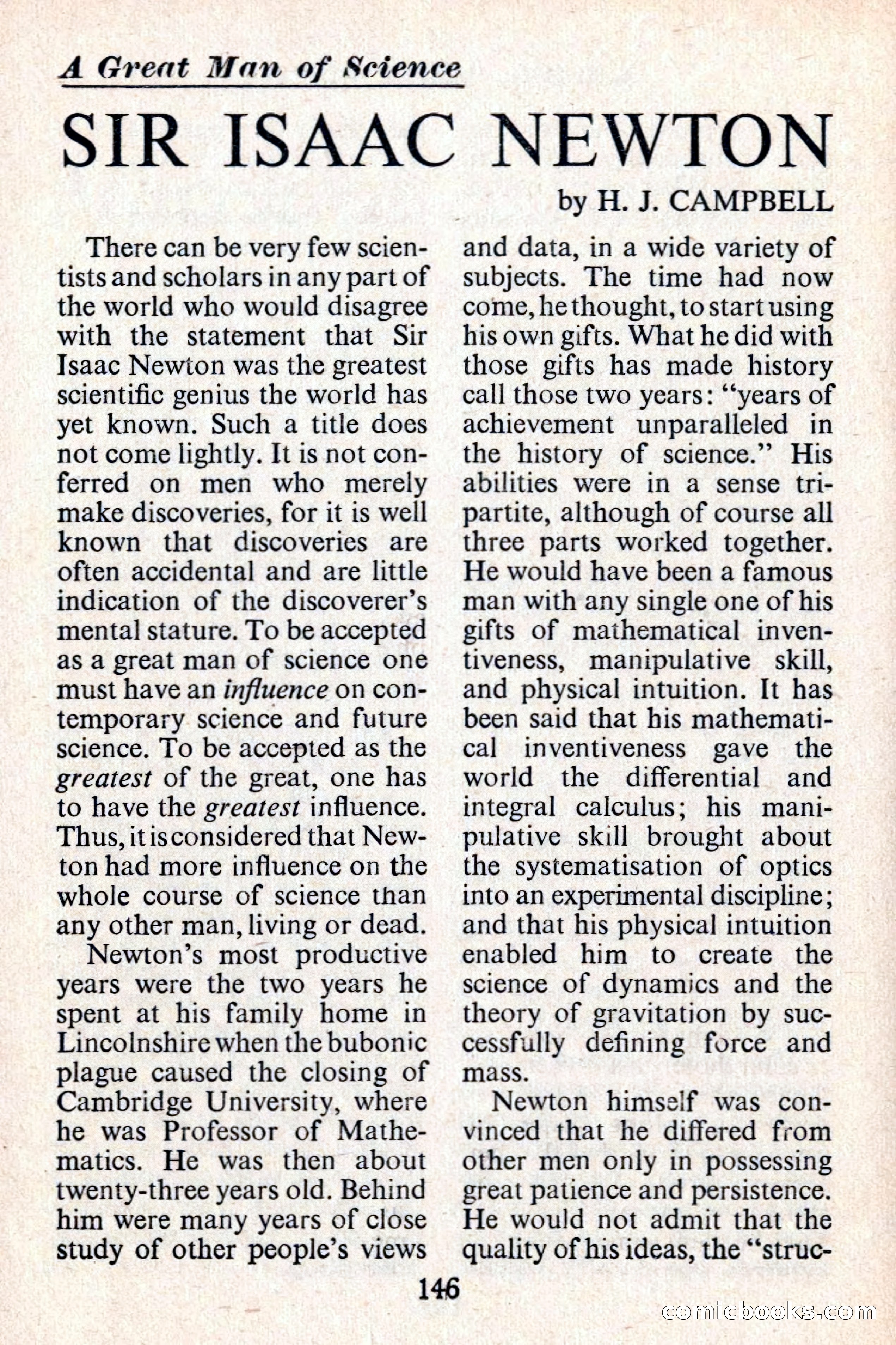
A restored page from Pulp Fiction, 1954. Page through the whole issue in the reader above.
📄 Transcribed text from this page (OCR, searchable)
Machine-transcribed from the original scan — historical spelling and the odd misread are preserved.
A Great Man of Science SIR ISAAC NEWTON There can be very few scien- tists and scholars in any part of the world who would disagree with the statement that Sir Isaac Newton was the greatest scientific genius the world has yet known. Such a title does not come lightly. It is not con- ferred on men who merely make discoveries, for it is well known that discoveries are often accidental and are little indication of the discoverer’s mental stature. To be accepted as a great man of science one must have an influence on con- temporary science and future science. To be accepted as the greatest of the great, one has to have the greatest influence. Thus, itisconsidered that New- ton had more influence on the whole course of science than any other man, living or dead. Newton’s most productive years were the two years he spent at his family home in Lincolnshire when the bubonic plague caused the closing of Cambridge University, where he was Professor of Mathe- matics. He was then about twenty-three years old. Behind him were many years of close study of other people’s views 146 by H. J. CAMPBELL and data, in a wide variety of subjects. The time had now come, he thought, to start using his own gifts. What he did with those gifts has made history call those two years: “‘years of achievement unparalleled in the history of science.’’ His abilities were in a sense tri- partite, although of course all three parts worked together. He would have been a famous man with any single one of his gifts of mathematical inven- tiveness, manipulative skill, and physical intuition. It has been said that his mathemati- cal inventiveness gave the world the differential and integral calculus; his mani- pulative skill brought about the systematisation of optics into an experimental discipline; and that his physical intuition enabled him to create the science of dynamics and the theory of gravitation by suc- cessfully defining force and mass. Newton himself was con- vinced that he differed from other men only in possessing great patience and persistence. He would not admit that the quality of his ideas, the “‘struc- comiclooks.corn