
Pulp Fiction, 1954 · page 130 of 162
Authentic Science Fiction Monthly, Issue 45 — page 130: what you’re looking at
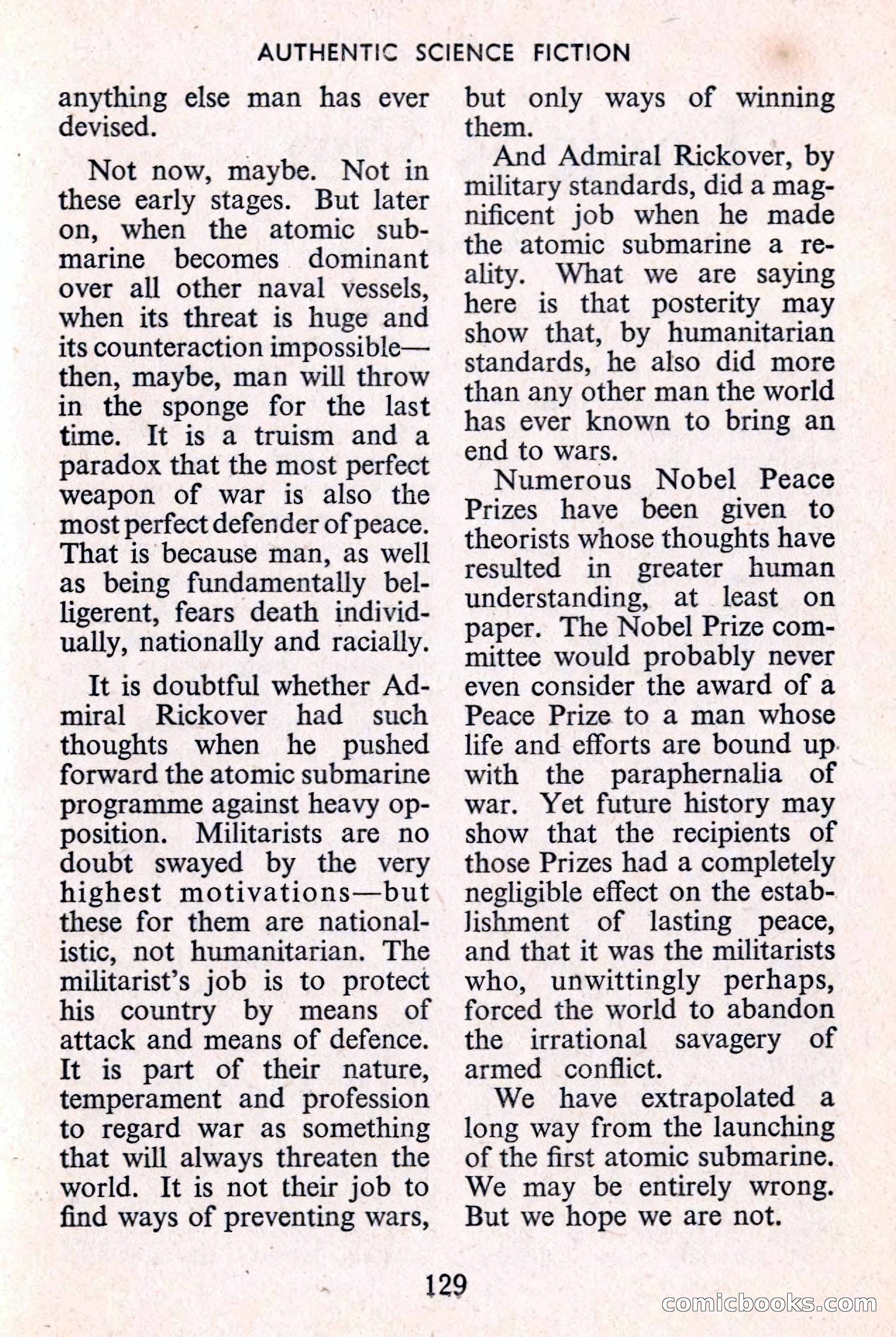
A restored page from Pulp Fiction, 1954. Page through the whole issue in the reader above.
📄 Transcribed text from this page (OCR, searchable)
Machine-transcribed from the original scan — historical spelling and the odd misread are preserved.
AUTHENTIC SCIENCE FICTION anything else man has ever devised. Not now, maybe. Not in these early stages. But later on, when the atomic sub- marine becomes dominant over all other naval vessels, when its threat is huge and its counteraction impossible— then, maybe, man will throw in the sponge for the last time. It is a truism and a paradox that the most perfect weapon of war is also the most perfect defender of peace. That is because man, as well as being fundamentally bel- ligerent, fears death individ- ually, nationally and racially. It is doubtful whether Ad- miral Rickover had such thoughts when he pushed forward the atomic submarine programme against heavy op- position. Méilitarists are no doubt swayed by the very highest motivations—but these for them are national- istic, not humanitarian. The militarist’s job is to protect his country by means of attack and means of defence. It is part of their nature, temperament and profession to regard war as something that will always threaten the world. It is not their job to find ways of preventing wars, 129 but only ways of winning them. And Admiral Rickover, by military standards, did a mag- nificent job when he made the atomic submarine a re- ality. What we are saying here is that posterity may show that, by humanitarian standards, he also did more than any other man the world has ever known to bring an end to wars. Numerous Nobel Peace Prizes have been given to theorists whose thoughts have resulted in greater human understanding, at least on paper. The Nobel Prize com- mittee would probably never even consider the award of a Peace Prize to a man whose life and efforts are bound up. with the paraphernalia of war. Yet future history may show that the recipients of those Prizes had a completely negligible effect on the estab- Jishment of lasting peace, and that it was the militarists who, unwittingly perhaps, forced the world to abandon the irrational savagery of armed conflict. We have extrapolated a long way from the launching of the first atomic submarine. We may be entirely wrong. But we hope we are not. comiclooks.corn