
Pulp Fiction, 1954 · page 112 of 162
Authentic Science Fiction Monthly, Issue 45 — page 112: what you’re looking at
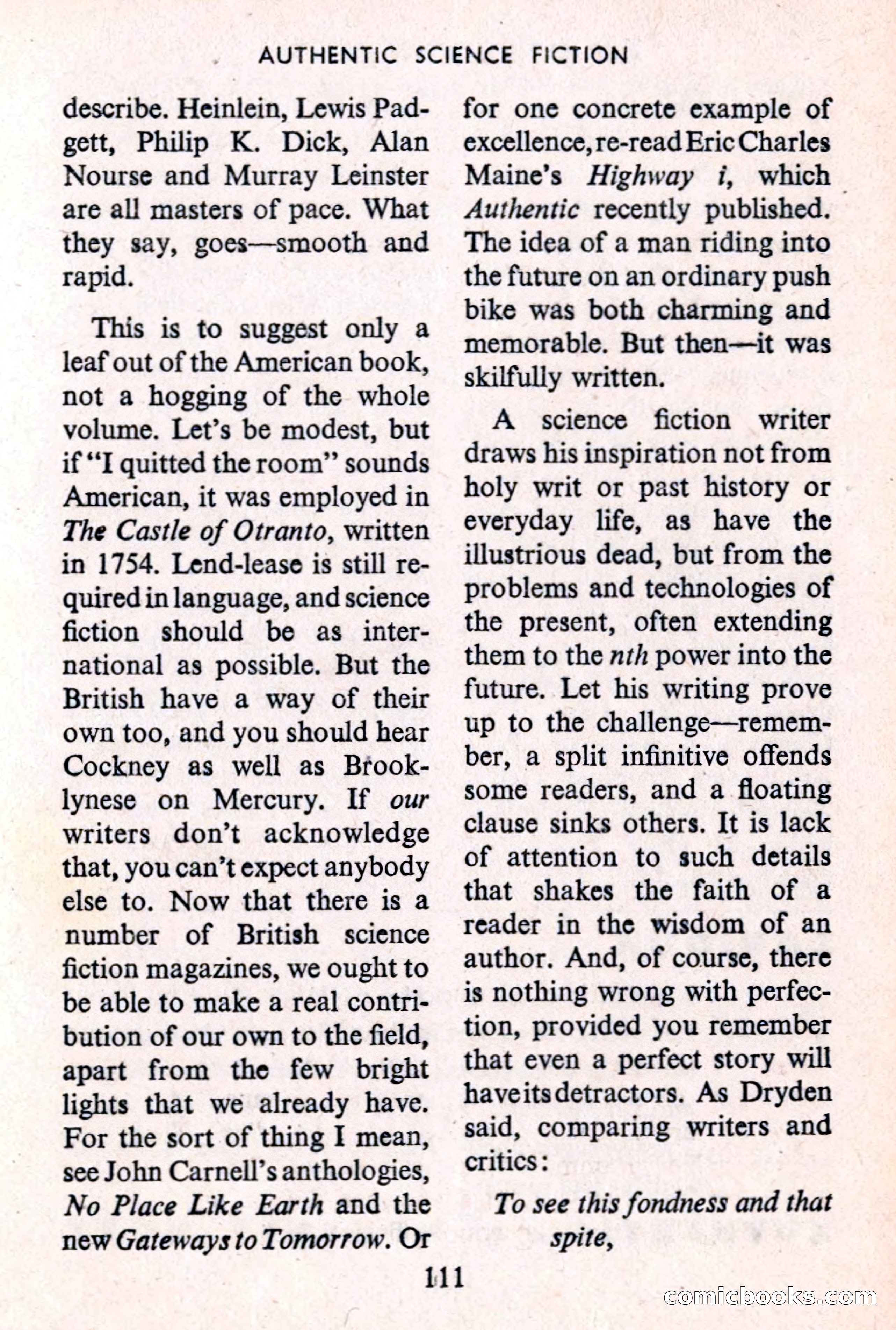
A restored page from Pulp Fiction, 1954. Page through the whole issue in the reader above.
📄 Transcribed text from this page (OCR, searchable)
Machine-transcribed from the original scan — historical spelling and the odd misread are preserved.
AUTHENTIC SCIENCE FICTION describe. Heinlein, Lewis Pad- gett, Philip K. Dick, Alan Nourse and Murray Leinster are all masters of pace. What they say, goes—smooth and rapid. This is to suggest only a leaf out of the American book, not a hogging of the whole volume. Let’s be modest, but if “I quitted the room’”’ sounds American, it was employed in The Castle of Otranto, written in 1754. Lend-lease is still re- quired in language, and science fiction should be as inter- national as possible. But the British have a way of their own too, and you should hear Cockney as well as Brook- lynese on Mercury. If our writers don’t acknowledge that, you can’t expect anybody else to. Now that there is a number of British science fiction magazines, we ought to be able to make a real contri- bution of our own to the field, apart from the few bright lights that we already have. For the sort of thing I mean, see John Carnell’s anthologies, No Place Like Earth and the new Gateways to Tomorrow. Or for one concrete example of excellence, re-read Eric Charles Maine’s Highway i, which Authentic recently published. The idea of a man riding into the future on an ordinary push bike was both charming and memorable. But then—it was skilfully written. A science fiction writer draws his inspiration not from holy writ or past history or everyday life, as have the illustrious dead, but from the problems and technologies of the present, often extending them to the nth power into the future. Let his writing prove up to the challenge—remem- ber, a split infinitive offends some readers, and a floating clause sinks others. It is lack of attention to such details that shakes the faith of a reader in the wisdom of an author. And, of course, there is nothing wrong with perfec- tion, provided you remember that even a perfect story will haveitsdetractors. As Dryden said, comparing writers and critics: To see this fondness and that spite, Lil comiclooks.conn