
Pulp Fiction, 1954 · page 57 of 162
Authentic Science Fiction Monthly No. 44 — page 57: what you’re looking at
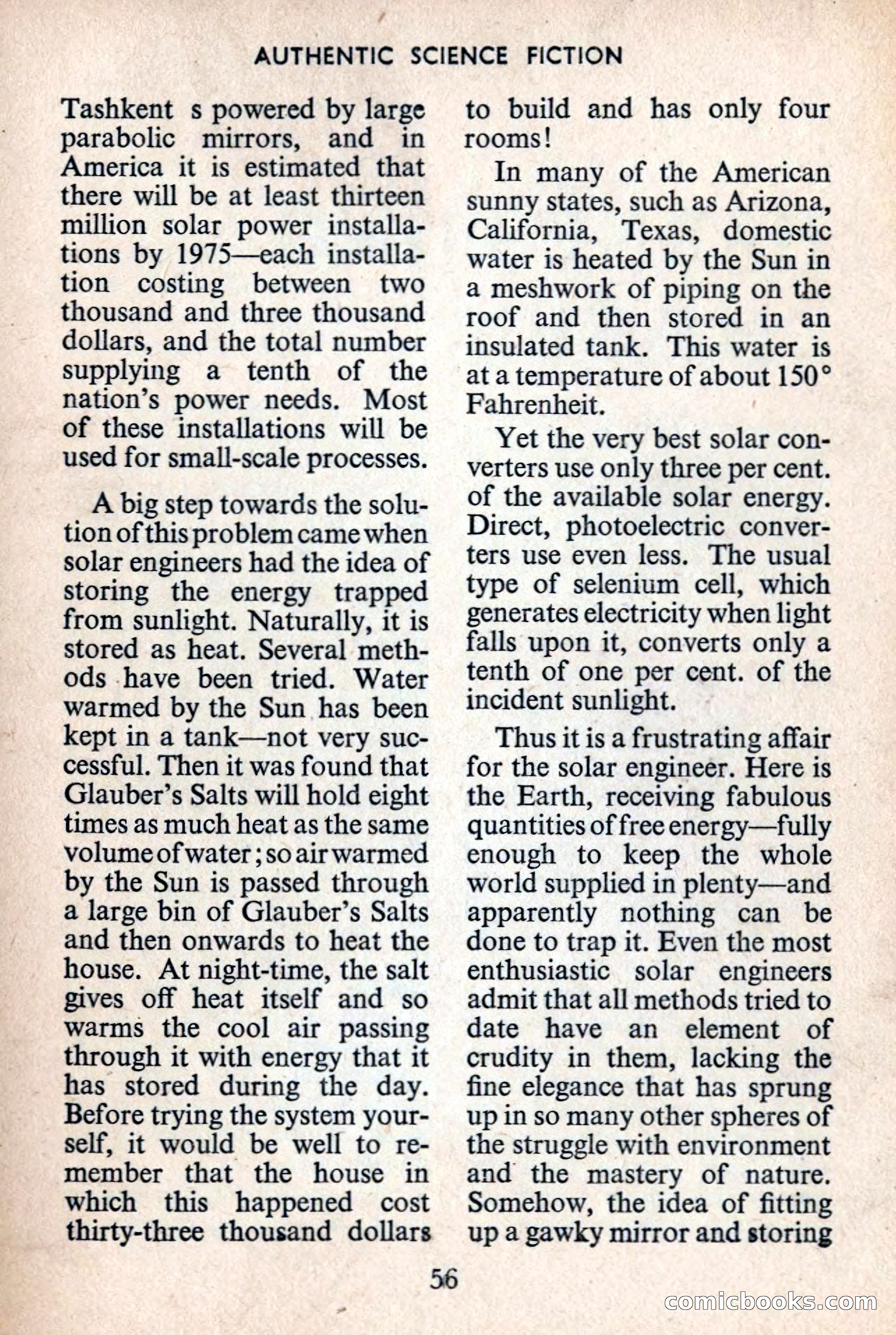
A restored page from Pulp Fiction, 1954. Page through the whole issue in the reader above.
📄 Transcribed text from this page (OCR, searchable)
Machine-transcribed from the original scan — historical spelling and the odd misread are preserved.
/ AUTHENTIC SCIENCE FICTION Tashkent s powered by large parabolic mirrors, and in America it is estimated that there will be at least thirteen million solar power installa- tions by 1975—each installa- tion costing between two thousand and three thousand dollars, and the total number supplying a tenth of the nation’s power needs. Most of these installations will be used for small-scale processes. A big step towards the solu- tion of this problem came when solar engineers had the idea of storing the energy trapped from sunlight. Naturally, it is stored as heat. Several meth- ods have been tried. Water warmed by the Sun has been kept in a tank—not very suc- cessful. Then it was found that Glauber’s Salts will hold eight times as much heat as the same volume of water ; so air warmed by the Sun is passed through a large bin of Glauber’s Salts and then onwards to heat the house. At night-time, the salt gives off heat itself and so warms the cool air passing through it with energy that it has stored during the day. Before trying the system your- self, it would be well to re- member that the house in which this happened cost thirty-three thousand dollars 56 to build and has only four rooms! In many of the American sunny states, such as Arizona, California, Texas, domestic water is heated by the Sun in a meshwork of piping on the roof and then stored in an insulated tank. This water is at a temperature of about 150° Fahrenheit. Yet the very best solar con- verters use only three per cent. of the available solar energy. Direct, photoelectric conver- ters use even less. The usual type of selenium cell, which generates electricity when light falls upon it, converts only a tenth of one per cent. of the incident sunlight. Thus it is a frustrating affair for the solar engineer. Here is — the Earth, receiving fabulous quantities of free energy—fully enough to keep the whole world supplied in plenty—and apparently nothing can be done to trap it. Even the most enthusiastic solar engineers admit that all methods tried to date have an element of crudity in them, lacking the fine elegance that has sprung up in so many other spheres of the struggle with environment and the mastery of nature. Somehow, the idea of fitting up a gawky mirror and storing comiclooks.corn