
Pulp Fiction, 1954 · page 137 of 162
Authentic Science Fiction Monthly No. 44 — page 137: what you’re looking at
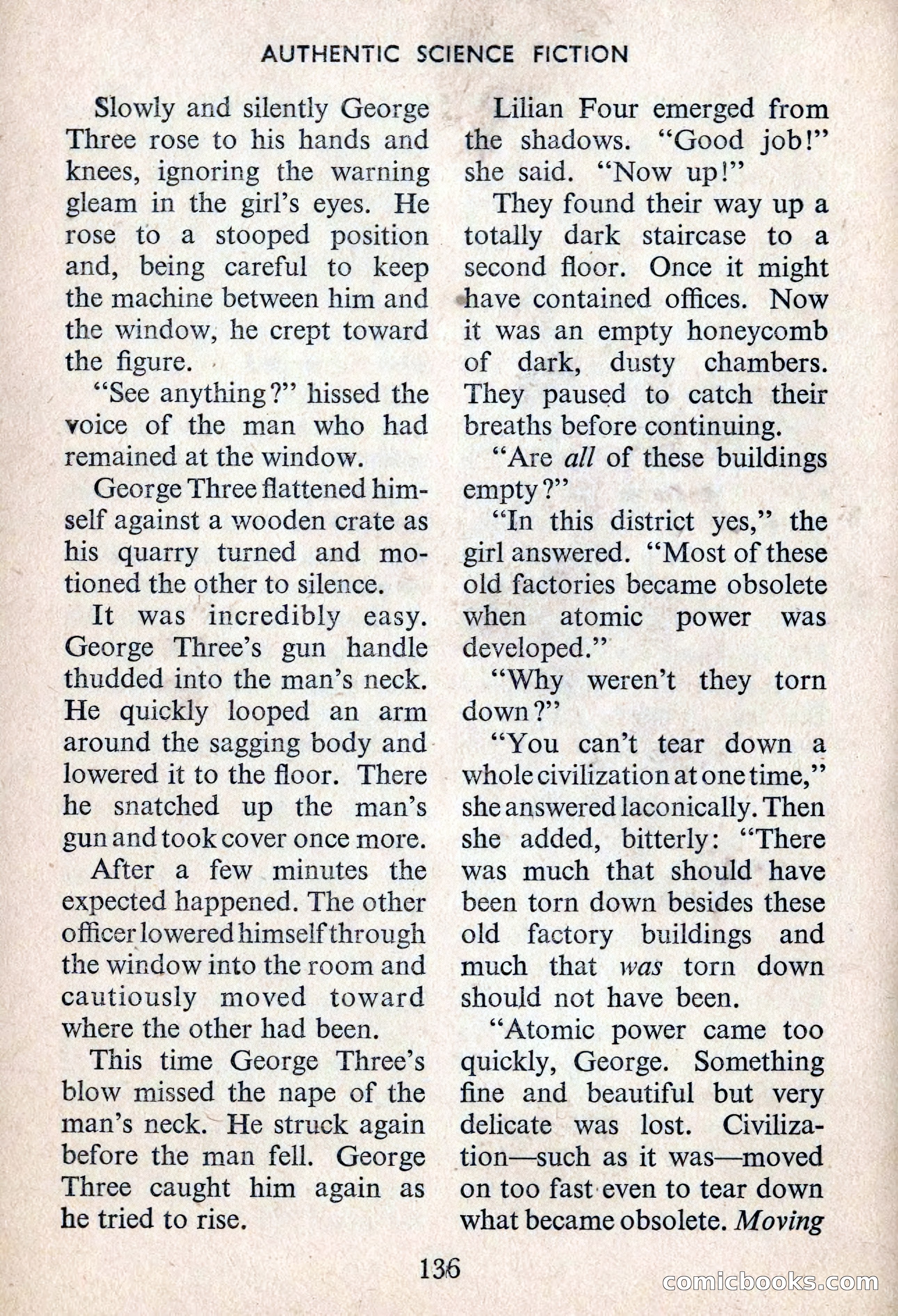
A restored page from Pulp Fiction, 1954. Page through the whole issue in the reader above.
📄 Transcribed text from this page (OCR, searchable)
Machine-transcribed from the original scan — historical spelling and the odd misread are preserved.
AUTHENTIC SCIENCE FICTION Slowly and silently George Three rose to his hands and knees, ignoring the warning gleam in the girl’s eyes. He rose to a stooped position and, being careful to keep the machine between him and the window, he crept toward the figure. » “See anything?’’ hissed the voice of the man who had remained at the window. George Three flattened him- self against a wooden crate as his quarry turned and mo- tioned the other to silence. It was incredibly easy. George Three’s gun handle thudded into the man’s neck. He quickly looped an arm around the sagging body and. lowered it to the floor. There he snatched up the man’s gun and took cover once more. After a few minutes the expected happened. The other officer lowered himself through the window into the room and cautiously moved toward where the other had been. This time George Three’s blow missed the nape of the man’s neck. He struck again before the man fell. George Three caught him again as he tried to rise. 136 Lilian Four emerged from the shadows. ‘“‘Good job!” she said. “‘Now up!” They found their way up a totally dark staircase to a second floor. Once it might shave contained offices. Now it was an empty honeycomb of dark, dusty chambers. They paused to catch their breaths before continuing. “Are all of these buildings empty ?” 3 “In this district yes,” the girl answered. ‘‘Most of these old factories became obsolete When atomic power was developed.” “Why weren’t they torn down?” “You can’t tear down a whole civilization at one time,”’ she answered laconically. Then she added, bitterly: “There was much that should have been torn down besides these old factory buildings and much that was torn down should not have been. “Atomic power came too quickly, George. Something fine and beautiful but very delicate was lost. Civiliza- tion—such as it was—moved on too fast:even to tear down what became obsolete. Moving conmiclooolkks.comn